Most people who microdose take their dose first thing in the morning, usually alongside breakfast or a cup of coffee. The logic is straightforward: you want whatever subtle shift a sub-perceptual dose provides to show up during your waking hours, when you can actually use it. But a growing number of people are flipping that script entirely, choosing to microdose at night instead. Some do it because morning doses left them feeling overstimulated. Others are curious whether sleeping through the initial onset might produce a different kind of next-day clarity. And a few are drawn to the reported dream enhancement that nighttime protocols seem to encourage. The question of whether microdosing at night is safe, and how it actually affects sleep, doesn’t have a single clean answer. Individual biology, the substance involved, the dose size, and your personal sensitivity to serotonergic compounds all play a role. What we can do is walk through the available evidence, the anecdotal reports, and the practical considerations so you can make a genuinely informed choice about your own protocol.
The Rise of Nocturnal Microdosing: Purpose and Potential
The shift toward evening microdosing didn’t emerge from clinical research. It came from online communities, personal experimentation, and a handful of thoughtful practitioners who noticed something interesting: taking a microdose before bed seemed to produce a qualitatively different experience than morning dosing. Where a morning microdose might create a gentle hum of energy throughout the day, an evening dose appeared to work more quietly, with people reporting that they woke up feeling unusually refreshed or emotionally settled.
Part of the appeal is practical. Some people find that even a well-calibrated microdose creates a slight physical buzz or a subtle restlessness that interferes with their work or social interactions. By moving the dose to the evening, they sidestep that daytime activation entirely. The idea is that your body processes the substance while you sleep, and you wake up with only the afterglow: a kind of residual openness or calm without any of the initial onset sensations.
There’s also a philosophical dimension to this approach. Sleep is when your brain consolidates memories, processes emotions, and runs its own internal maintenance routines. The theory, still largely unproven in formal research, is that introducing a microdose during this window might support those natural processes rather than competing with your conscious attention for resources. It’s speculative, but it’s not entirely without logic.
We should be honest about something, though. The evidence base for nighttime microdosing is thin. Most microdosing research, limited as it already is, focuses on daytime protocols. What we know about evening dosing comes primarily from self-reports, community surveys, and the kind of careful personal tracking that sites like Healing Dose encourage through journaling and reflection practices. That doesn’t make the reports worthless, but it does mean you should hold them lightly.
Common Substances Used for Nighttime Protocols
The two most commonly microdosed substances are psilocybin (from mushrooms) and LSD, and they behave quite differently in the context of sleep.
Psilocybin is the more popular choice for nighttime protocols. Its duration is shorter, typically four to six hours for a full dose, and a microdose (usually in the range of 0.05 to 0.15 grams of dried mushrooms) has an even shorter window of activity. Many people report that psilocybin feels more body-oriented and grounding, which may explain why it seems to interfere less with the ability to fall asleep.
LSD, even at microdose levels of 5 to 15 micrograms, has a much longer duration of action, often eight to twelve hours at full doses. Even sub-perceptual amounts can keep your nervous system slightly activated for longer than you might expect. For this reason, most people experimenting with nighttime protocols gravitate toward psilocybin rather than LSD. Taking even a small amount of LSD at 10 PM could mean your body is still processing it well into the early morning hours.
Some people also experiment with nighttime microdoses of mescaline-containing cacti or with substances like 4-AcO-DMT, a synthetic compound that metabolizes similarly to psilocybin. These are less commonly discussed, and the experience reports are sparser.
The Theory Behind Sleeping Through the Peak
The core idea behind nocturnal microdosing is simple: if you’re asleep during the onset and peak of the microdose, you avoid any daytime interference while still receiving the compound’s longer-term benefits. Think of it like taking a vitamin before bed rather than in the morning. The nutrient still gets absorbed; you just aren’t conscious for the process.
Proponents suggest that sleeping through the peak allows the substance to interact with your brain’s nighttime processes, including emotional processing, memory consolidation, and the natural serotonin fluctuations that occur during sleep cycles, without your conscious mind getting in the way. Some describe the experience as waking up with a sense of having “worked through” something overnight, even if they can’t pinpoint exactly what.
Critics of this approach point out that microdoses are, by definition, sub-perceptual. If you can’t feel the dose while awake, what difference does it make whether you’re asleep or not? It’s a fair question, and one that doesn’t have a definitive answer yet. But many people who have tried both morning and evening protocols report a noticeable difference in the quality of their experience, even if the mechanism remains unclear.
The Impact of Psychedelics on Sleep Architecture
To understand what a microdose might do to your sleep, you need a basic picture of what normal sleep looks like from the inside. Your brain cycles through several stages each night, including light sleep, deep sleep (also called slow-wave sleep), and REM sleep, where most vivid dreaming occurs. A healthy night typically includes four to six of these cycles, each lasting roughly ninety minutes.
These stages aren’t interchangeable. Deep sleep is when your body does most of its physical repair work and when growth hormone is released. REM sleep is critical for emotional regulation, learning, and creative problem-solving. Disrupting either one, even subtly, can affect how you feel the next day.
Full doses of psychedelics are known to significantly alter sleep architecture. Studies on ayahuasca and psilocybin have shown that these substances can suppress REM sleep, increase the time it takes to fall asleep, and reduce overall sleep efficiency. But these studies used much larger doses than what a microdosing protocol involves. The question is whether a sub-perceptual dose has a proportionally smaller effect, or whether sleep is sensitive enough that even tiny amounts of a serotonergic compound can create disruption.
The honest answer is that we don’t have rigorous sleep-lab data on microdosing specifically. What we have are self-reports, and they’re surprisingly mixed. Some people sleep better after an evening microdose. Others sleep worse. And a significant number report no change at all. Your individual response likely depends on factors like your baseline sleep quality, your sensitivity to serotonin-active compounds, and the specific substance and dose you’re using.
Disruption of REM and Deep Sleep Cycles
The most consistent finding from psychedelic sleep research involves REM suppression. Serotonin plays a regulatory role in REM sleep, and compounds that activate serotonin 2A receptors (which is the primary mechanism of action for classical psychedelics) tend to reduce the amount of time spent in REM.
At full doses, this effect is pronounced. People often report dreamless or fragmented sleep after a psychedelic experience. At microdose levels, the picture is murkier. Some people report that their dreams become more vivid and memorable after an evening microdose, which would suggest REM is being enhanced rather than suppressed. Others report the opposite: they sleep through the night but wake up feeling like they didn’t dream at all.
One possible explanation for this contradiction is dose sensitivity. A very small amount of serotonin 2A activation might actually increase dream vividness by making the brain slightly more active during REM without fully suppressing the stage. A slightly larger dose, still technically sub-perceptual, might cross a threshold where REM suppression kicks in. This is why careful dose calibration matters so much, and why we at Healing Dose consistently emphasize starting low and tracking your experiences in a journal.
Deep sleep appears to be less affected by microdoses than REM, based on the available reports. Most people don’t describe feeling physically unrested after nighttime microdosing, which suggests that slow-wave sleep remains largely intact. But again, without polysomnography data from controlled studies, this is educated inference rather than established fact.
The Role of Serotonin Receptors in Wakefulness
Here’s where the biology gets interesting. Serotonin is not just a “feel-good” neurotransmitter. It’s deeply involved in regulating your sleep-wake cycle. During waking hours, serotonin levels are relatively high. As you transition into sleep, serotonin activity drops, reaching its lowest point during REM sleep. This drop in serotonin is actually what allows REM to occur.
Classical psychedelics like psilocybin and LSD are partial agonists at the serotonin 2A receptor, meaning they activate this receptor in a way that mimics serotonin but with a different signaling profile. When you introduce one of these compounds at night, you’re essentially adding serotonergic activity during a period when your brain is trying to reduce it. Even at microdose levels, this could theoretically interfere with the natural serotonin decline that facilitates sleep onset and REM cycling.
Think of it like having a small amount of caffeine before bed. For some people, even a tiny bit of caffeine disrupts sleep. For others, it barely registers. Your individual receptor density, your baseline serotonin levels, and your overall nervous system sensitivity all determine how much a microdose will interfere with your sleep architecture.
This is also why timing within the evening matters. Taking a microdose at 6 PM, several hours before bed, gives your body more time to process the compound before sleep onset. Taking it at 11 PM, right before you close your eyes, means the peak of activity coincides with your first sleep cycles. These are meaningfully different scenarios, even though both qualify as “nighttime” dosing.
Safety Considerations and Potential Side Effects
Let’s talk directly about safety, because this is where many people have legitimate concerns. The good news is that classical psychedelics have a remarkably favorable safety profile at microdose levels. There’s no known lethal dose for psilocybin in humans, and the physiological risks of LSD at microgram-level doses are extremely low. The risks of nighttime microdosing are less about acute physical danger and more about subtle disruptions that compound over time.
The most commonly reported negative experience with evening microdosing is simply poor sleep. Difficulty falling asleep, waking up in the middle of the night, or feeling unrested in the morning are the complaints that come up most often. These aren’t dangerous in isolation, but chronic sleep disruption carries real health consequences over weeks and months. If you’re microdosing on a protocol that involves dosing every three days and you’re sleeping poorly on each dose night, that’s a meaningful chunk of your sleep being affected.
Another consideration is the interaction between microdosing and existing sleep difficulties. If you already struggle with insomnia or fragmented sleep, adding a serotonergic compound at night may not be the wisest starting point. It’s generally better to establish a stable sleep foundation before experimenting with anything that might alter your sleep architecture.
Psychological Risks of Uninterrupted Dreaming
Some people who microdose at night report intensely vivid or emotionally charged dreams. For many, this is actually a welcome experience: they feel like their subconscious is processing material that needed attention. But for others, particularly those with a history of trauma, anxiety, or nightmares, enhanced dream intensity can be destabilizing.
Vivid dreams aren’t inherently problematic. They become concerning when they’re distressing, when they disrupt sleep continuity (waking you up repeatedly), or when they leave you feeling emotionally raw the next morning. If you’re someone who already has active dream life or who experiences nightmares, approach evening microdosing with extra caution and consider keeping a dream journal to track patterns.
There’s also the question of what happens when difficult subconscious material surfaces during sleep without the conscious awareness to process it. During a waking microdose, you can notice a difficult emotion arising and choose to sit with it, journal about it, or talk to someone. During sleep, that processing happens automatically, and you may wake up with emotional residue that feels confusing or overwhelming without context. This is one reason why integration practices, including morning journaling and honest self-reflection, are especially important if you’re experimenting with nighttime protocols.
Physical Factors: Heart Rate and Body Temperature
Classical psychedelics can produce mild increases in heart rate and slight changes in body temperature, even at microdose levels. These effects are typically so subtle during the day that most people don’t notice them. But during sleep, when your body is supposed to be in a state of reduced cardiovascular activity and slightly lowered core temperature, even small deviations from baseline can affect sleep quality.
Some evening microdosers report feeling slightly warm or noticing a subtle increase in heart rate as they’re trying to fall asleep. This is consistent with the mild sympathomimetic effects of serotonin 2A agonism. For most people, these sensations pass within thirty to sixty minutes and don’t prevent sleep. But if you’re particularly sensitive to physical sensations while falling asleep, or if you have a cardiovascular condition, it’s worth paying attention to these signals.
Staying hydrated, keeping your bedroom cool, and avoiding combining your microdose with other stimulating substances (including caffeine and nicotine) can help minimize these physical effects. If you notice a persistent pattern of elevated heart rate or restlessness on dose nights, that’s useful data: your body may be telling you that evening dosing isn’t the right fit for you.
Reported Benefits: Vivid Dreams and Next-Day Clarity
Despite the cautions, plenty of people report genuinely positive experiences with nighttime microdosing. The two most frequently mentioned benefits are enhanced dream quality and a distinctive sense of next-day clarity.
On the dream front, many evening microdosers describe their dreams as more narrative, more emotionally meaningful, and easier to remember. Some people who rarely remember their dreams at all find that they start recalling detailed dream sequences after incorporating an evening microdose. For people interested in dreamwork, lucid dreaming practice, or simply a richer inner life, this can feel like a significant shift.
The next-day clarity that people describe is harder to pin down but remarkably consistent across reports. It’s often described as a feeling of emotional settledness, like waking up after having resolved something overnight. People use phrases like “the mental fog lifted” or “I felt like I’d already done my morning meditation before I even got out of bed.” This isn’t a dramatic or euphoric feeling; it’s more like a quiet baseline improvement in mood and focus.
Some people also report that nighttime microdosing reduces their morning anxiety. If you’re someone who wakes up with a racing mind or a tight chest, this is worth noting. The mechanism isn’t clear, but it may relate to the way serotonin 2A activation during sleep influences the brain’s emotional processing during REM cycles. By the time you wake up, some of that processing may already be complete.
It’s worth being honest, though: not everyone experiences these benefits. A substantial minority of people who try nighttime microdosing find that it simply doesn’t work for them, either because it disrupts their sleep or because they don’t notice any meaningful difference compared to morning dosing. Individual variability is the rule, not the exception.
Practical Protocols for Evening Microdosing
If you’ve decided to experiment with nighttime microdosing, approaching it methodically will give you the clearest picture of how it affects you personally. Don’t just switch from morning to evening dosing and hope for the best. Treat this as a structured experiment with clear variables and a way to track your observations.
Start by establishing a baseline. For at least a week before you begin, track your sleep quality, dream recall, morning mood, and energy levels without any microdose. Use a simple 1-to-10 scale or a brief journal entry each morning. This gives you a point of comparison that’s much more reliable than your memory alone.
When you’re ready to begin, start with the lowest dose you’ve used before, or even slightly lower. The goal is to isolate the variable of timing without introducing dose uncertainty. If you normally microdose 0.1 grams of psilocybin in the morning, try 0.08 grams in the evening for your first few nighttime sessions. You can always adjust upward later.
Give yourself at least three dose-nights before drawing any conclusions. A single night of poor sleep could be caused by anything: stress, what you ate for dinner, a noisy neighbor. Patterns only emerge over multiple data points. This is exactly the kind of patient, reflective approach that we encourage at Healing Dose, where self-awareness and honest tracking are the foundation of any protocol.
Timing Your Dose for Minimal Disruption
The single most important variable in nighttime microdosing is when exactly you take your dose relative to when you fall asleep. Getting this right can mean the difference between a restful night and a frustrating one.
Most people who report positive experiences with evening microdosing take their dose two to four hours before bed. This window allows the initial onset phase, where serotonin receptor activation is highest, to pass before you’re trying to fall asleep. By the time your head hits the pillow, the acute phase has settled into a gentler, more diffuse state.
Taking your dose right at bedtime is the approach most likely to cause difficulty falling asleep. Even if you don’t feel overtly stimulated, the subtle neurochemical shift happening in the first sixty to ninety minutes can interfere with sleep onset. If you absolutely want to dose close to bedtime, consider taking your microdose with a small amount of food, which can slow absorption and soften the onset curve.
Here’s a simple framework to start with:
- If you go to bed at 11 PM, try dosing between 7 and 9 PM
- Track how long it takes you to fall asleep compared to your baseline
- Note any middle-of-the-night awakenings and how easily you fall back asleep
- Record your dream recall and emotional quality of dreams
- Rate your morning alertness and mood on a consistent scale
Adjust your timing based on what the data tells you. If dosing at 8 PM works well but 9 PM causes restlessness, you have your answer. This kind of personal calibration is the only way to find your ideal protocol, because no one else’s body is identical to yours.
Stacking with Sleep-Supportive Supplements
Some evening microdosers combine their dose with natural sleep-supportive supplements to counterbalance any potential stimulating effects. This is a reasonable strategy, but it adds complexity and makes it harder to isolate what’s causing what.
Common supplements people pair with evening microdoses include:
- Magnesium glycinate (200 to 400 mg): widely used as a sleep support and generally well-tolerated; may help counteract any muscle tension or restlessness from the microdose
- L-theanine (100 to 200 mg): an amino acid found in tea that promotes relaxation without sedation; some people find it smooths out the subtle activation of a microdose
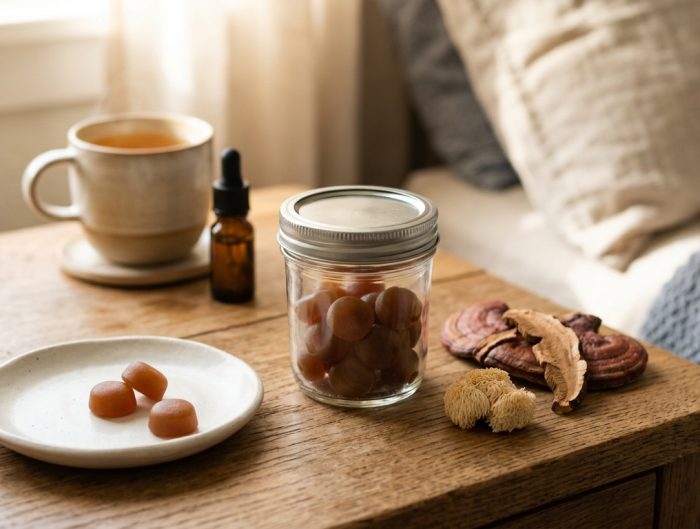
- Reishi mushroom extract: a traditional adaptogen that some people find calming before bed; pairs conceptually with a psilocybin microdose, though the interaction isn’t well-studied
- Tart cherry extract: a natural source of melatonin that may support sleep onset without the grogginess that synthetic melatonin sometimes causes
If you want to try stacking, introduce one supplement at a time and give it several nights before adding another. Otherwise, you won’t know which element is responsible for any changes you notice. And if you’re already taking any medications, especially SSRIs, SNRIs, or other serotonin-active drugs, consult with a healthcare provider before combining them with a microdose. Serotonin syndrome is rare but real, and the risk increases when multiple serotonergic substances are combined.
Comparing Daytime vs. Nighttime Microdosing Results
The question most people really want answered is straightforward: is nighttime microdosing better than morning microdosing? The honest answer is that “better” depends entirely on what you’re looking for.
Morning microdosing tends to produce effects that are noticeable during the day, even if they’re subtle. People often describe a slightly sparkly quality to their perception, enhanced focus, greater ease in social interactions, or a gentle lift in mood. These benefits are experienced in real-time, which makes them easier to recognize and appreciate. The downside is that some people find even a well-calibrated morning dose creates jitteriness, mild anxiety, or an uncomfortable sense of being “on” that they can’t quite turn off.
Nighttime microdosing, by contrast, tends to produce effects that are felt primarily the next morning and throughout the following day. The experience is less about an acute shift and more about waking up in a different baseline state. People describe it as feeling like they slept more deeply (even if objective sleep metrics don’t always confirm this) or like they’re starting the day from a more centered place. The downside is that some people experience disrupted sleep, and the lack of real-time feedback makes it harder to calibrate your dose.
Here’s a practical comparison:
- Daytime dosing: immediate feedback, easier to calibrate, potential for overstimulation, best for people who want in-the-moment support for focus or creativity
- Nighttime dosing: delayed feedback, harder to calibrate, potential for sleep disruption, best for people who want next-day emotional clarity or enhanced dream experiences
- Both approaches: require consistent tracking, benefit from integration practices, produce cumulative changes over weeks rather than dramatic single-day shifts
Some people find that alternating between morning and evening dosing on different protocol days gives them the best of both approaches. Others settle firmly into one camp after a few weeks of experimentation. There’s no universal right answer here, only the answer that fits your body, your goals, and your lifestyle.
One pattern we’ve noticed in the Healing Dose community is that people who are drawn to evening microdosing often have a more introspective orientation. They’re less interested in productivity enhancement and more interested in emotional processing, creative insight, and self-understanding. If that resonates with you, nighttime dosing might be worth exploring.
The most important thing, regardless of when you dose, is to approach the process with patience and genuine curiosity. Microdosing is not a quick fix for anything. It’s a practice that unfolds over time, and the people who get the most from it are the ones who pay close attention, keep honest records, and stay willing to adjust their approach based on what they actually experience rather than what they expected to experience.
Finding Your Own Rhythm
The question of whether microdosing at night is safe and how it affects sleep doesn’t resolve into a simple yes or no. For many people, evening microdosing is a perfectly viable approach that offers a distinct set of benefits. For others, it disrupts sleep in ways that undermine the whole point of the practice. Your job is to find out which camp you fall into, and the only reliable way to do that is through careful, honest experimentation.
Start low, track everything, and give yourself permission to change course if the data points in a different direction than you expected. If you’re not sure where to begin with dosing, our short quiz can help you find your starting range based on your goals, experience level, and personal sensitivity. It takes just a couple of minutes and gives you a thoughtful foundation to build from.
Whatever timing you choose, remember that the microdose is only one piece of the picture. The reflection, the journaling, the willingness to sit with what comes up: that’s where the real work happens. Sleep well, pay attention, and trust the process.

You might also like