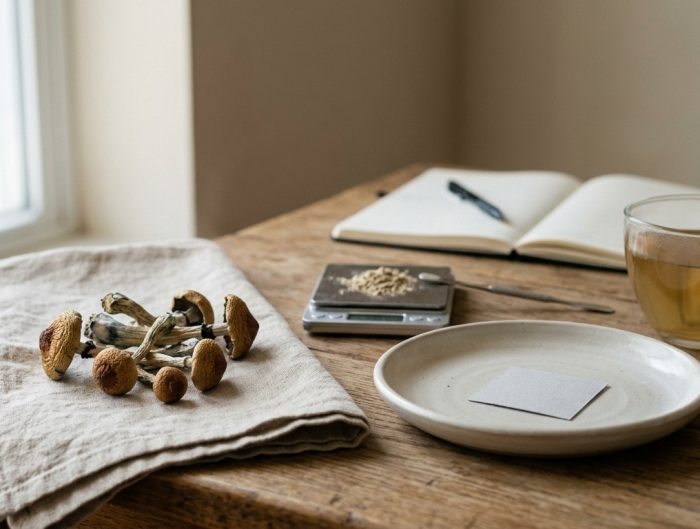
Few mushroom strains carry as much mystique, confusion, or curiosity as Penis Envy. If you’ve found yourself asking what is Penis Envy in the context of psilocybin mushrooms, you’re far from alone: it’s one of the most searched-for strains among both newcomers and experienced growers. The name itself raises eyebrows, but beyond the provocative label lies a genuinely fascinating story of genetic mutation, unusual potency, and decades of underground cultivation lore. This strain has earned its reputation not through marketing hype but through consistent reports of higher-than-average psilocybin content and a distinctive appearance that’s impossible to confuse with anything else. Whether you’re here out of pure curiosity or because you’re considering a thoughtful, low-dose approach to psilocybin, understanding this strain’s background, characteristics, and nuances will help you make more informed decisions. Let’s walk through everything you need to know, starting from the very beginning.
Origins and History of the Penis Envy Strain
The story of Penis Envy reads more like mycological folklore than a straightforward botanical history. Unlike most Psilocybe cubensis varieties, which were collected from the wild and catalogued with relatively little drama, this strain’s origin story involves legendary ethnobotanists, mysterious packages, and years of selective breeding in private labs. What makes it particularly interesting is that the strain didn’t emerge naturally: it was carefully developed through human intervention, making it one of the first “designer” psilocybin mushroom strains.
The exact timeline is debated, and some details have been embellished over the decades. But the broad strokes are well-documented enough to piece together a credible narrative. The strain first appeared sometime in the late 1970s or early 1980s, and its development involved at least two key figures whose contributions are still discussed in mycology communities today.
Understanding this history matters because it explains why Penis Envy behaves so differently from other cubensis strains. Its unusual potency and growth patterns aren’t random: they’re the result of deliberate genetic selection over many generations of cultivation.
The Terence McKenna Connection
Most accounts trace the strain’s origin back to Terence McKenna, the ethnobotanist and author who spent years in the Amazon basin studying psilocybin mushrooms. During the early 1970s, McKenna reportedly collected wild Psilocybe cubensis specimens from the Colombian Amazon. These spore prints eventually made their way into the hands of various mycologists and hobbyist growers.
One of those recipients was Steven Pollock, a medical doctor and mycology enthusiast based in Texas. Pollock is widely credited with isolating a particularly unusual mutation from McKenna’s original spore prints: a specimen with a thick, bulbous stem and an underdeveloped cap that bore an unmistakable resemblance to a phallus. Pollock recognized this mutation as something worth preserving and began selectively breeding it.
Pollock’s story took a tragic turn when he was murdered in 1981 under circumstances that remain mysterious to this day. But before his death, he had already shared spore prints of his mutant strain with other growers, ensuring its survival. The strain was eventually named “Penis Envy,” a nod to Freudian psychology that, despite the somewhat outdated theoretical origins of Freud’s concept, stuck as a memorable and distinctive label.
Genetic Mutations and Development
What Pollock isolated wasn’t just a funny-looking mushroom: it was a genuine genetic mutation that bred true across generations. Most cubensis strains produce mushrooms with a standard umbrella-shaped cap, a relatively thin stem, and a veil that breaks cleanly during maturation. The Penis Envy mutation disrupted all of these features.
The mutation likely involves changes in the genes controlling cap development and spore production. The cap remains small and tightly attached to the stem, sometimes never fully opening. The stem grows disproportionately thick and dense. These traits are recessive, meaning they only express consistently when both parent genetics carry the mutation: which is why maintaining pure Penis Envy genetics requires careful isolation work.
Over the decades since Pollock’s initial isolation, other cultivators have continued refining the strain. Some have crossed it with other cubensis varieties to create hybrids. Others have isolated further mutations within the Penis Envy lineage itself, producing sub-strains like Albino Penis Envy and Penis Envy Uncut. Each of these represents a slightly different expression of the original mutation, and we’ll cover them in detail later.
The result of all this selective breeding is a strain that behaves quite differently from standard cubensis in almost every measurable way: growth speed, physical appearance, spore production, and chemical composition.
Distinct Physical Characteristics and Identification
If you’ve ever seen a lineup of different cubensis strains side by side, Penis Envy stands out immediately. Where most cubensis mushrooms look more or less similar to each other, with variations mainly in size and color, this strain has a body plan that’s genuinely unique. Recognizing these physical traits is useful whether you’re a grower trying to verify your genetics or simply someone who wants to understand what makes this strain so distinctive.
The Unique Phallic Morphology
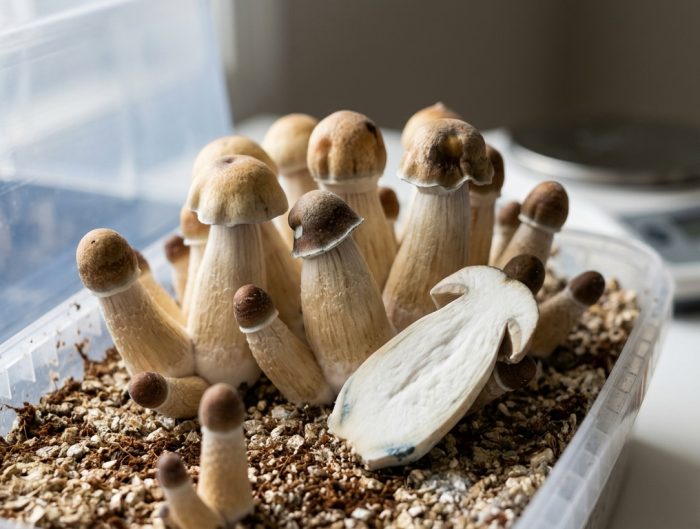
The most obvious feature is the stem, which is unusually thick, dense, and fleshy compared to other cubensis varieties. While a typical Golden Teacher or B+ mushroom might have a stem that’s proportional to its cap, Penis Envy mushrooms develop stems that can be two to three times thicker than average. The flesh is firm and meaty rather than hollow or fibrous.
The cap is equally distinctive. Rather than opening into a broad, flat umbrella shape, the cap on a Penis Envy mushroom tends to remain small, rounded, and tightly attached to the top of the stem. In many specimens, the cap never fully separates from the stem at all, giving the entire mushroom a bulbous, rounded top. The color ranges from light tan to a deeper caramel brown, and the surface often has a slightly wrinkled or wavy texture.
When bruised or handled, Penis Envy mushrooms tend to turn a deep blue-green color more quickly and intensely than other cubensis strains. This bruising reaction is caused by the oxidation of psilocin, and its intensity is often cited as an informal indicator of potency: the more dramatic the bluing, the higher the psilocin content tends to be.
The overall impression is of a mushroom that’s compact, heavy for its size, and visually unlike anything else in the cubensis family. Even dried specimens retain their distinctive shape, making identification relatively straightforward.
Spore Production and Density
Here’s where things get tricky for growers. Penis Envy mushrooms produce far fewer spores than standard cubensis strains. In many cases, the cap never opens fully enough to drop spores at all. This is a direct consequence of the genetic mutation that gives the strain its unusual shape: the same genes that keep the cap small and attached also suppress normal spore development.
For mycologists and hobbyist cultivators, this creates a practical challenge. Collecting spore prints from Penis Envy is significantly harder than from strains like Golden Teacher, which drop thick, dark purple-black spore prints with minimal effort. Penis Envy spore prints tend to be light, sparse, and sometimes barely visible.
This low spore production is one reason why Penis Envy spore syringes and prints tend to cost more than those of common strains. The scarcity is real, not artificial. It also means that contamination during the collection process is a bigger risk, since there are fewer spores to work with and more handling is required to gather a usable sample.
Some growers work around this limitation by using agar culture techniques instead of spore syringes. By transferring tissue from a healthy mushroom directly onto agar plates, cultivators can clone specific genetics without relying on spores at all. This approach also allows for more consistent results, since cloned tissue produces genetically identical mushrooms rather than the genetic lottery that comes with spore germination.
Potency and Chemical Composition
Potency is the single biggest reason Penis Envy has earned its reputation. While all Psilocybe cubensis strains contain psilocybin and psilocin as their primary active compounds, the concentrations vary significantly from strain to strain: and Penis Envy consistently lands near the top of the potency spectrum.
Psilocybin and Psilocin Concentrations
Standard cubensis strains typically contain between 0.5% and 0.9% total psilocybin and psilocin by dry weight. Penis Envy, by contrast, regularly tests between 1.0% and 1.5%, with some exceptional specimens reaching even higher. That’s roughly 50% to 100% more active compound per gram of dried mushroom compared to common varieties.
This difference matters enormously for dosing. If you’re accustomed to a particular dose of Golden Teacher or another standard strain, using the same weight of Penis Envy could produce a significantly more intense experience. For anyone exploring microdosing, this means starting with a lower weight than you might use with other varieties: a point we emphasize consistently at Healing Dose, where safety and individual calibration always come first.
The higher potency isn’t just anecdotal. Competition data from events like the Psilocybin Cup, where growers submit samples for laboratory analysis, has repeatedly confirmed that Penis Envy ranks among the strongest cubensis strains available. These results provide a more objective basis for the strain’s reputation than personal reports alone.
It’s also worth understanding that psilocybin and psilocin aren’t the only active compounds in these mushrooms. Baeocystin and norbaeocystin are present in smaller quantities, and their contribution to the overall experience is still being studied. Some researchers believe these secondary compounds may influence the character of the experience, potentially explaining why different strains can feel qualitatively different even at similar psilocybin doses.
Comparing Potency to Other Cubensis Strains
Putting Penis Envy’s potency in context helps you understand where it sits relative to other well-known varieties. Golden Teacher, one of the most popular beginner strains, typically tests around 0.6% to 0.8% total active compounds. B+ is similar. Mazatapec and Cambodian strains tend to fall in the same range.
Penis Envy, with its 1.0% to 1.5% range, is in a different category entirely. The only cubensis strains that consistently rival it are its own sub-strains (Albino Penis Envy, Penis Envy Uncut) and a few newer hybrids like Tidal Wave, which actually won the inaugural Psilocybin Cup with a record-breaking psilocybin content. Psilocybin mushrooms as a category are showing significant growth in both research interest and market attention, and potency data is becoming more widely available as a result.
A practical way to think about this: if your comfortable microdose with Golden Teacher is 0.15 grams, you might want to start with 0.08 to 0.10 grams of Penis Envy and adjust from there. The goal with microdosing is to stay below the perceptual threshold: that subtle, sub-perceptual zone where you feel a gentle shift in mood or focus without any visual or cognitive distortion. With a more potent strain, that threshold arrives at a lower weight.
Different strains may also produce qualitatively different experiences beyond what raw psilocybin numbers suggest. Many experienced users report that Penis Envy tends to produce more introspective, emotionally deep experiences compared to the lighter, more visual character of strains like Golden Teacher. Whether this is due to the specific ratio of active compounds or simply the higher dose-per-gram is an open question.
Popular Varieties and Sub-Strains
Over the years, cultivators have developed several distinct sub-strains within the Penis Envy lineage. Each one represents a slightly different expression of the original mutation, sometimes crossed with other cubensis genetics or isolated from naturally occurring variations. Two sub-strains in particular have become nearly as well-known as the original.
Albino Penis Envy (APE)
Albino Penis Envy, commonly abbreviated as APE, is exactly what it sounds like: a leucistic (partially albino) variant of the original Penis Envy strain. The mushrooms are ghostly white to pale blue, with the same thick stems and small caps as standard Penis Envy but with an even more striking visual appearance.
APE is widely considered one of the most potent cubensis strains in existence. Some tested samples have exceeded 1.5% total active compounds, placing it at the very top of the potency spectrum for cubensis mushrooms. The strain regularly appears in rankings of the strongest available varieties, and its reputation among experienced growers is well-established.
Growing APE is notoriously difficult. It colonizes slowly, fruits reluctantly, and is more susceptible to contamination than many other strains. The yields are typically lower than standard Penis Envy, which are already lower than most cubensis varieties. But for growers who value potency and uniqueness over ease and volume, APE remains a prized genetic line.
The mushrooms themselves bruise an intense blue when handled, even more dramatically than standard Penis Envy. Dried APE specimens often have a bluish tint throughout, which makes them easy to identify. If you’re considering working with APE for microdosing purposes, start with an even smaller weight than you would for standard Penis Envy: the potency difference is real and meaningful.
Penis Envy Uncut
Penis Envy Uncut (PEU) gets its name from the fact that the cap never separates from the stem at all. While standard Penis Envy caps remain small and partially attached, PEU caps stay completely fused, creating a smooth, rounded top that looks like a closed fist. The veil never breaks, and the mushroom never drops spores naturally.
This complete cap retention makes PEU one of the most difficult strains to propagate from spores. Growers almost exclusively use agar cloning techniques to maintain the genetics. The trade-off is that PEU is considered by many cultivators to be the most potent variant within the entire Penis Envy family, though laboratory data on this specific sub-strain is less abundant than for APE or standard PE.
PEU mushrooms tend to be shorter and squatter than standard Penis Envy, with an even denser flesh. They grow slowly and produce small flushes, but the individual mushrooms can be surprisingly heavy for their size due to their density. The strain is less commonly available than APE or standard PE, partly because of the propagation challenges and partly because fewer growers have maintained clean genetic lines over the years.
Other notable sub-strains include Trans Envy (a cross between Penis Envy and South African Transkei), Penis Envy #6 (a hybrid with Texas cubensis), and Melmac, which some mycologists believe may actually be closer to the original Pollock isolation than modern Penis Envy. The family tree is complex and sometimes contradictory, but the diversity within this single lineage speaks to the enduring interest cultivators have in these genetics.
Cultivation Challenges and Requirements
Growing Penis Envy is not a beginner project. If you’re new to mushroom cultivation, most experienced growers recommend starting with a forgiving strain like Golden Teacher or B+ to learn the basics before attempting anything in the Penis Envy family. The skills are the same: sterile technique, substrate preparation, temperature and humidity management. But the margin for error with PE is much narrower.
Colonization and Fruiting Speed
One of the first things you’ll notice when working with Penis Envy is how slowly it colonizes substrate compared to other cubensis strains. Where a jar of Golden Teacher might be fully colonized in two to three weeks, Penis Envy can take four to six weeks or even longer. During this extended colonization period, the risk of contamination increases significantly: every extra day the substrate sits partially colonized is another day for mold or bacteria to gain a foothold.
Patience is genuinely the most important skill here. It can be tempting to introduce partially colonized substrate to fruiting conditions early, but with Penis Envy, this almost always leads to poor results or contamination. Wait until the substrate is 100% colonized, and then wait a few more days for good measure. The mycelium needs to fully establish its territory before it can successfully produce fruit.
Fruiting is similarly slow. Once you’ve introduced proper fruiting conditions (fresh air exchange, high humidity, appropriate lighting cues), you may wait one to two weeks before seeing the first pins appear. The mushrooms themselves grow slowly, sometimes taking seven to ten days from pin to harvest-ready maturity. Total time from inoculation to first harvest can easily stretch to eight or ten weeks, compared to four to six weeks for faster strains.
The yields per flush are also typically lower than standard cubensis. You’ll get fewer but larger, denser mushrooms. Some growers report that second and third flushes are more productive than the first, which is somewhat unusual in cubensis cultivation.
Substrate and Environment Preferences
Penis Envy performs best on nutrient-rich substrates. While basic brown rice flour and vermiculite (BRF) cakes can work, most experienced growers prefer grain spawn (rye, oats, or wheat berries) colonized and then mixed with a bulk substrate like coco coir, vermiculite, and gypsum. The added nutrition from grain spawn gives the mycelium more energy to produce the dense, heavy mushrooms this strain is known for.
Temperature during colonization should stay between 75 and 80 degrees Fahrenheit. Penis Envy mycelium is sensitive to temperature fluctuations, so maintaining a stable environment matters more than with hardier strains. During fruiting, dropping the temperature to 70 to 75 degrees and increasing fresh air exchange helps trigger pinning.
Humidity is critical during fruiting. Aim for 90% to 95% relative humidity in your fruiting chamber, with enough fresh air exchange to prevent CO2 buildup. The balance between humidity and airflow is the trickiest part of mushroom cultivation, and it’s where many beginners struggle. Too much humidity with too little air creates conditions for bacterial contamination. Too much air with too little humidity causes pins to abort before they develop.
Sterile technique throughout the entire process is non-negotiable. Because Penis Envy colonizes slowly, any contamination introduced during inoculation or spawning has more time to establish itself. Use a still air box or flow hood for all transfers, flame-sterilize your tools, and work in the cleanest environment you can manage. The extra care pays off when you see those distinctive, dense fruits emerging from your substrate.
Effects, Safety, and Legal Status
The higher potency of Penis Envy means that the experiences it produces tend to be more intense, gram for gram, than those from standard cubensis strains. Many people describe the experience as more introspective and emotionally deep, with a stronger body sensation and a quality that feels different from lighter strains even when adjusted for dose. Whether you’re working with a full ceremonial dose or a careful microdose, understanding these characteristics helps you approach the strain with appropriate respect.
For microdosing specifically, the key consideration is weight. Because Penis Envy contains roughly 50% to 100% more psilocybin per gram than average cubensis, your microdose weight needs to be proportionally smaller. A typical cubensis microdose might be 0.10 to 0.20 grams. With Penis Envy, starting at 0.05 to 0.10 grams is more prudent. You can always adjust upward in small increments over subsequent sessions. At Healing Dose, we consistently encourage this kind of gradual, self-aware calibration: the goal is to find your own sub-perceptual threshold, not to follow someone else’s numbers blindly.
The price point for Penis Envy tends to be higher than common strains. Psilocybin mushrooms generally range from $10 to $40 per gram depending on variety and source, and Penis Envy typically sits at the higher end of that range due to its cultivation difficulty and reputation. Some vendors charge a premium for sub-strains like APE, and pricing can vary significantly based on location and quantity.
Safety considerations with Penis Envy are the same as with any psilocybin mushroom, but amplified by the higher potency. Set and setting matter enormously. If you’re new to psilocybin, starting with a lower-potency strain is generally a wiser choice: you can always explore Penis Envy later once you have a better understanding of how your body and mind respond to psilocybin in general. If you do choose to work with PE, have a trusted friend present, choose a comfortable and familiar environment, and give yourself plenty of time without obligations.
Physical safety risks from psilocybin mushrooms are relatively low compared to many other substances. There is no established lethal dose for psilocybin in humans, and physical addiction potential is essentially zero. The primary risks are psychological: intense anxiety, confusion, or distressing emotional experiences, particularly at higher doses or in uncomfortable settings. These risks are manageable with proper preparation but should not be dismissed.
The legal status of psilocybin mushrooms varies enormously by jurisdiction and is changing rapidly. In the United States, psilocybin remains a Schedule I controlled substance at the federal level. However, several cities and states have decriminalized possession or are developing regulated access programs. Oregon’s regulated psilocybin services program, launched in 2023, continues to operate in 2026 and has provided a model for other states considering similar frameworks. Colorado’s natural medicine program is also active. Outside the U.S., countries like Jamaica, Brazil, and the Netherlands have varying degrees of legal tolerance or regulated access.
Before acquiring, growing, or possessing any psilocybin mushroom strain, including Penis Envy, you are responsible for understanding and complying with the laws in your specific location. This is not an area where ignorance is a defense, and the legal consequences can be serious.
Integration: whatever your dose, the real value of working with psilocybin comes from what you do with the experience afterward. Journaling, reflection, and honest self-assessment turn a temporary shift in consciousness into lasting insight. A single session, whether a microdose day or something more substantial, means very little without the follow-up work of noticing patterns, questioning assumptions, and making small, deliberate changes in your daily life. This is the part that most guides skip, and it’s the part that matters most.
Finding Your Starting Point
Penis Envy occupies a unique place in the world of psilocybin mushrooms. Its unusual origin story, distinctive appearance, and consistently high potency make it one of the most recognizable and respected strains in the cubensis family. But respect is the key word here: this isn’t a strain to approach casually, and its higher psilocybin content demands more careful attention to dosing than you’d need with milder varieties.
Whether you’re drawn to Penis Envy out of curiosity about its history, interest in its cultivation challenges, or consideration for personal use, the most important thing is to move slowly and stay honest with yourself about your experience level and intentions. The quiet, reflective approach almost always serves people better than the bold, impulsive one.
If you’re considering microdosing and want to find a gentle starting range based on your goals, experience, and sensitivity, our short quiz can help you approach the process thoughtfully and at your own pace. Take the dose quiz to get a personalized starting point that accounts for the kind of strain you’re working with: because with something like Penis Envy, getting the dose right from the beginning makes all the difference.

You might also like