Your mind is racing. You sat down to work, or maybe you’re just trying to relax, and instead of settling into the moment, your thoughts have splintered into a dozen directions. You’re replaying a conversation from two days ago, worrying about a deadline next week, and somehow also questioning a decision you made six months ago. If you’ve recently started microdosing, you might be wondering whether those small doses are making this mental chatter louder, or whether you’re simply more aware of patterns that were always there. You’re not alone in that confusion. Roughly 10 million U.S. adults microdosed psilocybin, LSD, or MDMA in 2025, and many of them have wrestled with the same question: how do I stay grounded when my mind feels like it’s running at double speed? The intersection of microdosing and overthinking is a real and common experience, and the grounding practices that help you stay present don’t need to be complicated. They just need to be consistent. This guide is here to walk you through both the science and the practical tools, one step at a time.
The Relationship Between Microdosing and Cognitive Overdrive
If you’ve ever taken a microdose and found yourself caught in a loop of anxious thinking rather than the calm clarity you expected, you’re experiencing something that many people report but few resources address directly. The relationship between sub-perceptual doses of psilocybin or LSD and your thinking patterns is more nuanced than most online conversations suggest. A microdose doesn’t simply make you “more creative” or “more focused” like a switch being flipped. It interacts with your existing mental landscape in ways that can feel productive one day and overwhelming the next.
Think of it this way: a microdose is a bit like turning up the volume on a stereo. If the music playing is calm and beautiful, louder sounds great. But if there’s static on the channel, louder just means more static. Your baseline mental state, your stress levels, your sleep quality, and even what you ate for breakfast all influence how a microdose shows up in your experience. This is why some mornings feel like a gentle hum of clarity and others feel like your brain can’t stop narrating every possible future scenario.
The good news is that this isn’t a sign you’re doing something wrong. It’s actually useful information, and it gives you something concrete to work with.
How Microdosing Affects the Default Mode Network
The Default Mode Network, or DMN, is a group of interconnected brain regions that becomes most active when you’re not focused on the outside world. It’s the part of your brain responsible for self-referential thinking: daydreaming, ruminating, planning, and constructing your sense of self over time. When the DMN is overactive, you tend to get stuck in loops. You replay the past. You rehearse the future. You narrate your own story in ways that aren’t always kind or accurate.
Psilocybin, even at very low doses, appears to modulate DMN activity. Research into full-dose psychedelic experiences has shown significant decreases in DMN connectivity, which is one reason people describe feeling “ego dissolution” during larger doses. At the microdose level, the effect is far more subtle. You’re not dissolving anything. Instead, you might notice that the usual grooves your thinking follows feel slightly less automatic. There’s a tiny gap between a thought arising and your habitual response to it.
That gap is valuable, but it can also feel disorienting. If you’ve spent years on autopilot, suddenly having a bit more space between your thoughts and your reactions can feel like too much awareness rather than helpful awareness. This is where grounding practices become essential. They give you something to do with that extra space rather than letting your mind fill it with more worry.
Distinguishing Between Heightened Awareness and Overthinking
Here’s a distinction that took me a while to understand in my own practice: heightened awareness and overthinking can feel almost identical in the moment, but they’re fundamentally different processes. Heightened awareness is noticing more. You see details you usually miss. You feel emotions more precisely. You catch patterns in your behavior that were previously invisible. Overthinking is analyzing more, and specifically, analyzing in circles without reaching any useful conclusion.
The easiest way to tell the difference is to check whether your thinking is moving somewhere or just spinning. Awareness tends to feel open and curious, even when what you’re noticing is uncomfortable. Overthinking tends to feel tight and urgent, like you need to figure something out right now or something bad will happen.
On a microdose day, you might experience both within the same hour. You might notice a subtle physical buzz of heightened perception followed by your mind latching onto that perception and trying to “do something” with it. The practice isn’t to prevent the overthinking from happening. It’s to notice when you’ve shifted from open awareness into anxious analysis, and to gently redirect yourself. That’s exactly what grounding techniques are designed to help with.
Somatic Grounding Techniques for Immediate Presence
When your mind is spinning, the fastest way back to the present moment isn’t through your thoughts. It’s through your body. This might sound counterintuitive, especially if you’re someone who lives primarily in your head, but your body is always in the present tense. Your thoughts can be anywhere in time, but your physical sensations are happening right now. Somatic grounding techniques use this fact to pull your attention out of cognitive loops and back into immediate, felt experience.
These aren’t complicated practices. You don’t need special training or equipment. What you do need is the willingness to pause, even for sixty seconds, and redirect your attention downward from your head into your physical body. On microdose days especially, when your sensitivity might be slightly elevated, these techniques can feel surprisingly effective because you’re already primed to notice subtle sensations.
Breathwork Strategies to Calm the Nervous System
Your breath is the one autonomic function you can consciously control, which makes it a direct line to your nervous system. When you’re overthinking, your breathing tends to be shallow and fast, concentrated in your upper chest. This signals your body that something is wrong, which feeds more anxious thoughts, which makes your breathing even shallower. It’s a feedback loop, and breathwork interrupts it.
One approach that works well on microdose days is the 4-7-8 pattern: inhale through your nose for four counts, hold for seven counts, exhale through your mouth for eight counts. The extended exhale activates your parasympathetic nervous system, which is your body’s “rest and digest” mode. Three to four rounds of this can shift your state noticeably.
If counting feels like too much structure when your mind is already busy, try this simpler version: just make your exhale longer than your inhale. Breathe in for whatever feels natural, then breathe out for a little longer. Don’t force it. Don’t count. Just emphasize the out-breath. You can do this while sitting at your desk, walking to the kitchen, or standing in line at the grocery store.
A third option, particularly useful when anxiety has a physical grip on your chest, is box breathing: four counts in, four counts hold, four counts out, four counts hold. This one has a more structured rhythm that some people find easier to follow when their mind is scattered. Military personnel and first responders use it for acute stress, and it translates well to the quieter but still real stress of a racing mind.
The key with all of these is consistency over intensity. Five minutes of gentle breathwork will serve you better than one dramatic session. Try pairing it with a specific trigger: every time you notice your thoughts looping, take three slow breaths before doing anything else.
The 5-4-3-2-1 Sensory Engagement Method
This technique is one of the most widely recommended grounding exercises for a reason: it works quickly, requires nothing but your attention, and directly engages your senses in the present moment. The structure is simple. You identify five things you can see, four things you can touch, three things you can hear, two things you can smell, and one thing you can taste.
The power of this method lies in its specificity. You’re not just “being present” in some vague, abstract way. You’re actively cataloging your sensory environment, which forces your prefrontal cortex to engage with what’s actually here rather than what might happen later. On a microdose day, this exercise can feel particularly vivid. Colors might seem slightly richer. Textures might feel more distinct under your fingertips. That heightened perception, which moments ago was feeding your overthinking, now becomes an asset.
A few tips to make this practice more effective: slow down between each sense. Don’t rush through the list like a checklist. Really look at each of the five things you see. Notice the color, the shape, the way light falls on it. When you touch four things, feel the temperature, the texture, the weight. This isn’t about getting through the exercise. It’s about using the exercise to genuinely arrive in your body and your surroundings.
Some people at Healing Dose have shared that they keep a small textured object in their pocket on microdose days: a smooth stone, a piece of fabric, a wooden bead. When they notice overthinking starting, they reach for it and use the tactile sensation as an anchor. It’s a small thing, but small things are exactly what microdosing is about.
Environmental and Behavioral Anchors
Beyond immediate techniques you can deploy in the moment, your environment and daily habits play a significant role in whether you stay grounded or drift into cognitive overdrive. Think of these as the background conditions that make presence easier or harder. If your physical environment is chaotic and overstimulating, even the best breathwork practice is fighting an uphill battle. If your daily routine includes regular movement and time outdoors, you’ve already built a foundation that supports grounding naturally.
Nature Immersion and the Biophilia Effect
Humans have an innate affinity for natural environments. This isn’t just a nice idea: it’s a well-documented phenomenon called the biophilia effect. Time spent in nature reduces cortisol levels, lowers heart rate, and shifts brain activity away from the rumination-heavy patterns associated with the DMN. Forest bathing, a practice that originated in Japan as “shinrin-yoku,” has been shown to reduce anxiety and improve mood even in sessions as short as twenty minutes.
When you combine nature immersion with a microdosing practice, the effect can be particularly grounding. The subtle perceptual shifts from a microdose: slightly more vivid colors, a greater sensitivity to sound and texture: pair beautifully with the sensory richness of a natural setting. Instead of those heightened perceptions bouncing around inside a cluttered apartment or a fluorescent-lit office, they have somewhere to land.
You don’t need a forest. A park, a garden, even a tree-lined street will do. The key is to go with the intention of noticing rather than accomplishing. Leave your headphones out. Walk without a destination. Let your eyes rest on whatever draws them. If you notice your mind starting to churn, bring your attention to the feeling of the ground under your feet. Feel the temperature of the air on your skin. Listen for the farthest-away sound you can detect.
At Healing Dose, we often suggest that people schedule their microdose days on mornings when they can spend even fifteen minutes outside before the demands of the day take over. That window of quiet, nature-supported presence can set a tone that carries through the rest of the day.
Movement-Based Mindfulness: Walking and Yoga
Sitting meditation is wonderful, but for many people caught in overthinking, sitting still feels like torture. Your body wants to move, and fighting that impulse just adds another layer of tension. Movement-based mindfulness meets you where you are. It gives your body something to do while your mind practices presence.
Walking meditation is the most accessible version. You walk slowly, deliberately, paying attention to each phase of the step: lifting, moving, placing, shifting weight. It sounds almost absurdly simple, and that’s the point. The simplicity leaves no room for your mind to build elaborate narratives. You’re just walking. Lift. Move. Place. When your thoughts wander, and they will, you notice and return to the sensation of your feet.
Yoga offers a more structured movement practice. The physical demands of holding poses require your attention, which naturally pulls you out of your head. Styles like yin yoga, which involves holding gentle stretches for several minutes, can be particularly effective on microdose days because the long holds give you time to notice subtle sensations and emotional releases without the intensity of a vigorous flow. Restorative yoga, with its emphasis on supported postures and deep relaxation, is another excellent option.
The common thread here is that movement becomes a vehicle for attention rather than a distraction from it. You’re not exercising to “burn off” anxiety. You’re moving to practice being present in your body, which is the exact skill that counters overthinking.
Refining Your Microdosing Protocol to Minimize Anxiety
Sometimes the most effective grounding practice isn’t a technique at all: it’s an adjustment to your protocol. If you’re consistently experiencing more anxiety or mental chatter on microdose days, that’s worth paying attention to. Your body is giving you feedback, and the thoughtful response is to listen and adjust rather than push through.
Among adults who used psilocybin in the past year, roughly two-thirds reported microdosing at least once, which means a huge number of people are experimenting with dosing. But experimentation without reflection is just guessing. The people who get the most from their practice are the ones who treat it as an ongoing conversation with their own nervous system.
The Importance of Precision Dosing and Schedule
The word “microdose” covers a wide range. For psilocybin, common ranges fall between 0.05g and 0.3g of dried mushrooms, and the difference between the low and high end of that range can be significant. What feels like a quiet, barely-there shift at 0.1g might feel jittery and overstimulating at 0.25g, especially if you’re someone with higher sensitivity.
If overthinking is a consistent pattern on your microdose days, the first thing to try is reducing your dose. Drop by 0.05g and see what happens over two or three sessions. Many people discover that their ideal dose is lower than what they initially assumed. Think of it like caffeine sensitivity: some people can drink a double espresso and feel fine, while others get shaky from half a cup. There’s no “correct” dose that works for everyone.
Your schedule matters too. The most common protocols are the Fadiman protocol (one day on, two days off) and the Stamets protocol (four days on, three days off). If you’re prone to overthinking, the Fadiman protocol’s built-in rest days can be helpful because they give your nervous system time to integrate each experience before the next one. Stacking microdose days without adequate rest can create a cumulative effect that tips you from subtle awareness into overstimulation.
Timing within the day also plays a role. Morning dosing, ideally before 10 AM, gives the microdose time to move through your system before evening, reducing the chance of it interfering with sleep. Poor sleep feeds overthinking, which makes the next microdose day harder, which disrupts sleep further. Breaking that cycle often starts with something as simple as taking your dose earlier.
A study at McMaster University found significant anxiety reduction with microdosing, without improvement in depression, which suggests that the anxiety-related effects of microdosing are real and measurable, and that getting the dose right is particularly important for those of us who tend toward anxious thinking.
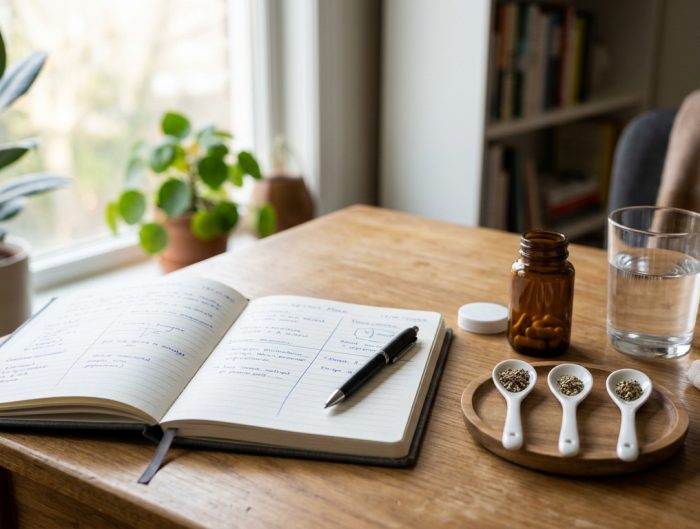
Journaling for Pattern Recognition and Emotional Release
If breathwork is the fastest grounding tool, journaling is the deepest. A regular journaling practice gives you a record of your inner experience over time, which is invaluable for spotting patterns that are invisible in the moment. Did your overthinking spike on days when you also drank coffee? Did it correlate with poor sleep the night before, or with a stressful meeting in the afternoon? You won’t know unless you write it down.
Keep it simple. You don’t need elaborate prompts or beautiful notebooks, though those are fine if they motivate you. A basic entry might include: the date, your dose, what time you took it, a few words about your mood before dosing, and a few words about your experience throughout the day. Pay special attention to moments when your thinking shifted from open awareness to anxious looping. What was happening right before that shift?
Over weeks and months, these entries become a map of your unique relationship with microdosing. You’ll start to see that certain conditions support presence and others undermine it. Maybe you’ll notice that microdose days paired with morning walks consistently feel calm, while microdose days spent entirely at a computer feel scattered. That’s not a failure of the microdose. That’s your body telling you what it needs.
Journaling also serves as emotional release. The act of putting swirling thoughts on paper externalizes them. They stop being an overwhelming internal storm and become words on a page: finite, contained, and something you can look at with a bit of distance. Many people find that ten minutes of freewriting after noticing overthinking is enough to break the cycle entirely.
Nearly half of the more than 200 million days of psilocybin use reported in the past year involved microdosing, and as one researcher noted, “our findings suggest that for those who use psychedelics, taking small doses is a big deal.” With that many people exploring this practice, building a personal record through journaling isn’t just helpful: it’s responsible. Healing Dose has always emphasized that integration, the work you do between doses, is where the real quiet changes happen.
Integrating Long-Term Presence into Daily Life
Grounding isn’t something you do only when you’re spiraling. The practices that help you stay present during a difficult microdose day are the same ones that build a more grounded baseline over time. The difference between someone who occasionally uses breathwork in a crisis and someone who has genuinely become more present is consistency. It’s the difference between owning a fire extinguisher and building your house with fireproof materials.
Start by choosing one grounding practice and committing to it daily for two weeks, regardless of whether it’s a microdose day or not. Maybe it’s five minutes of breathwork every morning. Maybe it’s a ten-minute walk without your phone. Maybe it’s a single page of journaling before bed. The specific practice matters less than the regularity. You’re training your nervous system to recognize and return to presence as a default state rather than something you have to fight for.
Over time, you’ll likely notice that the overthinking patterns that once felt overwhelming become quieter. Not because they’ve disappeared, but because you’ve built a stronger capacity to notice them early and redirect your attention. The gap between a thought arising and your response to it, that gap that microdosing may have helped reveal, becomes a space you know how to inhabit rather than a space that frightens you.
Be patient with yourself. There will be days when every grounding technique feels useless and your mind won’t stop churning. That’s normal. It doesn’t mean you’re failing. It means you’re human, and you’re paying attention, which is already more than most people do. The fact that you’re reading this, looking for ways to work with your overthinking rather than just suffering through it, says something good about your relationship with yourself.
For MDMA microdosing, a related but distinct practice, roughly 42% of use days involved microdosing, which suggests that this approach to small, intentional doses is spreading across multiple substances. Whatever you’re working with, the principles remain the same: start low, pay attention, ground yourself in your body, and build a practice of reflection that helps you understand your own patterns.
If you’re just beginning or want to make sure your dose is well-suited to your goals and sensitivity, take this short quiz to find a gentle starting range. It’s designed to help you approach microdosing thoughtfully and at your own pace, which is exactly the spirit these grounding practices are built on.
The most important thing you can take from all of this isn’t any single technique. It’s the understanding that presence is a skill, not a personality trait. You can build it. You can strengthen it. And on the days when it feels out of reach, you can trust that it will come back, because you’ve practiced enough to know the way home.