Colorado became one of the first states in the country to create a legal pathway for psilocybin therapy when voters approved Proposition 122 in November 2022. Since then, the state has been building the regulatory framework that determines who can access psilocybin, how sessions are facilitated, and what safety standards must be met. If you’ve been curious about whether this approach might support your mental health, you’re not alone. Thousands of Coloradans and out-of-state visitors are asking the same questions: How does it work? Is it safe? What does it actually cost? And most importantly, is it right for me? This guide walks you through everything you need to know, from the legal details to the practical realities of sitting in a facilitated session. Whether you’re someone managing persistent depression, processing difficult experiences, or simply exploring new ways to support your well-being, the information here is designed to help you make a thoughtful, informed decision at your own pace.
The Legal Landscape of Proposition 122
Understanding the legal framework is the first step toward making sense of psilocybin therapy in Colorado. Proposition 122, officially known as the Natural Medicine Health Act, passed with roughly 53% of the vote. It didn’t simply legalize psilocybin the way Colorado legalized cannabis years earlier. Instead, it created a two-pronged approach: personal decriminalization on one side and a state-regulated access model on the other.
The law covers more than just psilocybin. It also includes psilocin, dimethyltryptamine (DMT), ibogaine, and mescaline (excluding peyote, out of respect for Indigenous traditions). But psilocybin has received the most attention because it has the strongest body of clinical research behind it and is the first substance being rolled out through the regulated system.
Colorado’s Department of Regulatory Agencies (DORA) has been responsible for building the rules governing licensed facilities, facilitator training, and client safety protocols. The first licensed centers began accepting clients in mid-2025, and the system continues to evolve as regulators gather data and feedback from early participants.
Decriminalization vs. Regulated Access
These two concepts often get confused, but the distinction matters quite a bit for anyone considering this path.
Decriminalization means that adults 21 and older in Colorado can possess, grow, and share natural medicines like psilocybin without facing state criminal penalties. You cannot sell them. You cannot give them to minors. And local jurisdictions can still enact certain restrictions. But if you’re an adult growing mushrooms at home for personal use, state law no longer treats that as a criminal act.
Regulated access is something different entirely. This is the system of licensed facilities where you can receive psilocybin in a supervised setting with a trained facilitator. Think of it as the difference between brewing your own beer at home and going to a licensed bar. Both are legal, but the regulated model comes with professional oversight, safety screening, and structured support before, during, and after your session.
For many people, especially those new to psilocybin or managing a mental health condition, the regulated model offers a level of safety and guidance that personal use simply can’t match. You’re not figuring things out alone. You have someone trained to hold space for whatever comes up during your experience.
The Role of the Natural Medicine Advisory Board
The Natural Medicine Advisory Board was created by Proposition 122 to guide the state through the process of building this new system. It’s made up of professionals from various backgrounds: mental health clinicians, researchers, community advocates, people with lived experience using natural medicines, and experts in public health policy.
Their job has been to make recommendations to DORA on everything from facilitator training requirements to dosage guidelines, facility standards, and equity considerations. The board has also been tasked with thinking about how to make regulated access available to people across income levels, not just those who can afford premium wellness experiences.
One of the board’s notable recommendations involved ensuring that facilitators complete a minimum number of supervised practice hours before working independently. This mirrors how therapists and counselors are trained: you don’t just read textbooks and then start seeing clients. You practice under supervision until you demonstrate competence.
The board has also weighed in on whether to expand the regulated model to include other natural medicines beyond psilocybin. As of early 2026, psilocybin remains the primary substance available through licensed centers, but discussions about adding other compounds are ongoing. If you want to stay informed about these developments, the board’s meeting minutes and recommendations are publicly available through DORA’s website.
How Psilocybin Therapy Works in a Clinical Setting
If you’ve never experienced a facilitated psilocybin session, the process might feel mysterious or even intimidating. That’s completely normal. The reality is more structured and supportive than most people expect. The regulated model in Colorado follows a three-phase approach: preparation, administration, and integration. Each phase serves a specific purpose, and skipping any of them would undermine the value of the experience.
This isn’t about showing up, taking a dose, and hoping for the best. It’s a carefully designed process meant to create the conditions for meaningful personal growth.
Preparation and Screening Sessions
Before you ever sit down for a facilitated session, you’ll go through one or more preparation meetings with your facilitator. These sessions serve multiple purposes.
First, there’s a health screening component. Your facilitator will ask about your medical history, current medications, and mental health background. Certain conditions and medications are contraindicated with psilocybin, meaning they could create dangerous interactions or make the experience harmful rather than helpful. For example, lithium and psilocybin can be a dangerous combination. SSRIs may blunt the effects or create unpredictable responses. A responsible facilitator will want to understand your full picture before proceeding.
Second, preparation sessions help you clarify your intentions. Why are you seeking this experience? What are you hoping to explore or address? Intentions don’t need to be dramatic or perfectly articulated. They can be as simple as “I want to understand why I feel stuck” or “I’d like to explore my relationship with grief.” The point is to give your session some direction without rigidly scripting what should happen.
Third, your facilitator will explain what to expect during the administration session itself. They’ll describe the timeline: how long it takes for effects to begin (usually 30 to 60 minutes), how long the experience typically lasts (four to six hours), and what kinds of physical and emotional experiences are common. Knowing what’s coming helps reduce anxiety and allows you to settle into the experience rather than fighting it.
At Healing Dose, we emphasize that preparation isn’t just logistical. It’s the beginning of the therapeutic process. Journaling before your session, reflecting on your current patterns, and honestly assessing your emotional state all contribute to a more meaningful experience.
The Facilitated Administration Session
This is the part most people think about when they picture psilocybin therapy. You arrive at a licensed facility, settle into a comfortable space, and consume a measured dose of psilocybin under the supervision of your facilitator.
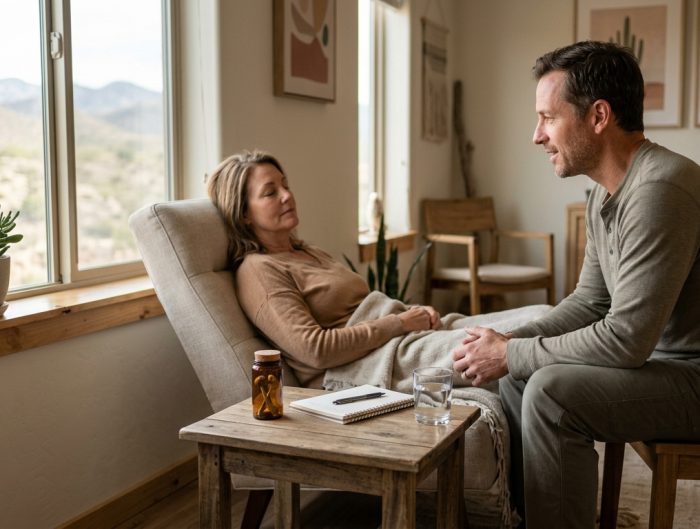
The environment matters more than you might think. Licensed centers in Colorado are required to provide safe, comfortable settings. Many feature soft lighting, comfortable seating or reclining options, blankets, and curated music playlists. The goal is to create a space where you feel safe enough to let go of control and allow the experience to unfold.
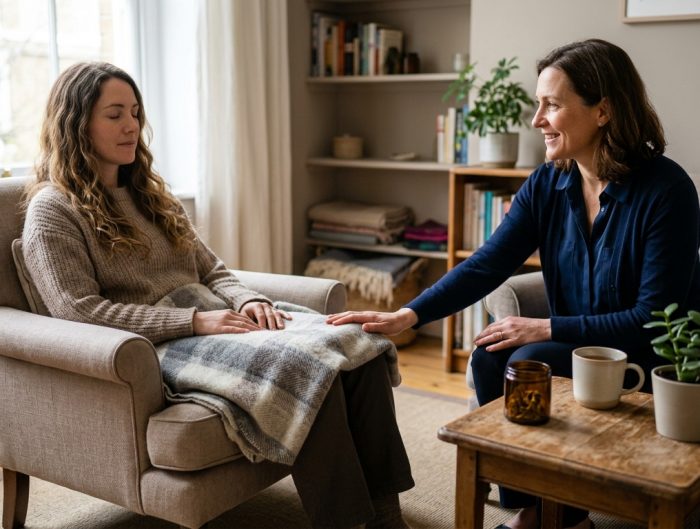
Your facilitator stays with you throughout the session. Their role is not to direct your experience or tell you what to think about. Instead, they’re there to provide reassurance if you feel overwhelmed, help you stay grounded if the experience becomes intense, and gently encourage you to stay present with whatever arises. Think of them as a steady, calm presence: someone who has seen this process many times and knows how to support you through it.
Dosage varies depending on your goals, your body, and your facilitator’s recommendations. Some people work with moderate doses (around 2 to 3.5 grams of dried mushrooms), while others may start lower, especially if it’s their first experience. The regulated model allows facilitators to tailor dosing to the individual rather than applying a one-size-fits-all approach.
During the session itself, experiences vary widely. Some people describe vivid visual imagery, deep emotional processing, or a sense of connection to something larger than themselves. Others have quieter, more introspective experiences. There’s no “right” way for a session to go. What matters most is what you do with the experience afterward, which brings us to integration.
Integration and Post-Session Support
If the administration session is the seed, integration is the soil, water, and sunlight. Without it, even the most profound experience can fade into a pleasant memory without producing lasting change.
Integration sessions typically happen in the days and weeks following your psilocybin experience. You’ll meet with your facilitator (or sometimes a separate integration therapist) to discuss what came up during your session, what emotions or insights surfaced, and how you might apply those realizations to your daily life.
This is where the real work happens. Psilocybin can open doors, but you’re the one who has to walk through them. If your session revealed patterns of self-criticism, for example, integration is where you develop practical strategies for responding differently when that inner critic shows up. If you experienced a deep sense of connection or compassion, integration helps you figure out how to carry that feeling into your relationships and routines.
Journaling is one of the most effective integration tools. Writing down your experience while it’s still fresh helps you capture details and emotional nuances that might otherwise slip away. Over the following weeks, returning to those notes and reflecting on how your perspective has shifted can reinforce the changes you’re working toward. We talk about this a lot at Healing Dose because integration is where subtle, quiet shifts become real behavioral change over time.
Some people find that a single session provides what they need. Others benefit from multiple sessions spaced weeks or months apart. There’s no universal timeline. The key is to give yourself enough space between sessions to fully process and integrate each one before considering another.
Conditions Treated and Therapeutic Benefits
Research into psilocybin’s therapeutic potential has accelerated dramatically over the past decade. Major institutions like Johns Hopkins, NYU, and Imperial College London have published studies showing promising outcomes for several mental health conditions. While Colorado’s regulated model doesn’t position psilocybin as a medical prescription, the growing body of evidence is a significant reason why voters approved Proposition 122.
It’s worth being honest here: psilocybin is not a magic solution for every mental health challenge. The research is encouraging but still evolving. Individual experiences vary enormously, and what works beautifully for one person may not resonate the same way for another. That variability is part of why the facilitated model, with its preparation and integration components, exists.
Treatment-Resistant Depression and Anxiety
The strongest research evidence for psilocybin involves depression, particularly cases that haven’t responded well to conventional approaches like SSRIs or talk therapy alone. A 2024 study published in The New England Journal of Medicine found that a single 25mg dose of synthetic psilocybin, combined with psychological support, produced significant reductions in depressive experiences that persisted for at least 12 weeks in a substantial portion of participants.
For people who have tried multiple medications without finding relief, this data is meaningful. It suggests that psilocybin works through different mechanisms than traditional antidepressants. Rather than adjusting serotonin levels on an ongoing basis, psilocybin appears to temporarily increase connectivity between brain regions that don’t normally communicate much. This heightened connectivity may allow people to break out of rigid thought patterns, the kind of mental loops that characterize depression: “I’m worthless,” “nothing will ever change,” “I don’t deserve to feel better.”
Anxiety, particularly end-of-life anxiety in people with terminal diagnoses, has also shown strong responses in clinical research. Studies at NYU and Johns Hopkins found that psilocybin-assisted sessions produced rapid and sustained reductions in anxiety and existential distress. Many participants described a fundamental shift in their relationship to mortality: not a denial of death, but a reduced fear of it.
If you’re living with persistent depression or anxiety, these findings offer real hope. But they’re not guarantees. Your experience will be shaped by your unique biology, your preparation, the quality of your facilitation, and your commitment to integration afterward.
Addressing PTSD and Substance Use Disorders
Research into psilocybin for PTSD is still in earlier stages compared to depression studies, but early data is encouraging. Several clinical trials are currently underway examining how psilocybin-assisted therapy might help people process traumatic memories in a way that reduces their emotional charge. The theory is that psilocybin’s ability to increase emotional openness and reduce the brain’s default fear responses could create a window where traumatic material can be revisited and reprocessed more safely.
This doesn’t mean psilocybin erases traumatic memories. Rather, it may help shift the relationship you have with those memories, reducing the intensity of flashbacks, hypervigilance, and emotional numbing that characterize PTSD.
For substance use disorders, the research is similarly promising but preliminary. A 2022 study from Johns Hopkins found that psilocybin-assisted therapy helped participants with alcohol use disorder significantly reduce their drinking compared to a control group. The effect was still measurable eight months later. Smaller studies have shown potential for tobacco cessation as well, with abstinence rates far exceeding those of conventional approaches.
What’s interesting about these findings is that psilocybin doesn’t seem to work like a traditional pharmaceutical intervention. It’s not replacing one substance with another or suppressing cravings through chemical means. Instead, participants often describe gaining a new perspective on their relationship with the substance: understanding why they use it, what it’s masking, and what they actually want from their lives. That kind of insight, when supported by good integration work, can be genuinely transformative over time.
Finding and Choosing a Licensed Facility
Choosing where to have your psilocybin experience is one of the most important decisions you’ll make in this process. The quality of your facilitator and the environment they create will significantly shape your experience. Colorado’s licensing system provides a baseline of safety and professionalism, but there’s still variation between facilities, and doing your homework pays off.
As of 2026, the number of licensed centers in Colorado is growing steadily. Most are concentrated along the Front Range, particularly in Denver, Boulder, and Colorado Springs, but facilities in mountain towns and rural areas are beginning to open as well.
Verifying Facilitator Qualifications
Every facilitator working in a licensed Colorado facility must meet training requirements established by DORA based on the Natural Medicine Advisory Board’s recommendations. These requirements include completing an approved training program, logging supervised practice hours, passing background checks, and maintaining ongoing education.
Here’s what to look for and ask about when evaluating a facilitator:
- What training program did they complete, and how many hours of supervised facilitation have they logged?
- Do they have a background in mental health, counseling, or a related field? While not strictly required, this experience can be valuable.
- How do they handle difficult moments during a session? Ask them to describe their approach to supporting someone who becomes frightened or overwhelmed.
- What does their integration support look like? A facilitator who ends their involvement after the administration session is missing a critical piece of the process.
- Can they provide references or testimonials from previous clients (with appropriate privacy protections)?
Trust your instincts during your initial conversations. You’re going to be in a deeply vulnerable state during your session, and you need to feel genuinely safe with this person. If something feels off during your preparation meetings, it’s okay to look elsewhere. There’s no obligation to proceed with a facilitator who doesn’t feel like the right fit.
Cost Considerations and Accessibility
Let’s be straightforward: psilocybin therapy in Colorado is not cheap. A full program including preparation, the facilitated session, and integration support typically ranges from $1,500 to $5,000 or more, depending on the facility, the number of sessions, and the level of support provided.
Insurance does not currently cover psilocybin therapy in Colorado. Because psilocybin remains a Schedule I substance at the federal level, health insurance companies are not reimbursing for these services. This creates a significant accessibility barrier, and it’s one that advocates and the Natural Medicine Advisory Board are actively working to address.
Some facilities offer sliding scale pricing or payment plans to make their services more accessible. A few nonprofit organizations have begun offering subsidized sessions for veterans, first responders, and low-income individuals. If cost is a barrier for you, it’s worth asking facilities directly about financial assistance options. Don’t be embarrassed to bring it up: good facilitators understand that this work should be available to people across economic backgrounds.
For those exploring psilocybin outside the regulated system (which is legal for personal use under decriminalization), the costs are obviously much lower. But you lose the professional screening, facilitation, and integration support that make the regulated model safer and more effective. If you’re managing a serious mental health condition, the investment in professional support is worth considering carefully.
Safety, Side Effects, and Contraindications
Psilocybin has a strong safety profile compared to many other psychoactive substances. It is not physically addictive, and lethal overdose from psilocybin mushrooms alone is extraordinarily rare. But “relatively safe” doesn’t mean “risk-free,” and being informed about potential side effects and contraindications is essential before you proceed.
During a session, common physical experiences include nausea (especially in the first hour), changes in body temperature, dilated pupils, increased heart rate, and muscle tension. These effects are typically mild and temporary. Some facilitators recommend fasting or eating lightly before a session to reduce nausea, and ginger tea is a common remedy.
Emotionally, psilocybin can bring up intense and sometimes difficult material. Grief, fear, sadness, and confusion are all possible during a session. This is not necessarily a sign that something is going wrong. In fact, many practitioners consider these challenging moments to be therapeutically valuable, provided you have adequate support to process them. A skilled facilitator will help you move through difficult emotions rather than getting stuck in them.
There are specific situations where psilocybin should be avoided entirely:
- If you have a personal or strong family history of psychotic disorders such as schizophrenia or bipolar I disorder, psilocybin could trigger a psychotic episode. This is one of the most serious risks and a primary reason why screening is so important.
- If you are currently taking lithium, the combination with psilocybin can cause seizures.
- If you are taking SSRIs, MAOIs, or other serotonergic medications, interactions can range from blunted effects to serotonin syndrome, a potentially dangerous condition.
- If you are pregnant or breastfeeding, there is insufficient safety data to recommend psilocybin use.
- If you have severe cardiovascular conditions, the temporary increase in heart rate and blood pressure during a session could pose risks.
This is why the screening process in the regulated model exists. A responsible facilitator will not proceed if your medical history suggests significant risk. If you’re working outside the regulated system, please take this screening seriously on your own. Talk to a healthcare provider who is knowledgeable about psychedelics before proceeding.
One more thing worth mentioning: the days following a psilocybin session can feel emotionally tender. Some people describe feeling more open and sensitive for a few days afterward, which can be beautiful but also vulnerable. Plan for some quiet time after your session. Don’t schedule a high-pressure work presentation for the next morning. Give yourself space to process.
At Healing Dose, we always encourage a safety-first approach. The potential benefits of psilocybin are real, but they’re best realized when you take the time to prepare properly, choose a qualified facilitator, and honor your own limits and boundaries.
The Future of Natural Medicines in Colorado
Colorado’s experiment with regulated psilocybin access is being watched closely by other states and by federal agencies. Oregon launched its own psilocybin services program slightly earlier, and the two states are generating valuable real-world data about how these programs function, who they serve, and what outcomes they produce.
Several trends are worth paying attention to as this space continues to develop. First, there’s growing momentum toward including additional natural medicines in the regulated framework. The Natural Medicine Advisory Board has been discussing timelines for potentially adding DMT and mescaline (non-peyote derived) to the list of substances available through licensed centers. These discussions are proceeding cautiously, with regulators wanting to see how the psilocybin rollout stabilizes before expanding.
Second, the conversation around insurance coverage and federal rescheduling continues to evolve. The FDA has been reviewing psilocybin through its drug approval process, and a positive outcome there could eventually open the door to insurance reimbursement for psilocybin-assisted therapy. That would dramatically change the accessibility equation for millions of people.
Third, research continues to expand into new areas. Studies are exploring psilocybin’s potential for conditions like eating disorders, chronic pain, obsessive-compulsive disorder, and cluster headaches. Each positive finding adds to the evidence base and strengthens the case for broader access.
For you personally, the most important thing is to approach this space with both openness and discernment. The hype cycle around psychedelics is real, and not every claim you encounter online will be grounded in evidence. Seek out reliable sources of information, ask hard questions of anyone offering services, and remember that psilocybin is a tool, not a solution in itself. The real work happens in how you prepare, how you show up during the experience, and especially how you integrate what you learn into the weeks and months that follow.
Colorado has created something genuinely new here: a legal, regulated pathway for adults to access psilocybin with professional support. Whether you’re ready to explore that pathway now or simply gathering information for the future, you’re already doing something meaningful by educating yourself and approaching this thoughtfully.
If you’re curious about starting smaller, perhaps exploring microdosing as a gentler entry point, we’ve created a short quiz that helps you find a starting range based on your goals, experience, and sensitivity. You can take the quiz here whenever you feel ready.
Whatever path you choose, take your time. There’s no rush. The mushrooms aren’t going anywhere, and neither is your capacity for growth.

You might also like