The tension in your shoulders hasn’t released since that morning meeting. Your jaw is still clenched from the commute. Maybe someone said something that stung, or you spent eight hours putting out fires that weren’t yours to fight. Now you’re home, and the day is technically over, but your body hasn’t gotten the memo.
This is the moment many people reach for their microdose, hoping it might help them decompress. And it can, genuinely. But microdosing after a hard day requires a different approach than dosing on a calm Saturday morning. When your nervous system is already activated, when stress hormones are still circulating, the experience shifts. Without intention and care, you might find yourself ruminating more intensely rather than finding relief.
Staying grounded and gentle with yourself during evening microdosing isn’t about following rigid rules. It’s about creating conditions where subtle support can actually reach you. Your frazzled nervous system needs signals of safety before it can soften. Your racing mind needs permission to slow down before it can gain perspective.
Over the past few years, I’ve learned this the hard way. Rushing home after difficult days and immediately taking a microdose often amplified my stress rather than easing it. The shift came when I started treating the transition from work to rest as something that deserved its own attention, something that needed tending before introducing any substance into the mix.
What follows are five approaches that have helped me and many others move from stress to steadiness on challenging days. These aren’t complicated protocols. They’re simple practices that honor both the difficulty you’ve experienced and the gentleness you deserve.
The Intersection of Stress Recovery and Microdosing
When stress and microdosing meet, the interaction is rarely neutral. Your physiological state at the time of dosing influences what unfolds in the hours that follow. Understanding this relationship helps you work with it rather than against it.
Stress isn’t just a mental experience. It’s a full-body event involving elevated cortisol, increased heart rate, shallow breathing, and muscular tension. These physical realities don’t disappear the moment you walk through your front door. They linger, sometimes for hours, creating an internal environment that colors everything you experience.
A microdose taken during this state encounters a nervous system on high alert. The subtle shifts in perception and mood that characterize sub-perceptual dosing can be amplified or distorted by this underlying activation. Some people report increased anxiety or a sense of being “too aware” of their stress when they dose without first addressing their physiological arousal.
This doesn’t mean microdosing after difficult days is inadvisable. It means preparation matters more than usual. The practices in this article aren’t about making microdosing “work better” in some optimization sense. They’re about creating the conditions where you can actually receive what the experience might offer.
Understanding the Post-Work Decompression Phase
The transition from work mode to rest mode doesn’t happen automatically. Your brain has been running certain programs all day: vigilance, productivity, social navigation, problem-solving. These programs don’t shut off because you’ve changed locations. They need active signals that the context has changed.
Research on stress recovery suggests that the first 30 to 60 minutes after leaving a stressful environment are particularly important. This window, sometimes called the “decompression phase,” is when your body begins the shift from sympathetic activation (fight or flight) to parasympathetic dominance (rest and digest). How you spend this time shapes how completely the transition occurs.
Many of us fill this window with activities that maintain stress: checking work emails, scrolling through social media that triggers comparison or outrage, or immediately diving into household responsibilities. We never give ourselves the clear signal that the demands of the day have actually ended.
When you microdose during an incomplete decompression, you’re essentially asking the substance to do work that your nervous system hasn’t been prepared to do. It’s like trying to have a meaningful conversation while still wearing noise-canceling headphones tuned to a different frequency.
The Importance of Intentionality Over Escapism
Here’s a distinction that took me years to understand: there’s a significant difference between using a microdose to avoid your difficult feelings and using it to be more present with them. The first approach usually backfires. The second can be genuinely supportive.
Escapism with microdosing looks like rushing to dose so you don’t have to feel the weight of your day. It’s treating the substance as a quick fix, expecting it to delete your stress rather than help you process it. This approach often leads to disappointment or increased discomfort because the feelings you’re trying to escape are still there, just with slightly altered perception.
Intentionality looks different. It involves acknowledging that you’ve had a hard day, recognizing that you’re carrying something heavy, and choosing to create conditions where you might relate to that heaviness differently. You’re not trying to make the feelings disappear. You’re hoping to meet them with a bit more spaciousness, perhaps a slightly wider perspective.
This shift from escapism to intentionality changes everything about evening microdosing. It transforms the practice from a coping mechanism into something closer to a gentle ritual of self-care. The substance becomes one element in a larger practice of tending to yourself after difficulty.
1. Establish a Transitional Ritual Before Dosing
The most helpful thing you can do before microdosing after a hard day is create a clear boundary between work and rest. This boundary isn’t about physical location alone. It’s about signaling to your entire system that the demands have ended and a different kind of time has begun.
Transitional rituals don’t need to be elaborate. They need to be consistent and sensory enough that your body recognizes them. Over time, these rituals become cues that trigger the relaxation response before you’ve consciously decided to relax. Your nervous system learns the pattern and begins shifting automatically.
Some people change clothes immediately upon arriving home, choosing garments that feel distinctly different from work attire. The act of removing the day’s uniform becomes a symbolic shedding of the day’s responsibilities. Others take a shower, letting water wash away not just physical grime but the energetic residue of stressful interactions.
The key is choosing something that works for your life and doing it consistently. Your ritual might take five minutes or twenty. It might involve making tea, sitting quietly in a specific chair, or walking around the block once before entering your home. What matters is that it becomes a reliable signal that creates psychological distance between the stress of your day and the rest of your evening.
Using Sensory Anchors to Signal Safety
Your nervous system responds powerfully to sensory input. This is why certain smells can instantly transport you to childhood memories or why a particular song can shift your mood within seconds. You can use this responsiveness intentionally by creating sensory anchors that signal safety and rest.
Scent is particularly effective because it bypasses cognitive processing and directly influences the limbic system. Consider having a specific essential oil or candle that you only use during your evening transition time. Lavender, chamomile, and sandalwood have research supporting their calming effects, but what matters most is that you personally associate the scent with relaxation.
Sound works similarly. A particular playlist, a specific album, or even a few minutes of silence can become part of your transitional anchor. I’ve found that instrumental music without lyrics helps me shift out of verbal, analytical thinking more quickly than songs with words. Some people prefer nature sounds or binaural beats designed to encourage alpha brain wave states.
Touch anchors might include a soft blanket you wrap around yourself, a specific texture of clothing, or even the sensation of bare feet on a particular surface. These tactile cues communicate safety to your body in ways that words cannot.
The more senses you engage in your transitional ritual, the more powerfully it signals the shift. Over weeks of consistent practice, simply lighting that candle or putting on that playlist will begin triggering the relaxation response automatically.
2. Pair Your Dose with Somatic Grounding Techniques
After a hard day, your stress lives in your body as much as your mind. Racing thoughts are often accompanied by shallow breathing, tight muscles, and a sense of physical bracing. Somatic grounding techniques address this physical dimension directly, creating conditions where mental calm can follow.
The word “somatic” simply means “of the body.” Somatic grounding involves bringing your attention into physical sensation as a way of anchoring yourself in the present moment. When you’re caught in stress, your awareness tends to be pulled into past regrets or future worries. Your body, however, is always in the present. It becomes a reliable anchor point.
Pairing these techniques with your microdose creates a synergy. The substance may enhance your capacity for body awareness while the grounding practices give that awareness somewhere useful to go. Instead of heightened perception amplifying mental chatter, it can deepen your connection to physical sensation and the relief that comes from releasing held tension.
These practices don’t require any special equipment or training. They’re accessible to anyone willing to spend a few minutes paying attention to their body with curiosity rather than judgment.
Breathwork to Regulate the Nervous System
Your breath is the most direct lever you have for shifting your nervous system state. Unlike heart rate or digestion, breathing is both automatic and voluntary. You can consciously change your breathing pattern, and that change will influence your entire physiology.
The simplest approach is extending your exhale. When your exhale is longer than your inhale, you activate the parasympathetic nervous system. Try breathing in for a count of four and out for a count of six or eight. Do this for just two to three minutes and notice what shifts.
Box breathing is another accessible technique: inhale for four counts, hold for four counts, exhale for four counts, hold empty for four counts. This pattern creates a sense of rhythm and control that can be particularly grounding after chaotic days.
If you want something even simpler, try physiological sighing. Take two short inhales through your nose, then one long exhale through your mouth. This mimics the natural sighing pattern your body uses to reset itself. Research from Stanford suggests this technique can reduce stress more quickly than other breathing methods.
The key is practicing these techniques before or alongside your microdose, not as an afterthought. Spend five to ten minutes with intentional breathing before you dose, and you’ll be meeting the experience from a calmer baseline.
Progressive Muscle Relaxation for Physical Release
Progressive muscle relaxation involves systematically tensing and releasing muscle groups throughout your body. It sounds almost too simple to be effective, but the technique has decades of research supporting its ability to reduce physical tension and anxiety.
Start with your feet. Curl your toes tightly, hold for five to seven seconds, then release completely. Notice the contrast between tension and relaxation. Move to your calves, tensing them by pointing your toes, holding, then releasing. Continue upward through your thighs, glutes, abdomen, hands, arms, shoulders, and face.
The magic is in the release. By intentionally creating tension first, you give your muscles something to let go of. Many of us hold chronic tension without realizing it because we’ve become habituated to the sensation. The contrast of deliberate tensing makes the release more noticeable and more complete.
A full progressive muscle relaxation sequence takes about fifteen minutes. Even a shortened version focusing on the areas where you hold the most tension, often shoulders, jaw, and hands, can make a meaningful difference. Doing this before your microdose helps you enter the experience from a more relaxed physical state, which influences everything that follows.
3. Curate a Low-Stimulation Environment
Your environment shapes your experience more than you might realize. After a hard day, your nervous system is already overstimulated. Adding more stimulation through bright lights, loud sounds, or visual clutter works against the rest you need.
Creating a low-stimulation environment isn’t about sensory deprivation. It’s about reducing unnecessary inputs so your system can process what it’s already carrying. Think of it as clearing space, both physical and perceptual.
Dim the lights or switch to warm-toned lamps. Reduce ambient noise or replace it with something soothing. Clear visual clutter from your immediate surroundings. These changes might seem superficial, but they communicate safety to your nervous system in ways that support the decompression process.
The goal is creating what I think of as a “container” for your evening experience. This container holds you gently, asking nothing of you, demanding no responses or decisions. Within this container, the subtle effects of a microdose have room to be noticed and integrated rather than drowned out by competing stimuli.
The Impact of Digital Detox on Microdosing Efficacy
Screens deserve special attention here. The blue light from phones, computers, and televisions suppresses melatonin production and signals alertness to your brain. The content on these screens, especially social media and news, often triggers emotional responses that maintain stress activation.
Consider establishing a screen-free window around your evening microdose. This might mean putting your phone in another room, turning off notifications, or simply committing to not checking anything for a set period. Even thirty minutes of screen-free time can make a noticeable difference in how grounded you feel.
I’ve noticed that my most difficult evenings with microdosing have often involved scrolling through my phone while waiting for effects to emerge. The combination of sub-perceptual shifts and algorithmically designed content creates a strange, unsettled feeling. By contrast, evenings where I’ve kept screens away have felt more spacious and restorative.
If complete digital detox feels impossible, consider at least changing what you consume. Swap social media for a physical book. Replace news with instrumental music. Choose a nature documentary over a thriller. The content you take in during a microdose experience becomes part of that experience.
At Healing Dose, we emphasize that the context surrounding your practice matters as much as the substance itself. Your environment is part of that context. Treating it with intention transforms microdosing from something that happens to you into something you’re actively participating in.
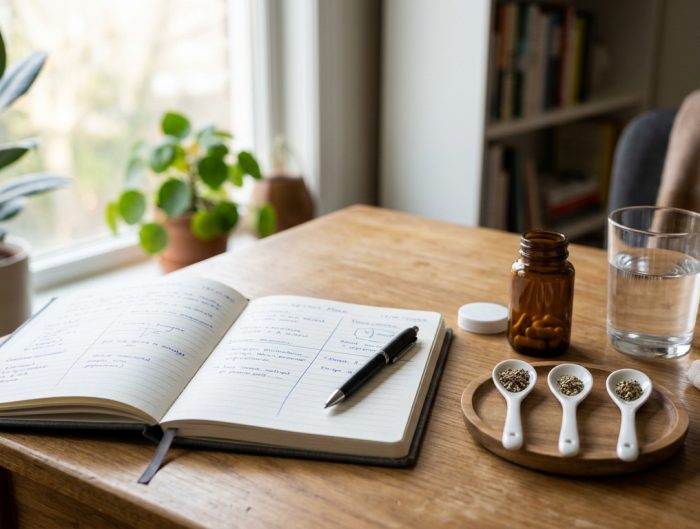
4. Utilize Reflective Journaling for Emotional Processing
Writing offers a way to externalize what’s happening internally. After a hard day, your mind may be crowded with unprocessed experiences, incomplete thoughts, and feelings that haven’t found expression. Journaling creates a channel for this material to move through you rather than staying stuck.
You don’t need to be a skilled writer or follow any particular format. The goal isn’t producing beautiful prose. It’s creating movement in your inner world. Sometimes the most helpful entries are messy, fragmented, or don’t make complete sense. The act of writing itself is what matters.
When paired with a microdose, journaling can become particularly revealing. The subtle shift in perspective that microdosing may offer can help you see your day’s difficulties from a slightly different angle. Thoughts that felt overwhelming might become more manageable when written down. Patterns you couldn’t see while inside the stress might become visible from this new vantage point.
Start with simple prompts if blank pages feel intimidating. “What am I carrying from today?” is a good opener. “What would I tell a friend who had my day?” can help access self-compassion. “What do I need right now that I haven’t given myself?” points toward unmet needs.
Write for at least ten minutes without stopping to edit or judge. Let the words come without filtering. You can always tear up the pages later if you want. What matters is the process of externalization, getting the internal material out where you can see it and relate to it differently.
Over time, a journaling practice paired with evening microdosing creates a record of your inner life. Looking back at entries from difficult periods can reveal growth you couldn’t see while inside the experience. This long-term perspective is part of what we at Healing Dose mean by integration: turning temporary experiences into lasting understanding.
5. Incorporate Gentle Movement and Nature
Movement helps complete the stress response cycle. When you’re stressed, your body prepares for physical action: fighting or fleeing. If that physical action never happens, the stress hormones and muscular tension have nowhere to go. Gentle movement provides an outlet.
The emphasis here is on gentle. After a hard day, intense exercise can sometimes add to your stress load rather than relieving it. What your nervous system needs is movement that feels safe and rhythmic, not demanding or competitive.
Walking is perhaps the most accessible option. A slow walk around your neighborhood, especially if you can find some green space, combines movement with the restorative benefits of nature exposure. Research consistently shows that time in natural environments reduces cortisol levels and improves mood.
Stretching and gentle yoga offer another pathway. These practices bring attention into the body while releasing physical tension. You don’t need a full yoga class or perfect form. Even ten minutes of intuitive stretching, moving in whatever ways feel good, can shift your state significantly.
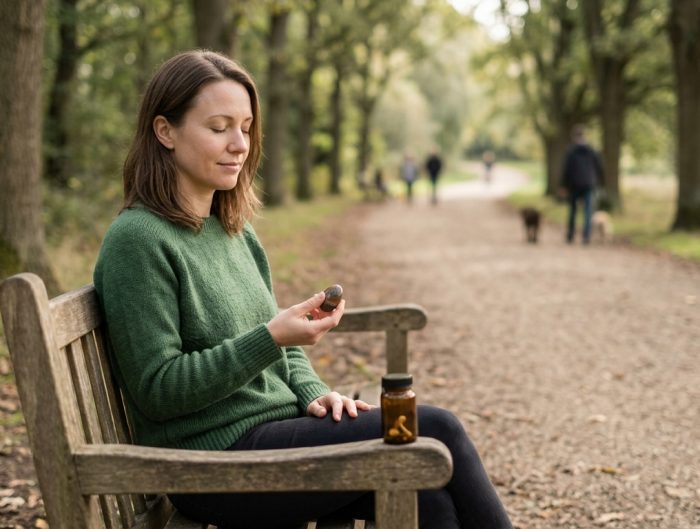
If you have access to outdoor space, consider taking your microdose outside. Sitting in a garden, on a balcony, or in a park adds the element of nature contact to your practice. Natural environments provide gentle sensory input: birdsong, wind, the sight of plants moving, that supports rather than overwhelms your nervous system.
The combination of gentle movement, nature exposure, and a microdose creates conditions for a particular kind of presence. Your attention settles into your body and your immediate surroundings. The worries of the day recede as you become absorbed in simple sensations: the feeling of your feet on the ground, the temperature of the air, the quality of light.
Best Practices for Evening Microdosing and Sleep Hygiene
Evening microdosing requires attention to sleep. While microdoses are sub-perceptual by definition, they can still influence your circadian rhythm and sleep architecture, especially if taken too late or too frequently.
The relationship between microdosing and sleep varies considerably between individuals. Some people find that evening doses help them unwind and sleep more deeply. Others experience subtle stimulation that makes falling asleep more difficult. Your response may also change depending on the substance, the dose size, and your current stress level.
Pay attention to your own patterns. Keep notes on when you dose and how you sleep that night. Over time, you’ll develop a sense of what works for your particular biology. This self-knowledge is more valuable than any general guideline.
If you notice sleep disruption, experiment with earlier timing, smaller doses, or taking breaks from evening dosing altogether. The goal is supporting your overall wellbeing, and sleep is foundational to that. A practice that helps you decompress but interferes with rest isn’t serving you well.
Consider your evening microdosing as part of a larger sleep hygiene picture. This includes consistent sleep and wake times, a cool and dark bedroom, and avoiding caffeine after early afternoon. The microdose is one element in an ecosystem of practices that either support or undermine your rest.
Timing Your Dose to Avoid Circadian Disruption
Most people find that dosing at least three to four hours before their intended bedtime minimizes sleep interference. This gives the acute effects time to subside before you’re trying to fall asleep.
If you get home from work at 6 PM and typically sleep at 10 PM, dosing around 6:30 or 7 PM after completing your transitional ritual gives you a reasonable window. Dosing at 9 PM, by contrast, might mean the experience is still active when you’re trying to sleep.
Psilocybin and its analogs tend to have effects lasting four to six hours, though the sub-perceptual nature of microdoses makes this harder to track precisely. LSD and its analogs typically have longer durations, sometimes eight to twelve hours, which makes them less suitable for evening use for many people.
Your individual sensitivity matters here. Some people metabolize these substances quickly and notice no sleep effects even with later dosing. Others are highly sensitive and need to dose earlier or stick to morning protocols. There’s no universal answer, only your own experience as a guide.
If you’re new to evening microdosing, start conservatively. Try your first few evening doses on nights when you can afford some sleep disruption, like Friday or Saturday. This gives you data about your response without consequences for your work week.
Finding Your Own Rhythm
The five approaches outlined here, transitional rituals, somatic grounding, low-stimulation environments, reflective journaling, and gentle movement, aren’t meant to be followed rigidly. They’re invitations to experiment and discover what actually helps you stay grounded and gentle with yourself after difficult days.
You might find that two of these practices become essential while the others don’t resonate. You might develop variations I haven’t mentioned. The point isn’t adherence to a protocol. It’s cultivating a relationship with yourself that includes care and intention, especially when you’re struggling.
Microdosing after a hard day can be genuinely supportive when approached thoughtfully. It can help you process what happened, release physical tension, and find perspective that eluded you while inside the stress. But it works best as part of a larger practice of self-tending, not as a standalone solution.
The hardest days are often the ones where we most need gentleness and the ones where we’re least likely to give it to ourselves. Building these practices into your routine means the support is already there when you need it. You don’t have to figure out how to take care of yourself while you’re depleted. The structure holds you.
If you’re curious about finding a starting point that matches your own sensitivity and goals, consider exploring our microdose quiz. It can help you approach this practice thoughtfully and at your own pace. Take the quiz here.
Whatever you discover, remember that the goal isn’t perfection. It’s presence. Some evenings will feel more grounded than others. Some days will be harder to shake off. What matters is that you keep showing up for yourself, keep experimenting with what helps, and keep extending the same compassion to yourself that you’d offer a struggling friend.