A quiet but persistent conversation has been building over the past decade, one that stretches from San Francisco tech offices to Berlin art studios to kitchen tables where people are simply trying to feel a little more present in their creative work. The question at the center of it: can taking a tiny, sub-perceptual dose of a psychedelic substance actually make you more creative? It is a question that sits at a fascinating intersection of personal testimony, neuroscience, cultural momentum, and genuine scientific uncertainty. Thousands of people report that microdosing has shifted something in the way they think, write, compose, or design. At the same time, controlled research is still catching up, and the findings so far are more complicated than the headlines suggest. If you have been curious about microdosing and creativity, about what people actually report and what the research says, you are in the right place. We are going to look at both sides honestly, without hype, and help you figure out what to make of it all.
The Rise of the Microdosing Phenomenon in Creative Industries
The idea that psychedelics and creative thinking share some kind of relationship is not new. Artists, musicians, and writers have described experiences with substances like LSD and psilocybin for decades. What is relatively new is the idea that you do not need a full-dose experience to access some of those benefits, that a fraction of a standard dose, taken on a regular schedule, might quietly sharpen your thinking without any perceptual distortion at all.
This concept gained serious traction in the early 2010s, fueled by a combination of underground experimentation, popular books like James Fadiman’s “The Psychedelic Explorer’s Guide,” and a growing willingness among professionals to talk about their experiences publicly, or at least semi-publicly. By the mid-2010s, microdosing had moved from a niche practice to a recognizable cultural phenomenon, with dedicated Reddit communities, podcasts, and a growing body of journalistic coverage.
The appeal is easy to understand. People working in creative and knowledge-intensive fields often feel stuck, whether by mental fatigue, rigid patterns of thought, or the kind of self-doubt that makes it hard to start anything new. The promise that a barely noticeable dose of a psychedelic could ease those blocks, even slightly, was enormously attractive.
Defining Microdosing: Dosage and Typical Substances
So what exactly are we talking about when we say “microdosing”? The term refers to taking roughly one-tenth to one-twentieth of what would be considered a standard psychoactive dose of a psychedelic substance. The goal is to stay below the sub-perceptual threshold, meaning you should not experience visual distortions, significant mood swings, or any of the hallmarks of a full psychedelic experience.
For psilocybin mushrooms, this typically means somewhere between 0.05 and 0.3 grams of dried material. For LSD, the range is usually 5 to 20 micrograms, compared to the 100 to 200 micrograms that would constitute a standard dose. Some people also microdose with substances like mescaline-containing cacti or synthetic tryptamines, though psilocybin and LSD remain the most commonly discussed.
Think of it this way: if a full dose is a loud song playing through speakers, a microdose is more like background music you are barely aware of. You might notice a subtle physical buzz or a gentle hum of energy, but nothing that would interfere with your workday. That is the intention, anyway. Individual variability is real, and what feels sub-perceptual for one person might be mildly noticeable for another, much like how caffeine sensitivity differs wildly from person to person.
Most people follow a dosing protocol, taking their microdose on specific days with rest days in between. The Fadiman protocol, one of the most popular, involves dosing on day one, taking two days off, and repeating. Others follow a schedule of every other day or four days on, three days off. The rest days are considered important for avoiding tolerance buildup and for giving yourself space to notice what, if anything, has shifted.
The Silicon Valley Influence and Professional Productivity
It is hard to talk about the rise of microdosing without acknowledging the role of Silicon Valley. By the mid-2010s, stories about tech workers microdosing LSD to boost focus and creativity had become a media staple. Engineers, designers, and startup founders described feeling more fluid in their thinking, more willing to approach problems from unusual angles, and more energized during long stretches of demanding work.
This was not just anecdotal chatter. Prominent figures in the tech world spoke openly about their experiences, and the cultural association between microdosing and high performance became firmly established. The narrative was compelling: here were some of the most productive, innovative people on the planet, and they were crediting a tiny dose of a psychedelic with helping them think better.
But this narrative also created problems. It framed microdosing primarily as a productivity tool, a way to get more done and think faster. That framing can obscure the more nuanced reality, which is that the reported benefits often have less to do with raw output and more to do with subtle shifts in perception, mood, and openness. Many people who microdose for creative purposes describe the change not as “I had more ideas” but as “I was less afraid to follow the ideas I already had.”
The Silicon Valley association also introduced a bias toward success stories. People who felt microdosing helped them were more likely to talk about it than people who noticed nothing or had uncomfortable experiences. This self-selection effect is worth keeping in mind as we look at the broader landscape of subjective reports.
Subjective Reports: What Users Claim About the Creative Spark
If you spend any time in microdosing communities, whether online or in person, you will hear a remarkably consistent set of claims about creativity. People describe feeling more open, more curious, more willing to make unexpected connections between ideas. They talk about colors seeming slightly richer, music sounding more layered, and writing flowing more easily. These reports are sincere, often detailed, and strikingly similar across different people and different substances.
A large 2019 survey published in the journal PLOS ONE, which collected data from nearly 300 microdosers, found that enhanced creativity was among the most frequently cited benefits, alongside improved mood and increased focus. Respondents described feeling more mentally flexible, more able to see problems from multiple perspectives, and more engaged with their creative work.
These are meaningful reports. They reflect real experiences from real people, and dismissing them outright would be a mistake. But they are also self-reported, uncontrolled, and shaped by the expectations and motivations of the people providing them. Understanding what people claim is the first step. Understanding why they claim it, and whether those claims hold up under scrutiny, requires a closer look.
Enhancements in Divergent Thinking and Problem Solving
One of the most common specific claims is that microdosing improves divergent thinking, the kind of thinking that generates multiple possible solutions to an open-ended problem. This is the brainstorming mode, the “what if” mode, and it is widely considered a core component of creative cognition.
People describe this in practical terms. A graphic designer might say that on a microdosing day, they generate more visual concepts in a shorter period. A songwriter might report that melodies come more easily, or that they are more willing to experiment with unusual chord progressions. A software developer might describe approaching a coding problem from an angle they would not have considered otherwise.
There is also a related claim about convergent thinking, the ability to zero in on a single correct solution. Some microdosers report that while their idea generation feels more expansive, their ability to evaluate and refine those ideas also improves. This combination, more ideas plus better judgment about which ideas are worth pursuing, is what many people mean when they say microdosing makes them “more creative.”
An often-cited 2018 observational study from the Netherlands (Prochazkova et al.) found that participants who microdosed with psilocybin truffles showed improvements on both divergent and convergent thinking tasks. The study attracted significant attention, but it had important limitations: there was no control group, no placebo condition, and participants knew they were taking a psychedelic. We will return to why those limitations matter in the next section.
Flow States and Reduction of the Inner Critic
Beyond specific cognitive skills, many microdosers describe something harder to quantify: a reduction in the internal resistance that normally accompanies creative work. The inner critic, that voice that says “this is not good enough” or “who are you to try this,” seems to quiet down.
This is a big deal for creative people. Much of the difficulty of creative work is not about having ideas but about getting past the fear and self-judgment that prevent you from executing them. If microdosing genuinely reduces that internal friction, even slightly, the practical impact on creative output could be significant.
Some people describe this as entering flow states more easily, those periods of deep, absorbed engagement where time seems to disappear and work feels effortless. Flow is not unique to creative work, athletes and surgeons experience it too, but it is particularly valued by artists, writers, and musicians. The claim that microdosing facilitates flow is one of the most appealing in the entire conversation.
At Healing Dose, we hear this kind of report frequently. People describe the shift not as dramatic but as something like a slightly sparkly quality to their attention, a gentle loosening of the mental grip that usually holds them back. These quiet changes can feel profoundly meaningful even when they are hard to measure with a standardized test.
It is worth noting, though, that flow states are also influenced by sleep, exercise, nutrition, stress levels, and the nature of the task itself. Attributing flow to a microdose when multiple variables are in play is a common cognitive shortcut, and one that makes it hard to isolate what is actually doing the work.
Clinical Insights: What Controlled Studies Actually Show
Here is where things get complicated, and honestly, a little humbling for anyone who has been riding the wave of enthusiastic anecdotal reports. The controlled research on microdosing and creativity is still in its early stages, and the findings so far do not straightforwardly confirm what people are reporting.
That does not mean the reports are wrong. It means the science has not yet caught up, and the studies that do exist have revealed some important complicating factors that anyone interested in this topic should understand.
The fundamental challenge is this: designing a rigorous study of microdosing is extremely difficult. You need a placebo control, you need participants who cannot tell whether they received the active substance or the placebo, you need validated measures of creativity, and you need legal permission to administer a controlled substance. Each of these requirements introduces its own set of obstacles.
The Placebo Effect and Expectancy Bias in Psychedelic Research
The single most important finding in microdosing research so far may have nothing to do with psychedelics at all. It has to do with the placebo effect.
A landmark 2021 study published in eLife, led by Balázs Szigeti and colleagues at Imperial College London, used an innovative “self-blinding” design. Participants who were already microdosing on their own were given instructions to create their own placebo-controlled setup using opaque capsules. Some capsules contained their microdose, others were empty, and participants did not know which they were taking on any given day.
The results were striking. Participants reported improvements in well-being, creativity, and cognitive function, but these improvements were statistically indistinguishable between microdose days and placebo days. In other words, people felt better and thought more creatively regardless of whether they had actually taken a psychedelic. The belief that they might have taken one appeared to be doing most of the heavy lifting.
This does not prove that microdosing has zero pharmacological effect. The study had limitations, including imprecise dosing and the fact that some participants could guess their condition based on subtle physical sensations. But it does strongly suggest that expectancy, the anticipation that something will help you, plays a very large role in the reported benefits.
If you are someone who microdoses and feels more creative afterward, this finding might feel deflating. But consider it from another angle: the placebo effect is not “nothing.” It is a real psychological phenomenon with measurable impacts on cognition and mood. The question becomes not just “does the substance work?” but “does the practice work, and what is driving it?”
Quantifying Creativity: Results from Standardized Cognitive Tests
Beyond the placebo question, there is the measurement problem. How do you test creativity in a laboratory?
Researchers typically use standardized tasks like the Alternate Uses Task (how many uses can you think of for a brick?), the Remote Associates Test (find the word that connects three seemingly unrelated words), or the Picture Concept Test. These tasks measure specific components of creative thinking, but they do not fully capture what most people mean when they say they feel “more creative.”
A 2022 study by Marschall and colleagues, published in Psychopharmacology, used a double-blind, placebo-controlled design with low doses of LSD (ranging from 5 to 20 micrograms). The study found no significant improvement on standardized creativity tasks at any dose level compared to placebo. Participants did report subjective increases in creative thinking, but these self-reports did not correspond to measurable improvements on the tests.
Similar findings have emerged from other controlled studies. A 2023 systematic review in the Journal of Psychopharmacology concluded that while microdosing may have subtle effects on mood and emotional processing, the evidence for cognitive enhancement, including creative enhancement, remains weak and inconsistent.
This creates an interesting disconnect. People genuinely feel more creative, but when you test their creative output under controlled conditions, the difference between microdose and placebo tends to disappear. There are several possible explanations: the tests may not capture the kind of creativity people are experiencing, the doses used in studies may not match what people use at home, or the laboratory setting itself may suppress the effects. But the simplest explanation, that expectancy and context are doing most of the work, cannot be ruled out.
Bridging the Gap Between Anecdote and Evidence
So where does this leave us? On one side, we have a large and growing body of personal testimony from people who sincerely believe microdosing has enhanced their creative lives. On the other, we have a small but growing body of controlled research that has not been able to confirm those claims under rigorous conditions. These two bodies of evidence are not necessarily contradictory, but they do point to a more complex picture than either “microdosing boosts creativity” or “microdosing does nothing.”
The most honest position right now is one of informed uncertainty. Something is happening for many people who microdose, but we do not yet know how much of that something is pharmacological, how much is psychological, and how much is contextual. And that distinction matters, not because psychological and contextual factors are unimportant, but because understanding the mechanism helps us know how to use these practices wisely.
The Role of Set and Setting in Sub-Perceptual Dosing
Anyone familiar with psychedelic culture has heard the phrase “set and setting,” referring to the mindset you bring to an experience and the environment in which it takes place. This concept, originally developed for full-dose psychedelic experiences, may be even more relevant for microdosing than most people realize.
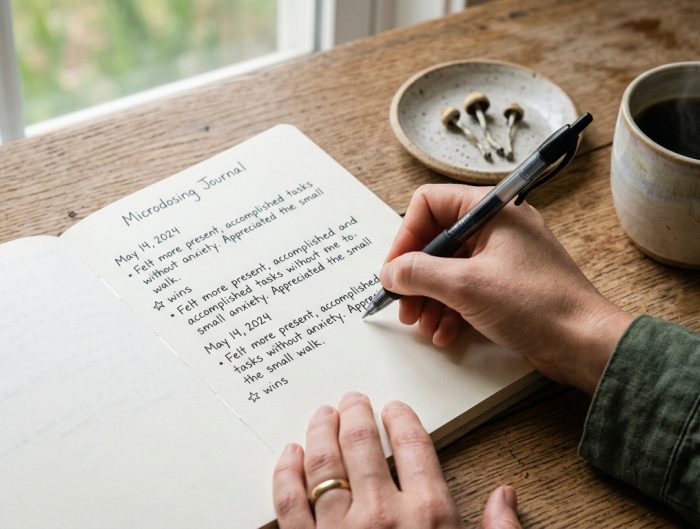
Think about it: if you wake up on a microdosing day with the intention of being more creative, you might also set up your workspace more thoughtfully, put on music that inspires you, clear your schedule of distractions, and approach your work with a sense of openness and curiosity. You might journal about your intentions beforehand, a practice we encourage at Healing Dose as part of a broader integration approach. All of these contextual factors could contribute to a more creative day, with or without a pharmacological boost from the substance itself.
This is not a criticism of microdosing. It is actually an argument for taking the practice seriously as a whole-person ritual rather than reducing it to a chemical input. If the act of microdosing prompts you to be more intentional about your creative practice, that intentionality has value regardless of what the substance is doing at a neurochemical level.
Some researchers have begun to frame microdosing as a “meaning-making practice” rather than a purely pharmacological intervention. The ritual of preparation, the act of taking the dose, the heightened attention to your own mental state throughout the day: all of these elements create a container for change that may be as important as the substance itself.
Neurobiological Hypotheses: Neuroplasticity and Connectivity
Even if the current evidence for cognitive enhancement is weak, there are plausible biological mechanisms that could explain why microdosing might influence creative thinking. The most discussed of these involves serotonin 2A receptor activation and its downstream effects on neural connectivity and plasticity.
Psilocybin and LSD both act primarily on serotonin 2A receptors, which are densely concentrated in the prefrontal cortex, a brain region heavily involved in abstract thinking, planning, and creative cognition. At full doses, activation of these receptors leads to dramatic changes in brain network connectivity, particularly a reduction in the activity of the default mode network (DMN), which is associated with habitual patterns of thought and self-referential processing.
The hypothesis is that even at sub-perceptual doses, there might be a subtle softening of these default patterns, allowing for more flexible and associative thinking. Some preliminary neuroimaging work has shown modest changes in functional connectivity at microdose-level doses, but the findings are inconsistent and the sample sizes are small.
There is also growing interest in the neuroplasticity angle. Animal studies have shown that low doses of psychedelics can promote the growth of new dendritic spines, the tiny projections on neurons that form synaptic connections. If this effect translates to humans, it could mean that repeated microdosing gradually increases the brain’s capacity for forming new associations, a process that would unfold over weeks or months rather than on any single dosing day.
This timeline aligns with what many experienced microdosers describe. The benefits are not immediate fireworks but rather a slow, cumulative shift in baseline patterns of thinking and feeling. You might not notice much on day one, but after several weeks of consistent practice combined with reflection and journaling, you start to recognize that your relationship to your creative work has changed in subtle but meaningful ways.
Ethical and Practical Considerations for the Future
The conversation about microdosing and creativity does not happen in a vacuum. It takes place within a complex web of legal restrictions, safety concerns, and ethical questions that shape both the research and the practice itself. If you are considering microdosing, or if you are already doing it, these practical realities deserve your attention just as much as the neuroscience.
Legal Barriers to Large-Scale Creative Research
The biggest obstacle to better research on microdosing is, frankly, the law. Psilocybin and LSD are classified as Schedule I substances in the United States and are similarly restricted in most other countries. This classification means that researchers face enormous bureaucratic and financial hurdles to conduct studies, even small ones.
Getting approval to administer a Schedule I substance in a clinical trial requires navigating the DEA, the FDA, institutional review boards, and a thicket of regulations that can add months or years to a study timeline. Funding is also a challenge: while organizations like the Usona Institute and MAPS have made significant progress in funding psilocybin research for conditions like depression and PTSD, creativity-focused studies are a lower priority and receive far less financial support.
The result is that most of what we know about microdosing comes from either self-report surveys or small studies with limited statistical power. We are making policy decisions and personal decisions based on incomplete data, which is uncomfortable but honest. The legal landscape is slowly shifting, with cities like Denver, Oakland, and Washington, D.C. decriminalizing psilocybin, and Oregon establishing a regulated psilocybin therapy program. These changes may eventually open the door to larger and more rigorous studies.
Until then, anyone interested in microdosing needs to be aware of the legal status in their jurisdiction. This is not a minor consideration. Possession of these substances carries serious legal consequences in many places, and no potential creative benefit is worth a criminal record. We encourage everyone to stay informed about local laws and to approach this topic with appropriate caution.
Long-term Safety Concerns and Physiological Risks
Beyond legality, there are genuine safety questions that the current research has not fully answered. Most microdosing studies have been short-term, lasting a few weeks at most. We do not have good data on what happens when someone microdoses regularly for months or years.
One specific concern involves cardiac health. Both psilocybin and LSD activate serotonin 2B receptors, which are found in heart valve tissue. Chronic activation of these receptors by other drugs (notably fenfluramine, the diet drug withdrawn from the market in the 1990s) has been associated with valvular heart disease. Whether microdose-level exposure carries any meaningful cardiac risk is unknown, but it is a legitimate concern that deserves more research.
Other potential considerations include:
- Tolerance buildup, which could lead to gradual dose escalation
- Interactions with psychiatric medications, particularly SSRIs and lithium
- Psychological discomfort or anxiety in people with a personal or family history of psychotic disorders
- The risk of developing psychological dependence on the practice, even if the substances themselves are not physically addictive
None of these risks are reasons to panic, but they are reasons to be thoughtful. If you are considering microdosing, a safety-first approach means starting with the lowest possible dose, keeping rest days in your protocol, tracking your experiences through journaling, and being honest with yourself about whether the practice is serving you well. At Healing Dose, we believe that self-awareness and reflection are not optional add-ons but essential components of responsible practice.
It is also worth mentioning that some people try microdosing and simply do not notice anything, or notice only mild discomfort like a slightly unsettled stomach or a vague sense of restlessness. Not every experience is positive, and that is okay. The honest reality is that individual variability is enormous, and there is no way to predict in advance exactly how you will respond.
The Honest Middle Ground
The relationship between microdosing and creativity is genuinely fascinating, but it resists simple answers. People report real shifts in how they think, create, and engage with their work. Controlled research has not yet confirmed these reports, and the placebo effect appears to play a significant role. The neuroscience offers plausible mechanisms but not definitive proof. And the legal and safety landscape adds layers of complexity that cannot be ignored.
If you take one thing from this discussion, let it be this: approach the topic with curiosity rather than certainty. The most thoughtful microdosers we have encountered are the ones who treat the practice as an experiment, not a guarantee. They journal, they reflect, they pay attention to what changes and what does not, and they are willing to adjust or stop if the practice is not serving them.
Whether the creative benefits of microdosing turn out to be primarily pharmacological, primarily psychological, or some combination of both, the practices that surround it, intentionality, reflection, openness to new patterns of thinking, have value on their own terms. Those are habits worth building regardless of what you put in a capsule.
If you are curious about finding a starting point that matches your goals and sensitivity, our short dosing quiz can help you think through the basics at your own pace. There is no rush, and there are no wrong questions. The most important step is simply being willing to learn.

You might also like