If you’ve been curious about microdosing but feel unsure about where to begin with amounts, schedules, and safety, you’re not alone. An estimated 10 million U.S. adults microdosed psilocybin, LSD, or MDMA in 2025, and the majority of those people started exactly where you are right now: cautious, a little overwhelmed, and looking for clear guidance. The good news is that getting started doesn’t require a chemistry degree or expensive equipment. What it does require is patience, precision, and a willingness to listen to your own body. This microdosing dosage guide covers the typical ranges people work with, the measurement methods that matter most, and the cautions you should take seriously before your first dose. Whether you’re drawn to psilocybin mushrooms or lysergamides like LSD, the principles of careful, intentional practice apply across the board. Let’s walk through it together, one step at a time.
Defining the Microdose: Thresholds and Typical Ranges
Before measuring anything, you need a clear understanding of what a microdose actually is and what it isn’t. The concept sounds simple on the surface: take a very small amount of a psychedelic substance, small enough that you don’t feel any overt perceptual changes. No visual distortions, no altered sense of time, no feeling “off” in social situations. The goal is sub-perceptual, meaning the dose sits below the threshold where you’d consciously notice psychoactive shifts.
Think of it like the difference between drinking three cups of coffee and taking a single sip. That sip still contains caffeine, and your body still processes it, but you’re not going to feel wired or jittery. A microdose works on a similar principle: it introduces a substance into your system at a level where the body responds, but the mind doesn’t get pulled into an altered state.
The reason this distinction matters is that many people accidentally take too much on their first attempt. They assume “small” means whatever feels small to them, rather than working from established reference points. Getting the range right from the start saves you from uncomfortable experiences and helps you build a consistent, reflective practice.
Standard Dosage Windows for Psilocybin and LSD
For psilocybin, the most commonly referenced microdose range falls between 0.1 and 0.3 grams (100 to 300 mg) of dried Psilocybe cubensis mushrooms. Most people who are new to the practice start at 0.1 grams and slowly work upward over several weeks. This conservative starting point gives you room to observe how your body responds without overshooting.
For LSD, the standard microdose window is typically between 5 and 20 micrograms. A full recreational dose of LSD often starts around 100 micrograms, so you’re working with roughly one-tenth to one-fifth of that amount. Because LSD is measured in micrograms rather than milligrams, precision becomes especially important, and we’ll cover the tools for that in the next section.
A few things to keep in mind about these ranges:
- They’re starting points, not prescriptions. Your ideal dose may fall at the low end, the high end, or somewhere in between.
- Psilocybin content varies between mushroom species and even between individual mushrooms of the same species.
- LSD tabs are notoriously inconsistent in dosage unless sourced from a highly reliable and tested supply.
- Body weight, metabolism, and individual sensitivity all play a role in how you respond.
The numbers give you a framework. Your own careful experimentation fills in the details.
The Sub-Perceptual Goal: Finding Your ‘Sweet Spot’
Your “sweet spot” is the dose where you notice subtle, positive shifts in your day without feeling impaired or distracted. Some people describe it as a gentle hum of energy, a slightly easier time focusing, or a quiet sense of emotional openness. Others notice nothing dramatic at all on dosing days but observe cumulative changes over weeks: better sleep, more patience, a slightly different relationship with stress.
Finding this sweet spot takes time and self-awareness. At Healing Dose, we encourage people to treat the first month as a calibration period rather than expecting immediate, obvious changes. Start at the lowest recommended amount. If after two or three dosing days you notice absolutely nothing, increase by a small increment, perhaps 0.025 grams for psilocybin or 2 to 3 micrograms for LSD.
If you notice any perceptual shifts, visual brightness, a sense of being “slightly high,” or difficulty concentrating in normal settings, that’s a signal you’ve gone past your sub-perceptual threshold. Drop back down. The sweet spot lives right below the line where you’d say, “I can feel something.” It’s a quiet place, and that quietness is the point.
Measurement Techniques and Precision Tools
Precision is one of the most practical aspects of a responsible microdosing practice, and it’s often the area where beginners underinvest their attention. Eyeballing a dose or breaking a tab into rough pieces introduces too much variability. When you’re working with amounts this small, even minor inconsistencies can mean the difference between a productive day and an uncomfortably stimulated one.
The measurement approach you use depends entirely on the substance you’re working with. Liquid lysergamides require a different technique than dried mushrooms, and each method has its own learning curve. Neither is particularly difficult once you understand the basics.
Volumetric Dosing for Liquid Lysergamides
Volumetric dosing is the gold standard for measuring LSD microdoses, and it’s simpler than it sounds. The idea is straightforward: you dissolve a known quantity of LSD into a measured volume of liquid, then use that liquid to portion out precise doses.
Here’s how the process typically works:
- Place a single tab of known dosage (for example, 100 micrograms) into a small glass container with a tight-fitting lid.
- Add a measured amount of distilled water or high-proof alcohol. Most people use 10 milliliters, which creates a solution where each milliliter contains 10 micrograms.
- Let the tab sit in the liquid for at least 24 hours, shaking gently a few times to ensure even distribution.
- Use an oral syringe (available at any pharmacy) to draw out your desired dose. If you want 10 micrograms, draw 1 milliliter. If you want 7 micrograms, draw 0.7 milliliters.
Store the solution in a dark, cool place, ideally in an amber glass bottle. LSD degrades with exposure to light and heat, so proper storage matters. The solution typically remains stable for several weeks to a couple of months when stored correctly.
The beauty of volumetric dosing is its consistency. Once you’ve prepared the solution, every dose is identical, which makes it much easier to track your responses and adjust over time.
Milligram Scales and Grinding for Dried Botanicals
Measuring dried psilocybin mushrooms requires a different approach because you’re dealing with a solid material that varies in potency from cap to stem and from one mushroom to the next. Two strategies help minimize this variability: grinding and weighing.
Start by grinding your dried mushrooms into a fine, uniform powder using a clean coffee grinder or herb grinder. This step is crucial because it homogenizes the psilocybin content across the entire batch. A single large mushroom might have more psilocybin concentrated in its cap than its stem, but once everything is ground together, each scoop of powder contains a more consistent concentration.
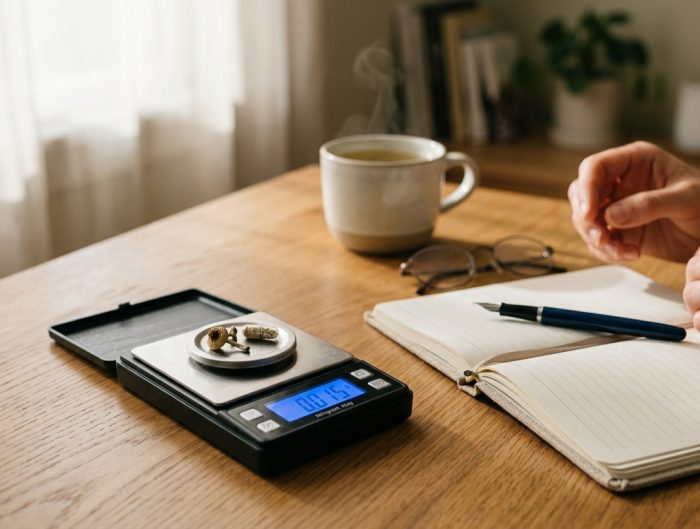
Next, you need a milligram-precision scale, sometimes called a jewelry scale or gem scale. These are widely available online for $20 to $40. Look for a scale that reads to 0.001 grams (1 milligram). Scales that only read to 0.01 grams aren’t precise enough for this purpose, since the difference between 0.10 grams and 0.15 grams is significant at microdose levels.
Weigh your powder on the scale and portion it into individual doses. Many people use small empty capsules (size 00 or 0) to store pre-measured doses, which also eliminates the taste issue that some find unpleasant. Label each capsule batch with the date and weight so you can maintain a clear record.
One common mistake is weighing whole dried mushrooms instead of ground powder. Because individual mushrooms vary so much in density and psilocybin content, this introduces unnecessary inconsistency. Always grind first, then weigh.
Common Protocols and Frequency Schedules
Once you’ve settled on a starting dose and have your measurement method dialed in, the next question is scheduling: how often do you take a microdose, and what does the pattern look like week to week? Two protocols dominate the conversation, and each has a different philosophy behind it.
The Fadiman Protocol vs. The Stamets Stack
The Fadiman Protocol, named after psychedelic researcher James Fadiman, follows a simple three-day cycle. Day one is your dosing day. Day two is a transition day where you don’t dose but may still notice residual subtle shifts. Day three is a full rest day with no residual effects. Then you repeat. This cycle means you’re dosing roughly twice per week, with built-in recovery time.
The Stamets Stack, associated with mycologist Paul Stamets, takes a different approach. It involves dosing for four consecutive days followed by three days off. Stamets also recommends combining the psilocybin microdose with lion’s mane mushroom and niacin (vitamin B3), a combination he believes may support neuroplasticity. The niacin component can cause a temporary flushing sensation, warmth and redness in the skin, which some people find uncomfortable.
Neither protocol is objectively “better.” The Fadiman approach tends to appeal to people who want more space between doses and prefer a gentler rhythm. The Stamets Stack suits those who want a more concentrated dosing window. Some people try both over separate months and compare their journal notes to see which pattern feels more aligned with their goals.
A third option that many experienced microdosers settle into is intuitive dosing: taking a microdose when they feel drawn to it, perhaps two or three times per week, without following a rigid schedule. This approach works best after you’ve spent several months on a structured protocol and have developed strong self-awareness around how microdosing affects your baseline.
The Importance of Integration and ‘Off’ Days
The days when you don’t dose are just as important as the days when you do. This is a concept we talk about frequently at Healing Dose because it’s the piece most people skip or undervalue. Off days serve two functions: they prevent tolerance buildup, and they give you space to notice what’s actually changing in your life.
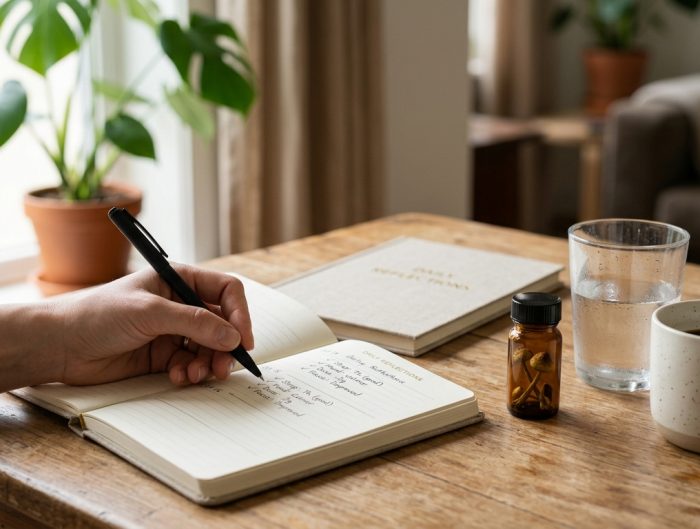
Integration means actively reflecting on your experiences rather than passively consuming a substance and hoping for the best. A simple journaling practice, even just three or four sentences each evening, can reveal patterns you’d otherwise miss. You might notice that your patience with a difficult coworker has quietly improved, or that you’ve been sleeping more deeply, or that a creative project suddenly feels less intimidating.
Without this reflective component, microdosing becomes just another thing you do in the morning, like taking a vitamin. The substance provides a nudge, but you have to meet it halfway with attention and intention. Write down how you feel on dosing days and off days. Note your energy levels, mood, sleep quality, and any moments that stood out. Over four to six weeks, these notes become incredibly valuable data about your own patterns.
Variables Influencing Individual Sensitivity
One of the most common frustrations beginners experience is comparing their response to someone else’s. Your friend might feel a gentle lift at 0.1 grams of psilocybin while you notice nothing until 0.2 grams. Or you might find that 0.15 grams feels like too much while someone else considers it barely noticeable. This variability is completely normal, and understanding why it happens can save you a lot of confusion.
Metabolism, Body Weight, and Personal Biochemistry
Your body processes psilocybin by converting it into psilocin, the compound that actually interacts with serotonin receptors in your brain. The speed and efficiency of this conversion varies from person to person based on liver enzyme activity, gut health, and overall metabolic rate. Someone with a faster metabolism might process a microdose more quickly, experiencing a shorter and potentially less noticeable window of subtle shifts.
Body weight plays a role, though it’s not as straightforward as “heavier people need more.” A 200-pound person and a 130-pound person might respond identically to the same dose, or they might not. Weight is one variable among many, and it’s less predictive than individual biochemistry.
Think of it like caffeine sensitivity. Some people can drink an espresso at 8 PM and sleep soundly by 10. Others feel jittery from a single cup of green tea. The same principle applies here. Your unique neurochemistry, including your baseline serotonin levels, receptor density, and genetic makeup, shapes your response in ways that no dosage chart can fully predict.
This is why the calibration period matters so much. Treat the first four to six weeks as an experiment with yourself as the subject. Start low, adjust slowly, and trust your own observations over anyone else’s reported experience.
Potency Variations in Natural vs. Synthetic Sources
If you’re working with psilocybin mushrooms, potency variation is a real and significant factor. Different species of psilocybin-containing mushrooms have wildly different concentrations of active compounds. Psilocybe cubensis, the most commonly cultivated species, contains roughly 0.6 to 0.7 percent psilocybin by dry weight on average. But Psilocybe azurescens, a species found in the Pacific Northwest, can contain up to 1.8 percent, nearly three times as much.
Even within a single species, potency varies based on growing conditions, harvest timing, and how the mushrooms were dried and stored. Two batches of Psilocybe cubensis from different growers might differ in psilocybin content by 30 to 50 percent. This is why grinding and homogenizing your supply is so important: it averages out the variation within a single batch, even if it can’t account for differences between batches.
Synthetic or semi-synthetic sources, like pharmaceutical-grade psilocybin or precisely laid LSD, offer more consistency. Each unit contains a known, tested amount. But access to lab-tested materials remains limited in most regions, which means most people are working with natural sources and need to account for this inherent variability.
The practical takeaway: whenever you start a new batch of mushrooms, treat it like a reset. Go back to your lowest dose and work upward again. Don’t assume that 0.15 grams from your previous batch will feel the same as 0.15 grams from a new one.
Key Cautions and Safety Considerations
Microdosing carries a reputation for being gentle and low-risk, and for most people, it is. But “low-risk” is not the same as “no-risk,” and there are specific situations where caution is essential. Taking these seriously isn’t about being fearful; it’s about being responsible with your own wellbeing.
RAND researcher Michelle Priest put it well when she noted that for those who use psychedelics, taking small doses is a big deal. The scale of this practice means that safety conversations need to keep pace with growing interest.
Contraindications and Pharmaceutical Interactions
The most critical safety concern involves interactions with existing medications, particularly SSRIs, SNRIs, MAOIs, and lithium. Both psilocybin and LSD interact with the serotonin system, and combining them with serotonergic medications can increase the risk of serotonin syndrome, a potentially dangerous condition characterized by agitation, rapid heart rate, high blood pressure, and in severe cases, seizures.
If you’re currently taking any psychiatric medication, do not begin microdosing without consulting a healthcare provider who is knowledgeable about psychedelic interactions. This isn’t a formality; it’s a genuine safety issue. Abruptly stopping psychiatric medication to start microdosing is also dangerous and should never be done without medical supervision.
Other contraindications to be aware of:
- A personal or family history of psychotic disorders, including schizophrenia or bipolar disorder with psychotic features, significantly increases risk.
- Pregnancy and breastfeeding: there is insufficient safety data to consider microdosing safe during these periods.
- Heart conditions: psilocybin and LSD can cause mild increases in heart rate and blood pressure, which may be relevant for people with cardiovascular concerns.
- Color blindness or visual snow syndrome: some anecdotal reports suggest that even microdoses can exacerbate certain visual conditions, though research is limited.
If none of these apply to you, the risk profile is considerably lower. But even healthy individuals should approach the practice with respect and awareness.
Managing Tolerance and Potential Psychological Risks
Tolerance to psilocybin and LSD builds quickly with frequent use. If you dose every day, you’ll likely find that the same amount produces diminishing responses within just a few days. This is one of the key reasons structured protocols include off days: they allow your receptors to reset and maintain sensitivity to the substance.
Some people respond to diminishing effects by increasing their dose, which is a pattern worth watching carefully. If you find yourself gradually creeping upward in dosage, it’s usually a sign that you need more rest days, not more substance. The goal of microdosing is not to chase a feeling but to support subtle, cumulative shifts over time.
On the psychological side, microdosing can occasionally amplify existing emotional states. If you’re going through a period of significant stress, grief, or anxiety, a microdose might make those feelings more vivid rather than less. This isn’t inherently harmful, but it can be uncomfortable and disorienting if you’re not expecting it.
A useful guideline: if you’re having a particularly difficult day emotionally, consider skipping your scheduled dose. Microdosing works best as a supplement to a stable baseline, not as a rescue tool during acute distress. Your journal entries will help you spot patterns here. If you notice that dosing during stressful periods consistently leads to heightened anxiety or rumination, adjust your schedule accordingly.
Monitoring Progress and Adjusting Your Regimen
The real value of a microdosing practice reveals itself not in any single day but in the gradual, quiet changes that accumulate over weeks and months. This is why tracking matters so much, and why we encourage everyone at Healing Dose to build a simple but consistent monitoring habit from day one.
Your tracking doesn’t need to be elaborate. A notebook, a spreadsheet, or even a notes app on your phone works fine. Record the date, your dose, whether it was a dosing or off day, and a few brief observations about your mood, energy, focus, sleep, and any notable moments. Rate your overall day on a simple 1-to-10 scale if that helps you spot trends.
After four weeks, review your notes. Look for patterns rather than isolated events. Are your average mood ratings slightly higher on dosing weeks compared to off weeks? Has your sleep quality shifted? Are you noticing more creative ideas, more patience, or more emotional steadiness? These are the kinds of subtle signals that matter.
Nearly half of the approximately 216 million days of psilocybin use reported in the past year involved microdosing, which tells us that millions of people are engaging with this practice regularly. But engagement without reflection is just consumption. The people who get the most from microdosing are the ones who pay attention, adjust thoughtfully, and treat the process as an ongoing conversation with themselves.
Adjustments should be small and deliberate. If you feel your current dose isn’t producing any noticeable shifts after six weeks of consistent practice and journaling, try increasing by 0.025 grams (psilocybin) or 2 micrograms (LSD). If you’re experiencing too much stimulation, drop back down. If your current protocol feels too rigid, experiment with a different schedule. The point is to stay curious and responsive rather than locked into a fixed routine.
Some people find that after several months of microdosing, they naturally feel ready to take an extended break, weeks or even months without dosing. This is healthy and worth honoring. The practice isn’t meant to be permanent or compulsory. It’s a tool, and like any tool, it’s most useful when you pick it up intentionally and set it down when the work is done.
With roughly 69% of adults who used psilocybin in the past year reporting that they microdosed at least once, this is clearly a practice that resonates with a wide range of people. Your version of it will look different from anyone else’s, and that’s exactly how it should be.
If you’re just getting started and want help narrowing down a sensible beginning dose based on your goals and personal sensitivity, our short quiz can point you in the right direction. It’s free, takes just a couple of minutes, and is designed to help you find your starting range with confidence rather than guesswork.
The most important thing you can do right now is give yourself permission to go slowly. There’s no rush, no competition, and no “right” timeline. Start low, pay attention, write things down, and trust that the quiet changes are the ones that tend to stick.