If you’ve ever felt like you absorb the world a little more deeply than most people around you, you’re not alone. Sensitivity is a real, measurable trait, and it shapes how you respond to everything from crowded rooms to a single cup of coffee. So it makes sense that the idea of microdosing, even at tiny amounts, might feel intimidating. You might worry about being overwhelmed, overstimulated, or simply “too sensitive” for something that other people describe as barely noticeable. Here’s the thing: your sensitivity isn’t a liability. It might actually be one of your greatest assets in this process, because you’re already wired to notice subtle shifts that others miss entirely. The key is learning how to work with your nervous system rather than against it. This guide is built for you: the cautious, the thoughtful, the person who reads three articles before trying anything new. We’ll walk through how to begin a microdosing practice that respects your sensitivity, honors your pace, and keeps overwhelm off the table. Whether you’re drawn to microdosing for emotional regulation, creative flow, or simply a gentler relationship with your own inner world, you deserve an approach that meets you where you are.
Understanding the Highly Sensitive Person (HSP) and Psychedelics
The concept of the Highly Sensitive Person was first identified by psychologist Elaine Aron in the 1990s, and it describes roughly 15 to 20 percent of the population. HSPs process sensory information more deeply than average. This isn’t a disorder or a weakness: it’s a temperament trait rooted in a more reactive nervous system. You might startle easily, feel drained after social gatherings, or pick up on emotional undercurrents that others seem oblivious to.
This heightened processing applies to everything you put into your body, including psychoactive substances. Where a friend might take a standard microdose and feel nothing remarkable, you might notice a gentle hum of energy, a shift in emotional texture, or even mild physical sensations that feel disproportionate to the tiny amount consumed. That’s your sensitivity doing exactly what it does best: amplifying input.
The growing interest in microdosing among sensitive individuals makes sense when you look at the numbers. An estimated 10 million US adults microdosed in 2025, citing reasons like improved mood, sharper focus, and enhanced creativity. Many of those people are likely HSPs drawn to the promise of emotional balance without the heavy side effects of conventional approaches.
Why HSPs Experience Substances More Intensely
Your nervous system has a lower threshold for stimulation. Think of it like a volume knob that’s already turned up a few notches higher than most people’s. When you introduce any substance, whether it’s caffeine, alcohol, or a psychedelic compound, your system registers it more acutely.
This is backed by clinical observation. Psychiatrist Judith Orloff has noted that empaths and sensitive people often require a much lower dose of medication to get a positive effect. What works for someone with average sensitivity might be twice what you need. And what’s sub-perceptual for them might produce noticeable shifts in your awareness, mood, or physical state.
This isn’t something to fear. It’s something to plan for. If you know you’re the person who feels one glass of wine while your friends are on their third, you already have useful data about your system. That same principle applies here. Your starting point will simply look different, and that’s not just okay, it’s smart.
The serotonin system plays a central role in this equation. Psilocybin and similar compounds interact primarily with 5-HT2A serotonin receptors, and HSPs tend to have more reactive serotonergic systems. This means the same dose can produce a wider range of responses in your body compared to someone with a less sensitive baseline.
The Potential Benefits of Microdosing for Emotional Regulation
One of the most common reasons HSPs explore microdosing is emotional regulation. When you feel everything intensely, the emotional highs can be beautiful, but the lows can be crushing. Many sensitive people describe a kind of emotional exhaustion that comes from simply being alive in a stimulating world.
Microdosing, at appropriate amounts, may support a gentler relationship with those emotional waves. Some people report that their reactions to stressful situations feel less automatic, as though there’s a small buffer of awareness between the trigger and the response. Others describe a quiet reduction in the inner critic: that voice that tells you you’re too much, too sensitive, too emotional.
These aren’t dramatic changes. They tend to show up as subtle shifts over weeks: a slightly easier morning, a conversation that doesn’t drain you quite as much, a creative idea that arrives without the usual self-doubt attached. At Healing Dose, we emphasize this kind of slow, cumulative change because it’s what actually sticks. The flashy promises you see elsewhere rarely reflect the real experience, especially for sensitive people who need gentleness above all.
It’s also worth understanding that roughly a fifth of people who microdose report some kind of negative psychological or physical effect. For HSPs, that risk may be slightly elevated simply because of how your system processes input. This isn’t a reason to avoid microdosing. It’s a reason to approach it with more care, more awareness, and a better plan.
The ‘Start Low, Go Slow’ Philosophy for Sensitive Systems
You’ve probably heard “start low, go slow” before. It’s standard advice for almost any new substance or practice. But for HSPs, this isn’t just a suggestion: it’s the entire foundation. The difference between a supportive experience and an overwhelming one often comes down to a fraction of a gram.
The goal of microdosing is to stay sub-perceptual, meaning you shouldn’t feel “high” or altered in any obvious way. For most people, a standard microdose of psilocybin falls between 0.05g and 0.25g. But if you’re highly sensitive, that upper range might already be too much. Your sweet spot could be significantly lower than what most guides recommend.
Think of it like adjusting the thermostat by half a degree instead of five. You’re looking for the smallest effective input, the point where something shifts without tipping into discomfort. This requires patience, honest self-observation, and a willingness to go slower than you might want to.
Defining a ‘Micro-Microdose’: Finding Your Threshold
A micro-microdose is exactly what it sounds like: a dose even smaller than the standard microdose range. For psilocybin, this might mean starting at 0.025g to 0.05g. For LSD, it could mean 2 to 5 micrograms instead of the commonly cited 10 to 15 micrograms. These amounts might seem almost absurdly small, and that’s the point.
Here’s a practical way to find your threshold:
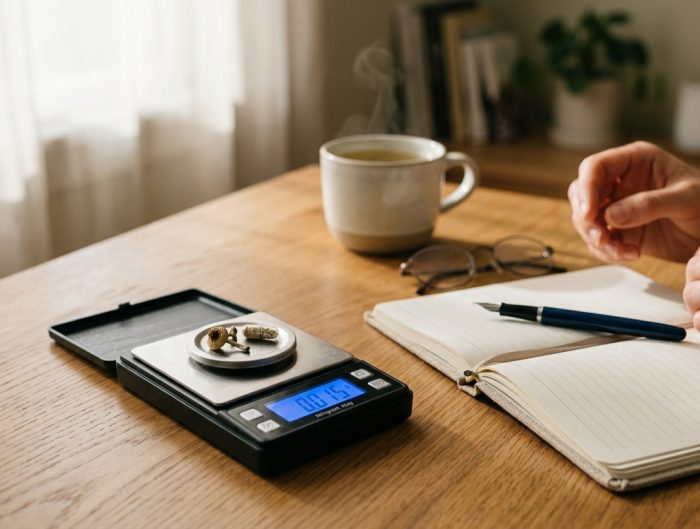
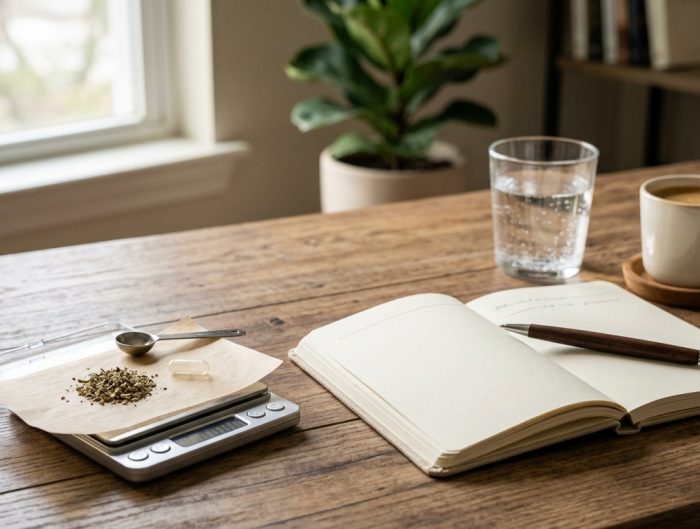
- Begin with the smallest measurable dose you can prepare accurately (a precision scale reading to 0.001g is essential for psilocybin).
- Take your first micro-microdose on a day with no obligations, ideally a calm morning at home.
- Note everything: mood, energy, physical sensations, appetite, sleep quality that night.
- If you felt nothing notable, including nothing negative, you can increase by a tiny increment (0.01g to 0.025g) on your next dosing day.
- Continue this gradual increase until you find the dose where you notice a subtle positive shift without any discomfort or overstimulation.
That sweet spot is your personal threshold. It might take three or four dosing days to find it, and that’s perfectly fine. Rushing this process is the single most common mistake sensitive people make. Your threshold might be half of what a friend uses, and that dose might work better for you than their larger one works for them.
I remember my own early experiments with microdosing: I started at what most guides called “the lowest recommended dose” and spent an entire afternoon feeling jittery and overstimulated. It wasn’t until I cut that amount in half that I found the quiet, grounded feeling I’d been looking for. That experience taught me that published ranges are averages, not prescriptions.
Choosing the Right Protocol: Fadiman vs. Every Other Day
The two most popular microdosing schedules are the Fadiman Protocol (one day on, two days off) and the every-other-day approach. For HSPs, the choice between them matters more than you might think.
The Fadiman Protocol gives you two full rest days between doses. This is often the better starting point for sensitive people because it allows your nervous system ample time to process and return to baseline. The pattern looks like this: dose on Monday, rest Tuesday and Wednesday, dose again Thursday, rest Friday and Saturday, and so on.
The every-other-day protocol (sometimes called the Stamets Protocol, though Stamets actually recommends four days on, three days off) provides less recovery time. Some HSPs find this too frequent, especially in the first few weeks. The cumulative effect of dosing every other day can build in a way that feels like background noise you can’t quite shake.
My suggestion: start with Fadiman’s schedule for at least three to four weeks. Pay close attention to how you feel on your rest days. If you feel clear, grounded, and stable, you might experiment with slightly more frequent dosing later. If your rest days feel necessary for recovery, that’s your body telling you exactly what it needs. Listen to it.
Some sensitive people eventually settle into their own custom rhythm, perhaps dosing twice a week on specific days that align with their schedule and energy patterns. There’s no single correct protocol. The best one is the one that supports your wellbeing without adding stress to your life.
Optimizing Set and Setting to Prevent Sensory Overload
“Set and setting” is a concept borrowed from psychedelic research, and it refers to your mindset (set) and your physical environment (setting). For full-dose experiences, this is considered essential. For microdosing, especially as a highly sensitive person, it’s just as important, though the details look different.
You won’t be having a psychedelic experience in the traditional sense. But your nervous system will be in a slightly more open, receptive state on dosing days. For someone who already absorbs environmental input deeply, this means your surroundings and mental state carry extra weight.
Managing Environmental Stimuli on Dosing Days
Plan your dosing days around calm, predictable routines. This doesn’t mean you need to sit in a dark room: it means being intentional about what you expose yourself to during the first few hours after dosing.
Some practical guidelines for your dosing-day environment:
- Keep your morning quiet. Avoid checking social media or the news for at least the first hour.
- Choose comfortable clothing. This sounds trivial, but HSPs often have heightened tactile sensitivity, and a scratchy tag or tight waistband can become genuinely distracting.
- If you work from home, start with your least stimulating tasks. Save the high-pressure calls or creative brainstorming for later in the day once you know how you’re feeling.
- If you work in an office or public space, consider dosing on days when your environment is calmer, or simply dose on weekends until you understand your response.
- Reduce auditory input. Noise-canceling headphones with gentle ambient music can be a lifeline for sensitive people on dosing days.
The goal isn’t to create a hermetically sealed bubble. It’s to give your system a gentle on-ramp rather than throwing it into the deep end. As you become more familiar with how microdosing affects you, you’ll naturally relax these guidelines. But in the beginning, treat your environment as part of the practice.
The Importance of Pre-Dose Intentions and Nervous System Regulation
Before you take your microdose, spend five to ten minutes calming your nervous system. This isn’t spiritual theater: it’s practical preparation. A regulated nervous system processes subtle inputs more clearly, and it’s less likely to interpret a new sensation as a threat.
Simple pre-dose practices that work well:
- Three to five minutes of slow, diaphragmatic breathing. Inhale for four counts, hold for four, exhale for six.
- A brief body scan, starting at your feet and moving upward, noticing where you’re holding tension.
- Setting a simple intention for the day. Not a grand goal, just a gentle focus. Something like “I’d like to notice moments of ease today” or “I’m curious about what feels different.”
The intention piece is especially valuable for HSPs because it gives your awareness a direction. Without it, your sensitivity can scatter outward, picking up on every stimulus around you. With an intention, you have a soft anchor point to return to throughout the day.
I’ve found that the days I skip this preparation are the days I’m most likely to feel scattered or mildly anxious. It only takes a few minutes, but those minutes create a container for the experience that makes everything else smoother. At Healing Dose, we consider this kind of preparation non-negotiable, not because it’s complicated, but because it’s the difference between a thoughtful practice and a random experiment.
Monitoring Effects and Adjusting Your Routine
Microdosing without tracking is like adjusting a recipe without tasting the food. You might get lucky, but you’re far more likely to miss important signals. For HSPs, those signals are often quieter than expected: not dramatic mood swings, but tiny shifts in how you move through your day.
The changes you’re looking for won’t announce themselves. They tend to whisper. A slightly easier time getting out of bed. A moment of patience with your partner that would normally have been irritation. A creative idea that arrives during your morning walk. These are the breadcrumbs that tell you something is working.
Tracking Subtle Shifts in Mood and Physical Sensation
Keep a simple journal, either on paper or in a notes app, and record a few observations on both dosing and rest days. Consistency matters more than detail. A few sentences each evening is plenty.
Track these categories:
- Mood: Rate your overall emotional state from 1 to 10, then add a sentence about what stood out. “Felt calmer than usual during my commute” is more useful than “good day.”
- Energy: Did you feel wired, steady, sluggish, or somewhere in between?
- Physical sensations: Any tension, lightness, digestive changes, or that subtle physical buzz some people describe?
- Sleep: How did you sleep the night before, and how did you sleep after a dosing day?
- Social interactions: Did conversations feel easier, harder, or about the same?
After three to four weeks, review your entries and look for patterns. You might notice that your mood scores are slightly higher on the day after dosing, or that your sleep improves on rest days. These patterns are your personal data, and they’re far more valuable than any generic guide.
One thing I wish someone had told me early on: some days will feel like nothing happened. That’s normal, and it doesn’t mean it’s not working. The absence of a bad day is itself a data point. Over time, you may notice that your baseline has shifted quietly upward, like the tide rising so gradually you don’t see it until the waterline has moved.
Recognizing Signs of Overstimulation and When to Take a Break
This is where honesty with yourself becomes critical. About 17% of microdosers report anxiety or depersonalization episodes, particularly at higher doses. For HSPs, these experiences can show up at doses that would be perfectly comfortable for less sensitive individuals.
Signs that your dose may be too high or your protocol too frequent:
- Persistent jitteriness or restlessness that doesn’t settle within a few hours
- Increased emotional reactivity rather than the gentle buffering you’re looking for
- Difficulty sleeping on dosing days
- A feeling of being “on” that you can’t turn off
- Heightened sensitivity to light, sound, or touch beyond your normal baseline
- A vague sense of unreality or disconnection
If you notice any of these, don’t push through. Take a full week off. When you return, reduce your dose by half and see how that feels. There’s no award for maintaining a schedule that doesn’t serve you.
It’s also important to know your personal risk factors. People with genetic variations in the COMT gene or a family history of schizophrenia face significantly elevated risks when working with psychedelic compounds. If this applies to you, please consult with a healthcare professional before beginning any microdosing practice.
Breaks aren’t failures. They’re part of the practice. Many experienced microdosers cycle through periods of active dosing and extended rest, finding that the integration periods are where the most meaningful changes consolidate.
Integration Practices for Long-Term Sensitivity Management
Microdosing without integration is like planting seeds and never watering them. The dose itself is only the input. What you do with the subtle shifts it produces determines whether those shifts become lasting patterns or fleeting moments that fade by Tuesday.
For HSPs, integration isn’t optional: it’s where the real work happens. Your natural depth of processing is actually an advantage here, because you’re already inclined toward reflection and self-awareness. The practices below simply give that inclination a structure.
Combining Microdosing with Somatic Therapy or Journaling
Somatic therapy works with the body’s stored tension and emotional patterns. For sensitive people, who often carry stress physically (tight shoulders, clenched jaw, shallow breathing), combining somatic practices with microdosing can create a powerful feedback loop. The microdose gently opens your awareness, and the somatic work gives that awareness somewhere productive to go.
You don’t need a therapist for basic somatic practices, though working with one can deepen the process significantly. Simple approaches include:
- Body scanning after your microdose to notice where sensations are concentrated
- Gentle shaking or tremoring exercises to release physical tension (look up TRE, or Trauma Release Exercises)
- Slow, mindful movement like yoga, tai chi, or even a walk where you focus on the physical sensations of each step
Journaling is the other essential integration tool. We talk about it constantly at Healing Dose because it’s the simplest way to turn a fleeting insight into a lasting shift. Your journal doesn’t need to be eloquent. It needs to be honest.
Some prompts that work well on dosing days:
- What felt different today, even slightly?
- Was there a moment where I responded to something in a way that surprised me?
- What did my body feel like at its calmest point today?
- Is there something I noticed that I want to pay attention to next time?
The cumulative effect of this practice is remarkable. After a month of entries, you’ll have a detailed map of your inner landscape that no external guide could ever provide. You’ll see your patterns, your growth edges, and your quiet victories written in your own words.
Navigating Social Interactions and High-Pressure Environments
One of the trickiest aspects of microdosing as an HSP is managing social situations. Your sensitivity to others’ emotions can feel amplified, even at sub-perceptual doses. A colleague’s frustration, a friend’s sadness, or the general tension of a crowded room might register more strongly than usual.
This doesn’t mean you should avoid people on dosing days. But it does mean having a plan.
If you know you have a socially demanding day ahead, consider whether it’s the right day to dose. Some HSPs prefer to keep their dosing days relatively quiet and social, saving more intense interactions for rest days when their baseline sensitivity is already familiar. Others find that microdosing actually helps them hold their ground in social settings without absorbing everyone else’s energy.
The only way to know which camp you fall into is to experiment, carefully. Start with low-stakes social situations: a coffee with a close friend, a casual team meeting, a phone call with someone you trust. Notice how your energy feels afterward compared to your usual pattern.
For high-pressure environments like presentations, difficult conversations, or large gatherings, I’d recommend waiting until you have at least four to six weeks of microdosing experience before testing those waters. You want to know your dose, your response patterns, and your coping strategies before adding high-stimulus variables.
A simple grounding technique for moments when social overwhelm starts creeping in: press your feet firmly into the floor, take three slow breaths, and silently name five things you can see. This pulls your attention back into your own body and out of the emotional field around you. It works whether or not you’ve microdosed that day, and it’s a skill that gets stronger with practice.
Remember that 92% of serious adverse events related to microdosing are linked to lack of supervision or contaminated substances. Source quality and careful preparation are non-negotiable safety measures, regardless of your sensitivity level.
Finding Your Own Rhythm
Starting a microdosing practice as a highly sensitive person isn’t about overcoming your sensitivity. It’s about honoring it. Your nervous system isn’t broken: it’s finely tuned. The approach that works for you will look different from what works for someone with a higher threshold, and that’s exactly how it should be.
Go smaller than you think you need to. Go slower than feels necessary. Track everything. Rest without guilt. And trust that the quiet changes, the ones you almost miss, are often the most meaningful ones.
If you’re ready to figure out where to begin, our short quiz can help you find your starting range based on your goals, your experience level, and your unique sensitivity. It takes just a few minutes and gives you a personalized starting point so you’re not guessing.
Your sensitivity brought you here. Let it guide you forward, one careful step at a time.