Something quiet is happening across the country. An estimated 10 million U.S. adults microdosed psilocybin, LSD, or MDMA in 2025, and interest in the practice has been building for nearly a decade. Google searches for microdosing-related terms jumped 1,250% between 2015 and 2023, a sign that curiosity is outpacing the available guidance. If you’re reading this, you’re probably part of that wave of curiosity, and you’re smart enough to want to do this thoughtfully. Microdosing with intention starts well before the first dose: it starts with honest questions. The ones you ask yourself now, in this quiet moment of consideration, will shape everything that follows. This isn’t about rushing toward a new experience. It’s about pausing long enough to understand what you’re really looking for, whether you’re genuinely ready, and how to set yourself up for something meaningful rather than haphazard. The simple questions outlined here are designed to help you build that foundation, one honest answer at a time.
The Philosophy of Intentional Microdosing
There’s a difference between doing something and doing something on purpose. You can take a walk, or you can walk with the specific aim of clearing your mind after a hard conversation. The activity is the same; the quality of the experience is not. Microdosing works the same way. When you approach it with clear intention, you create a container for the experience: a framework that helps you notice subtle shifts, make sense of what you observe, and adjust your approach over time.
Intentional microdosing means treating the practice as a form of self-inquiry rather than a passive experiment. You’re not just ingesting a sub-perceptual amount of a substance and hoping for the best. You’re actively participating in a process of observation, reflection, and gentle course correction. That participation is what separates people who find the practice genuinely useful from those who try it for a few weeks and shrug.
At Healing Dose, we talk about this a lot: the substance itself is only one piece of the puzzle. Your mindset, your environment, your willingness to sit with discomfort, your commitment to honest self-reflection: these are the elements that give microdosing its shape and depth. Without them, you’re just taking a very small amount of something and hoping it does the work for you. That’s not how this works.
Moving Beyond Recreational Use
Recreational use and intentional microdosing exist on entirely different spectrums. Recreational use is about altering your state of consciousness for pleasure or novelty. Microdosing, by contrast, operates at the sub-perceptual threshold, meaning the dose is small enough that you shouldn’t feel noticeably altered. A typical microdose of psilocybin mushrooms is around 200 mg, or 0.2 grams, while microdoses of LSD typically range from 5 to 20 micrograms. These amounts are deliberately small.
The goal isn’t to feel “something happening.” The goal is to create conditions where quiet changes can emerge over time. Think of it like adjusting the thermostat by one degree: you probably won’t notice the shift in the first five minutes, but over the course of a day, the room feels different. People who approach microdosing with a recreational mindset often feel disappointed because they’re looking for an event. Intentional microdosers are looking for a pattern.
This distinction matters because it shapes how you evaluate the practice. If you’re waiting for a dramatic moment of clarity on dose day, you’ll likely conclude that nothing is working. But if you’re tracking your mood, sleep quality, creative output, and emotional responses over the course of weeks, you might notice that your baseline has shifted in ways you didn’t expect. The changes are cumulative, not instantaneous.
The Role of Mindset and Setting
“Set and setting” is a concept borrowed from the broader psychedelic conversation, and it applies to microdosing too, just in a quieter register. “Set” refers to your mindset: your emotional state, your expectations, your fears, your hopes. “Setting” refers to your physical and social environment: where you are, who you’re with, what your day looks like.
Before you begin, ask yourself: what am I bringing to this? If you’re starting from a place of desperation, hoping that microdosing will fix everything that feels broken, that desperation will color your experience. You’ll be hypervigilant for changes, frustrated when they don’t appear on your timeline, and prone to abandoning the practice prematurely. A calmer starting point, one rooted in curiosity rather than urgency, tends to produce a more sustainable relationship with the practice.
Your setting matters too. If your daily life is chaotic, stressful, and devoid of quiet moments for reflection, you’ll have a harder time noticing the subtle shifts that microdosing may support. This doesn’t mean your life needs to be perfectly calm before you start. It means you should be honest about the conditions you’re working within, and realistic about what any single practice can do inside those conditions.
Clarifying Your ‘Why’ and Desired Outcomes
This is the question that deserves the most time, and it’s the one most people rush past. Why do you want to microdose? Not the surface answer: the real one. “I want to feel better” is a starting point, not a destination. Better how? Better compared to what? What does “better” look like on a Tuesday afternoon when nothing special is happening?
Getting specific about your “why” serves two purposes. First, it gives you something to measure against. If you know that you’re exploring microdosing because you want to feel less reactive during stressful conversations at work, you now have a concrete behavior to observe. Second, it helps you recognize when the practice is working in ways you didn’t anticipate. Maybe your reactivity at work doesn’t change much, but you notice you’re sleeping more deeply or feeling more patient with your kids. Without a clear starting intention, those observations float by unnoticed.
Write your “why” down. Put it somewhere you’ll see it. Revisit it after a few weeks and see if it still feels accurate. Intentions evolve, and that’s fine. But you need a starting point.
Identifying Emotional or Cognitive Goals
Most people considering microdosing have either emotional or cognitive goals, and sometimes both. Emotional goals might include feeling less anxious in social situations, experiencing more ease in your body, or noticing a reduction in the low-grade sadness that seems to follow you around. Cognitive goals might include improved focus during work, greater creative fluidity, or the ability to hold complex problems in your mind without feeling overwhelmed.
Be as specific as you can. “I want to be happier” is hard to measure. “I want to notice when I’m spiraling into negative self-talk and have an easier time interrupting that pattern” is something you can actually track. The more precise your goal, the more useful your observations will be.
Here are some questions to help you clarify:
- What feeling or pattern am I most hoping to shift?
- When during my day or week does this pattern show up most clearly?
- What would a 10% improvement in this area actually look like?
- Am I looking for emotional relief, cognitive support, or something else entirely?
Don’t worry if your answers feel small or mundane. The most meaningful shifts in a microdosing practice tend to be exactly that: small and mundane. A slightly sparkly quality to your morning. A moment where you choose patience instead of irritation. A day where the background noise of anxiety drops to a gentle hum instead of a roar.
Distinguishing Between Relief and Growth
This is a distinction worth sitting with. Are you looking for relief from something difficult, or are you looking for growth toward something new? Both are valid, but they ask different things of you.
Relief-oriented goals are about reducing suffering. You’re in pain, whether emotional, cognitive, or existential, and you want that pain to lessen. There’s nothing wrong with this motivation. But it’s worth being honest about the degree of your suffering, because microdosing is not a substitute for professional mental health support. If you’re in crisis, please reach out to a qualified professional first.
Growth-oriented goals are about expansion. You’re functioning reasonably well, but you sense there’s more available to you: more creativity, more presence, more connection. You’re not trying to escape something; you’re trying to move toward something. This motivation tends to pair well with microdosing because it comes with less pressure and more openness.
Many people carry both motivations simultaneously, and that’s perfectly normal. The point of this question isn’t to choose one or the other. It’s to understand the proportions, because they’ll influence how you evaluate your experience and how much patience you’ll need with the process.
Self-Assessment: Am I Ready for This Practice?
Readiness isn’t about meeting some ideal standard of emotional health or lifestyle perfection. It’s about being honest with yourself about where you are right now and whether this is a good time to add something new to your life. Sometimes the answer is “not yet,” and that’s a perfectly valid conclusion. Knowing when to wait is its own form of wisdom.
The questions in this section are designed to help you assess your current conditions without judgment. Think of them as a weather check before a hike: you’re not looking for perfect conditions, just conditions you can work with safely.
Evaluating Current Mental and Physical Health
Start with the basics. How are you sleeping? How is your appetite? Are you managing any chronic physical conditions? Are you currently taking medications, particularly psychiatric medications like SSRIs, SNRIs, or lithium? Some of these medications interact with psychedelic substances in ways that are poorly understood, and combining them without professional guidance is genuinely risky.
If you have a personal or family history of psychotic disorders, bipolar disorder, or severe dissociative experiences, this is a conversation to have with a healthcare provider, not a blog. We say this not to gatekeep the practice but because safety comes first, always. One of the things we emphasize at Healing Dose is that responsible exploration means knowing where your boundaries are.
Ask yourself these questions honestly:
- Am I currently in a mental health crisis or experiencing severe emotional instability?
- Am I taking any medications that might interact with psychedelic substances?
- Do I have a history of psychosis, mania, or severe dissociation?
- Am I using microdosing as a replacement for professional support I actually need?
If any of these give you pause, slow down. There’s no rush. The practice will still be here when the timing is right.
Your physical health matters too. Fatigue, chronic pain, hormonal shifts, and nutritional deficiencies all influence how your body and mind respond to any new input. You don’t need to be in peak physical condition, but you should have a baseline understanding of how you’re doing physically so you can notice changes accurately.
Assessing Your Support System and Environment
Microdosing doesn’t happen in a vacuum. You live in a world with other people, responsibilities, and stressors, and all of these shape your experience. Before you begin, take stock of your environment.
Do you have someone you trust enough to talk to about this practice? You don’t need a full support team, but having at least one person who knows what you’re doing and can offer a grounded perspective is valuable. This person doesn’t need to be an expert. They just need to be someone who will listen without judgment and gently tell you if they notice something concerning.
Your living situation matters too. If you share a home with people who would be stressed or upset by your practice, that tension will affect your experience. If your work schedule is so demanding that you have no time for reflection, you’ll struggle to integrate what you observe. None of these are dealbreakers, but they’re factors to weigh honestly.
Consider the practical realities as well. Do you have a private space where you can journal and reflect? Is your schedule stable enough to maintain a consistent protocol? Can you commit to this for at least four to six weeks before evaluating whether it’s working? These aren’t trivial questions. The consistency of your practice matters as much as the substance itself.
Defining the Logistics of Your Protocol
Once you’ve clarified your intentions and assessed your readiness, you need a plan. Not a rigid one: a flexible framework that gives you structure without making the practice feel clinical or burdensome. The logistics of microdosing are simpler than most people expect, but they do require some upfront thought.
Choosing a Schedule and Dosage Method
Several established protocols exist, and each has its own rhythm. The Fadiman Protocol, developed by Dr. James Fadiman, involves dosing on day one, taking days two and three off, and then dosing again on day four. The Stamets Protocol, associated with mycologist Paul Stamets, suggests four consecutive days on followed by three days off. Some people prefer a simpler every-other-day approach or even a twice-weekly schedule.
There’s no single “correct” protocol. The best one is the one you can maintain consistently and that gives you enough off-days to notice the contrast between dose and non-dose days. That contrast is important: it’s how you learn what the substance is actually contributing versus what’s just a good day.
For dosage, start at the low end of the established range. For psilocybin, that might mean 50 to 100 mg rather than the commonly cited 200 mg. For LSD, 5 to 8 micrograms rather than 15 to 20. You can always increase gradually. You can’t undo a dose that was too high. Think of it like caffeine sensitivity: some people feel jittery after half a cup of coffee while others can drink a full pot without blinking. Your sensitivity is yours, and you’ll only discover it through careful, patient experimentation.
Plan to take your microdose in the morning, ideally on a day when you don’t have high-pressure obligations. Not because anything dramatic will happen, but because you want the mental space to notice how you feel without the distraction of a packed schedule. As you become more familiar with your response, you can adjust the timing to fit your life.
Planning for Observation and Adjustment
A protocol without a plan for observation is just a schedule. The real value of microdosing with intention comes from what you notice and how you respond to those observations. Before your first dose, decide how you’re going to track your experience.
Some people prefer a simple daily rating system: mood on a scale of 1 to 10, energy level, sleep quality, notable emotional moments. Others prefer open-ended journaling where they write whatever comes to mind. Both approaches work. The key is consistency. If you only journal on days when something interesting happens, you’ll miss the gradual shifts that unfold over weeks.
Build in a formal review point. After two weeks, sit down with your notes and look for patterns. After four weeks, do it again. Are you noticing any changes in the areas you identified as goals? Are there unexpected shifts, positive or negative, that you didn’t anticipate? Has your “why” evolved?
Be prepared to adjust. If a dose feels too high, even slightly, lower it. A subtle physical buzz or a gentle hum of energy is one thing; feeling distracted, overstimulated, or emotionally raw is a signal to pull back. Some days, nothing happens at all, and that’s fine. Not every dose day will feel noteworthy. The practice is about the arc, not the individual data points.
Integrating the Experience into Daily Life
Here’s where many people stumble. They get the logistics right: the dosage, the schedule, the substance. But they skip the integration work, and without it, the practice stays shallow. Integration is what turns a temporary experience into lasting behavioral change. It’s the bridge between “I felt slightly different on Tuesday” and “I’ve noticed a genuine shift in how I respond to stress over the past two months.”
Journaling and Tracking Progress
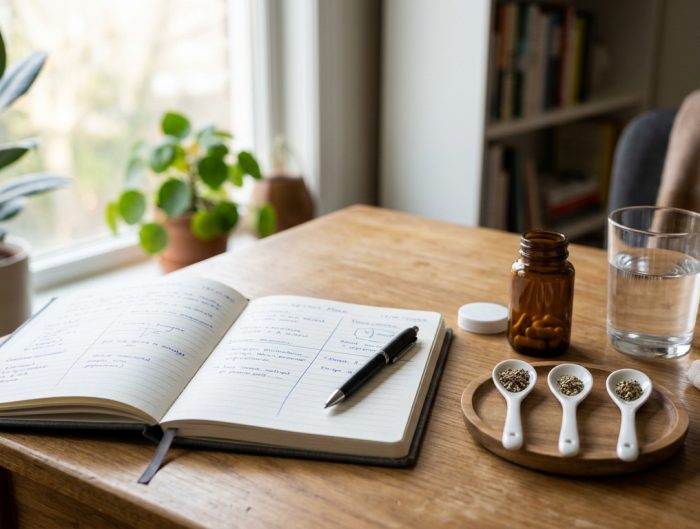
If there’s one non-negotiable recommendation we make at Healing Dose, it’s this: keep a journal. It doesn’t need to be elaborate. A few lines each day are enough. But the act of writing forces you to translate vague internal sensations into specific language, and that specificity is what makes patterns visible over time.
Here’s a simple framework you can use:
- Date, dose day or off day, dosage amount
- Morning mood and energy level (1-10 scale)
- One or two sentences about your emotional state
- Any notable moments: interactions, creative insights, physical sensations, dreams
- Evening reflection: how did the day compare to your expectations?
Don’t judge what you write. Some entries will feel boring or repetitive. That’s expected. The value emerges when you read back through several weeks of entries and notice threads you couldn’t see in real time. Maybe you realize that your best days aren’t dose days at all, but the days after. Maybe you notice that your anxiety tends to spike on the third off-day. These patterns are gold, and you’ll only find them if you’ve been writing consistently.
Resist the urge to evaluate the practice too early. Two weeks is not enough time to draw meaningful conclusions. Give yourself at least a full month, ideally six to eight weeks, before you decide whether the practice is serving you. The changes are often so quiet that you don’t recognize them until someone else points them out or you read your own journal from three weeks ago and realize how different you sound.
Maintaining Mindfulness Outside of Dose Days
One of the most common misconceptions about microdosing is that the substance does the heavy lifting. It doesn’t. The substance creates a subtle opening, a slightly different quality of attention, a gentle loosening of habitual patterns. What you do with that opening is up to you.
Off-days are just as important as dose days. They’re when you practice the skills that microdosing may be supporting: presence, patience, emotional regulation, creative engagement. If you only pay attention to your inner life on dose days, you’re missing the point. The goal is to build a more reflective, self-aware relationship with your own mind, and that relationship doesn’t take days off.
Simple practices that support this integration include:
- A five-minute morning check-in where you notice your mood, energy, and any physical sensations before the day gets busy
- Brief pauses throughout the day to ask yourself “How am I feeling right now?” without trying to change the answer
- An evening review where you note one thing that went well and one thing that felt difficult
- Regular time in nature, even just a short walk, to ground yourself in sensory experience
These aren’t complicated practices, and none of them require a microdose to be valuable. They’re the foundation that makes the microdosing practice meaningful. Without them, you’re relying entirely on the substance, and that’s a fragile strategy. With them, you’re building a practice of self-awareness that the microdose gently supports.
The psychedelic drugs market is projected to grow from USD 2.04 billion in 2026 to USD 5.16 billion by 2034, which means more people will be exploring these practices in the coming years. That growth makes the need for intentional, well-informed approaches even more pressing. As one researcher noted, “psychedelics are becoming a mainstream public health issue and microdosing seems to be a fashionable trend, with policy and beliefs moving faster than the evidence.” Being thoughtful now puts you ahead of the curve.
Final Reflections for a Conscious Journey
The questions you’ve considered here: your motivations, your readiness, your protocol, your integration plan: are not boxes to check. They’re invitations to know yourself a little better before you begin something new. That self-knowledge is the real foundation of the practice. The substance is just one ingredient.
If you’ve read this far and feel more uncertain than when you started, that’s actually a good sign. It means you’re taking this seriously. Uncertainty is a much better starting point than overconfidence. You don’t need to have all the answers right now. You just need to be willing to keep asking the questions, honestly, as you go.
If you’re ready to take a practical next step, our microdose quiz can help you find your starting range based on your goals, experience level, and personal sensitivity. It’s a gentle way to move from reflection into action, at whatever pace feels right for you.
Whatever you decide, go slowly. Pay attention. Write things down. And trust that the quiet, undramatic shifts are often the ones that matter most.