Two of the most discussed plant medicines in the psychedelic space share a common thread: they both work primarily through serotonin receptors, and they both have centuries of ceremonial use behind them. Yet the experience of drinking ayahuasca in a candlelit maloca is profoundly different from sitting quietly with a dose of psilocybin mushrooms in a therapist’s office. If you’re weighing ayahuasca against psilocybin, you’re not just comparing two substances: you’re comparing two entire frameworks for inner work, each with its own rhythm, risks, and rewards. The right choice depends on your intentions, your physical and psychological readiness, and the kind of container you feel safest in. This guide walks through the key differences honestly, without hype, so you can make a thoughtful decision that respects both your curiosity and your well-being.
The Core Differences: Botany, Chemistry, and Tradition
Before comparing subjective experiences or therapeutic potential, it helps to understand what these substances actually are at a molecular level and where they come from culturally. Both ayahuasca and psilocybin have deep roots in indigenous practice, but they emerged from entirely different ecosystems, traditions, and pharmacological mechanisms. Knowing the basics of each will ground your decision-making in something more solid than anecdote.
The Amazonian Brew: DMT and MAOIs
Ayahuasca is not a single plant. It’s a brew, traditionally made from two key ingredients: the Banisteriopsis caapi vine and the leaves of Psychotria viridis (sometimes called chacruna). The chacruna leaves contain N,N-dimethyltryptamine, or DMT, which is a powerful psychoactive compound that your body actually produces in small amounts naturally. On its own, though, DMT taken orally would be broken down by monoamine oxidase enzymes in your gut before it ever reached your brain.
That’s where the vine comes in. Banisteriopsis caapi contains beta-carboline alkaloids: harmine, harmaline, and tetrahydroharmine: that function as monoamine oxidase inhibitors (MAOIs). These compounds temporarily disable the enzymes that would normally destroy DMT, allowing it to cross the blood-brain barrier and produce its characteristic visionary effects. It’s a remarkably sophisticated pharmacological pairing, and the fact that indigenous Amazonian peoples identified this combination among tens of thousands of plant species remains one of the great mysteries of ethnobotany.
The brew has been used for centuries, possibly millennia, by indigenous groups across the Amazon basin, including the Shipibo-Conibo, the Asháninka, and many others. In these traditions, ayahuasca is not recreational. It’s regarded as a teacher plant, used for diagnosis of illness, spiritual communication, and community decision-making. A curandero or ayahuascero typically prepares and serves the brew in ceremony, guiding participants through the experience with icaros (sacred songs) and energetic work.
In 2026, ayahuasca ceremonies take place not only in the Amazon but in retreat centers across Costa Rica, Portugal, the Netherlands, and elsewhere. The legal status varies significantly by country. In the United States, ayahuasca remains a Schedule I substance, though certain religious organizations like the União do Vegetal (UDV) and Santo Daime have won legal exemptions for ceremonial use.
The Sacred Mushroom: Psilocybin and Psilocin
Psilocybin mushrooms belong to the genus Psilocybe, with over 200 known species found on every continent except Antarctica. The most commonly used species is Psilocybe cubensis, though others like Psilocybe semilanceata and Psilocybe azurescens are also well-known. These mushrooms contain the prodrug psilocybin, which your body converts into psilocin through a process called dephosphorylation. Psilocin is the compound that actually binds to serotonin 5-HT2A receptors in your brain and produces psychoactive effects.
Unlike ayahuasca’s two-plant MAOI system, psilocybin’s mechanism is more straightforward. You ingest the mushroom, your body converts psilocybin to psilocin, and psilocin does the work. There’s no need for an enzyme inhibitor because psilocin survives the digestive process on its own.
The cultural history of psilocybin mushrooms is equally rich, though geographically distinct. Mesoamerican cultures, particularly the Mazatec people of Oaxaca, Mexico, have used psilocybin mushrooms in ceremonial contexts for centuries. The Aztecs called them teonanácatl, meaning “flesh of the gods.” The modern Western encounter with psilocybin mushrooms is often traced to R. Gordon Wasson’s 1957 Life magazine article about his experience with Mazatec curandera María Sabina, though this popularization came with significant ethical complications for the Mazatec community.
In 2026, psilocybin occupies a unique regulatory position. Oregon’s regulated psilocybin services program has been operational for over two years. Colorado’s framework is expanding access. Australia approved psilocybin for treatment-resistant depression in 2023 through authorized psychiatrists. Clinical trials at Johns Hopkins, NYU, and Imperial College London continue to produce compelling data. While psilocybin remains federally scheduled in the U.S., the momentum toward regulated therapeutic access is undeniable.
Comparing the Subjective Experience
Understanding the chemistry is one thing. Knowing what it actually feels like to sit with each of these medicines is another. The subjective differences between ayahuasca and psilocybin are significant, and they matter a great deal when you’re trying to decide which path feels right for you.
Duration and Intensity: Short Journey vs. Long Pilgrimage
One of the most practical differences is time. A psilocybin experience typically lasts four to six hours, with the peak occurring roughly two to three hours after ingestion. For many people, this feels like a manageable window. You can prepare in the morning, move through the experience during the day, and be in a relatively grounded state by evening. The comedown is usually gentle, often described as a quiet, reflective space where insights begin to settle.
Ayahuasca, by contrast, is a longer commitment. A single ceremony typically lasts four to six hours, but the active period can stretch to eight hours in some cases. Many retreat formats involve multiple ceremonies over several days: three ceremonies across a week is common, and some intensive retreats include five or more. Each ceremony builds on the previous one, and the cumulative effect is part of the design. You’re not just having one experience; you’re moving through a multi-night process.
The intensity profiles also differ. Psilocybin’s onset is gradual: you might notice a shift in perception 20 to 40 minutes after eating the mushrooms, with effects building steadily. With ayahuasca, the onset can be more abrupt and the intensity can fluctuate in waves throughout the ceremony. Some people describe ayahuasca as arriving in distinct “chapters,” each with its own emotional texture, separated by periods of relative calm.
A moderate psilocybin dose (2 to 3.5 grams of dried Psilocybe cubensis) can produce profound perceptual changes, emotional openness, and mystical-type experiences. Ayahuasca’s intensity is harder to standardize because the DMT content of the brew varies significantly depending on preparation. This variability is one reason why the ceremonial container and the experience of the person serving the medicine matters so much.
Visuals, Purging, and Physical Sensations
Both substances can produce vivid visual phenomena: geometric patterns, color intensification, and closed-eye imagery that ranges from abstract to deeply narrative. Ayahuasca’s visuals, however, are often described as more elaborate and story-like. People frequently report encountering entities, animals, or symbolic scenes that feel personally meaningful. Psilocybin visuals tend to be more organic and fluid: breathing surfaces, fractal patterns in nature, enhanced appreciation of light and color.
The most distinctive physical difference is purging. Ayahuasca frequently induces vomiting, and sometimes diarrhea. This is not a side effect in the traditional framework: it’s considered a central part of the process, an energetic and physical cleansing. Most ceremonial facilitators view purging as the medicine doing its work, releasing stored tension, grief, or toxicity from the body. Buckets are standard equipment at any well-run ceremony.
Psilocybin can cause nausea, particularly during the come-up phase, but sustained vomiting is much less common. Some people experience stomach discomfort that passes within the first hour. Techniques like making tea instead of eating whole mushrooms, or using lemon tek (soaking ground mushrooms in lemon juice), can reduce gastrointestinal distress.
Other physical sensations differ too. Ayahuasca often produces a heavy, sometimes overwhelming body load: feelings of heat, pressure, or energetic movement through the torso and limbs. Psilocybin’s body sensations are typically lighter: a subtle physical buzz, tingling in the extremities, or a sense of bodily dissolution at higher doses. Neither experience is purely mental. Both medicines remind you, sometimes forcefully, that you have a body.
Therapeutic Potential and Mental Health Benefits
Research into both substances has accelerated dramatically since the early 2020s, and by 2026, the evidence base is substantial enough to draw meaningful comparisons. Both show genuine promise for specific mental health challenges, though the research maturity differs considerably.
Psilocybin for Depression and End-of-Life Anxiety
Psilocybin is the most clinically studied psychedelic compound in the world right now. Multiple Phase II and Phase III clinical trials have demonstrated statistically significant reductions in depression scores for people with treatment-resistant depression and major depressive disorder. The landmark COMPASS Pathways Phase IIb trial and subsequent studies showed that a single 25mg psilocybin session, combined with psychological support, produced sustained improvements in depression scores at 3-week, 6-week, and even 12-month follow-ups in some cohorts.
The evidence for end-of-life anxiety is particularly compelling. Studies at Johns Hopkins and NYU found that psilocybin-assisted therapy produced rapid and sustained decreases in anxiety and depression in patients with life-threatening cancer diagnoses. Many participants rated the experience as one of the most meaningful of their lives, and the effects persisted for months. This work has been influential in shifting regulatory attitudes.
Psilocybin also shows early promise for obsessive-compulsive disorder, alcohol use disorder, and tobacco addiction. A 2023 Johns Hopkins study found that psilocybin-assisted therapy produced an 80% abstinence rate for smoking cessation at 6-month follow-up, far exceeding conventional approaches.
The clinical model for psilocybin typically involves preparation sessions with a therapist, the medicine session itself in a controlled environment, and integration sessions afterward. This structure: prepare, experience, integrate: is considered essential to the therapeutic outcome. The molecule alone isn’t doing the work. Your engagement with the experience, and the meaning you make of it afterward, is what drives lasting change.
Ayahuasca for Trauma Recovery and Addiction
Ayahuasca research is less advanced in terms of randomized controlled trials, but the observational and preliminary clinical evidence is growing. Several studies have found significant reductions in depression and anxiety scores following ayahuasca use, including a notable 2019 open-label trial published in Psychological Medicine. Research from the University of São Paulo and other Brazilian institutions has been particularly active in this area.
Where ayahuasca shows distinctive promise is in trauma recovery and addiction. The extended duration of the experience, combined with the purging process and the ceremonial container, seems to facilitate a kind of deep emotional processing that some people describe as reliving and releasing traumatic memories. This is not the same as cognitive behavioral therapy or even EMDR: it’s a different modality entirely, one that works through the body and through symbolic, often pre-verbal emotional material.
For addiction, the evidence is largely observational but consistent. Studies of members of ayahuasca churches (Santo Daime and UDV) show lower rates of substance abuse compared to matched controls. The Canadian MAPS-affiliated research by Dr. Gabor Maté and others found that ayahuasca-assisted therapy produced significant reductions in problematic cocaine and alcohol use. The Takiwasi Center in Peru has operated an ayahuasca-assisted addiction program for over 30 years with documented outcomes.
One important caveat: ayahuasca research faces methodological challenges that psilocybin research has largely overcome. It’s difficult to create a placebo for a brew that causes intense physical sensations and vomiting. The variability in brew preparation makes dosing standardization hard. And the ceremonial context introduces variables that are difficult to control for in a clinical trial. This doesn’t mean ayahuasca is less effective: it means the evidence is at an earlier stage of scientific validation.
The Importance of Setting: Ceremony vs. Clinical Environment
The container in which you encounter these medicines shapes the experience as much as the substance itself. This is one of the most important considerations when comparing ayahuasca to psilocybin, and it’s often underappreciated.
Ayahuasca is almost always consumed in ceremony. A skilled facilitator or curandero holds the space, sings icaros or plays music, and monitors participants throughout the night. You’re typically lying on a mat in a darkened room with other participants. The communal aspect is part of the design: hearing others purge, cry, or laugh becomes part of your own experience. There’s a surrender involved in entering ceremony that goes beyond the pharmacological effects. You’re placing trust in the facilitator, in the tradition, and in the group field.
This can be profoundly supportive, but it also introduces risks. The quality of facilitation varies enormously. In the worst cases, untrained or unethical facilitators have caused psychological harm or enabled abuse. Choosing a ceremony requires careful vetting: look for facilitators with genuine lineage training or extensive apprenticeship, transparent safety protocols, and clear ethical boundaries. Ask about their screening process, their approach to contraindicated medications, and what happens if someone has a difficult experience.
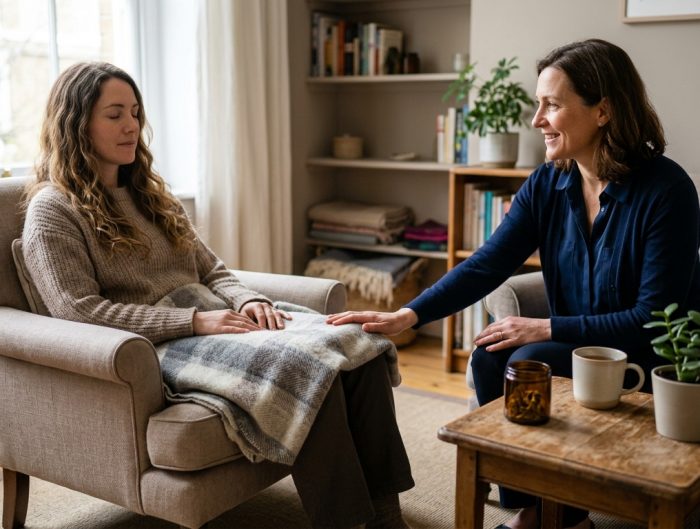
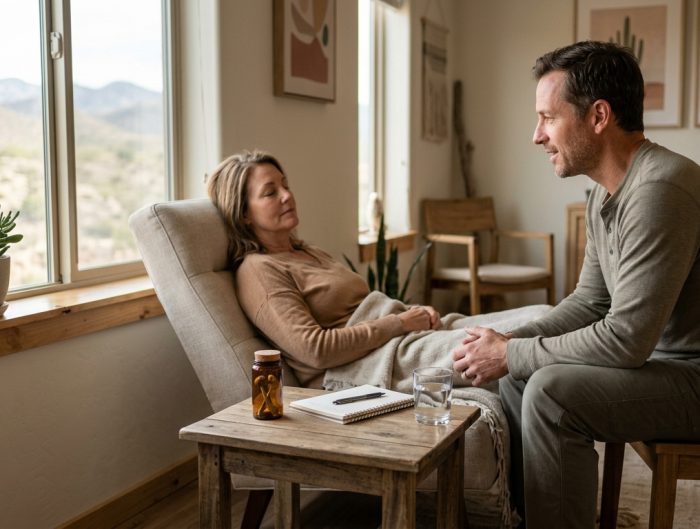
Psilocybin, by contrast, is increasingly available in clinical or semi-clinical settings. Oregon’s regulated service centers offer psilocybin sessions with trained facilitators in comfortable, private rooms. Clinical trials use a similar model: a quiet room, eyeshades, a curated music playlist, and one or two trained therapists present throughout. The setting is intentionally neutral, allowing your inner experience to unfold without strong external influence.
Some people feel safer in a clinical environment. The one-on-one attention, the medical screening, and the professional boundaries provide a sense of containment that can be especially important if you’re working with anxiety or trauma. Others find clinical settings sterile and prefer the richness and spiritual depth of ceremony.
Neither setting is inherently better. The question is which one you feel genuinely safe in: not intellectually, but in your body. If the idea of lying in a dark room with strangers while a shaman sings makes you feel anxious, that’s worth listening to. If a therapist’s office feels too clinical and disconnected from the sacred, that’s equally valid information. At Healing Dose, we consistently emphasize that your sense of safety is the foundation everything else is built on.
Safety Considerations and Contraindications
Both ayahuasca and psilocybin have favorable physical safety profiles compared to most pharmaceutical drugs, but neither is risk-free. Understanding the specific safety considerations for each substance is essential, not optional.
Dietary Restrictions and Medication Interactions
Ayahuasca’s MAOI component creates a unique set of dietary and pharmacological restrictions that psilocybin does not share. MAOIs inhibit the breakdown of tyramine, an amino acid found in aged cheeses, cured meats, fermented foods, and certain other items. Consuming high-tyramine foods while MAOIs are active can cause a hypertensive crisis: a dangerous spike in blood pressure. Most reputable retreat centers provide dietary guidelines for the days leading up to ceremony, typically recommending avoidance of aged, fermented, and processed foods.
The medication interactions are even more critical. Combining ayahuasca with SSRIs, SNRIs, or other serotonergic medications can cause serotonin syndrome, a potentially life-threatening condition characterized by agitation, hyperthermia, rapid heart rate, and muscle rigidity. This is not a theoretical risk: it has caused deaths. If you take antidepressants, you must taper off under medical supervision well before an ayahuasca ceremony, and the tapering timeline varies by medication. Some SSRIs require weeks to fully clear your system.
Other contraindicated medications include:
- MAOIs (prescribed for depression or Parkinson’s disease)
- Tramadol and other opioids
- Stimulants like amphetamines
- St. John’s Wort
- Certain migraine medications (triptans)
- Some cough suppressants containing dextromethorphan (DXM)
Psilocybin’s interaction profile is less dangerous but still worth taking seriously. Psilocybin does not contain MAOIs, so the tyramine concern doesn’t apply. However, combining psilocybin with SSRIs can blunt the experience significantly, and there are theoretical concerns about serotonin syndrome with high doses of both, though documented cases are rare. Lithium is a notable exception: combining psilocybin with lithium has been associated with seizures and should be strictly avoided.
People with cardiovascular conditions should exercise caution with both substances. Ayahuasca can increase heart rate and blood pressure. Psilocybin generally has milder cardiovascular effects but can still elevate heart rate during peak experiences.
Psychological Readiness and Post-Experience Integration
Physical safety is only half the picture. Psychological readiness matters just as much, and this is where honest self-assessment becomes crucial.
Both substances are contraindicated for individuals with a personal or strong family history of psychotic disorders, including schizophrenia and bipolar I disorder. Psychedelics can precipitate psychotic episodes in vulnerable individuals, and this risk applies equally to ayahuasca and psilocybin. If you have any history of psychosis, mania, or dissociative disorders, please consult with a psychiatrist who is knowledgeable about psychedelics before considering either substance.
Beyond clinical contraindications, there’s the question of emotional readiness. Are you in a stable enough place to encounter difficult material? Both ayahuasca and psilocybin can surface suppressed emotions, painful memories, and existential fears. This is often where the growth happens, but it requires a baseline of psychological stability to process constructively. If you’re in acute crisis: actively suicidal, in the midst of a major life upheaval, or barely functioning day to day: a high-dose psychedelic experience may not be the right next step.
Integration is where the real work happens, and this is something we emphasize constantly at Healing Dose. The experience itself, whether it’s a four-hour psilocybin session or a week of ayahuasca ceremonies, is just the beginning. What you do in the days, weeks, and months afterward determines whether insights become lasting changes or fade into interesting memories.
Effective integration practices include:
- Journaling within 24 hours while the experience is fresh
- Working with a therapist or integration coach who understands psychedelic experiences
- Maintaining a regular mindfulness or meditation practice
- Reducing alcohol and other numbing substances in the weeks following
- Being patient with yourself: some shifts are subtle and emerge over weeks
The difference between a meaningful experience and a confusing one often comes down to how much attention you give to integration. A quiet morning spent writing about what came up during a psilocybin session can be more valuable than the session itself.
Deciding Which Medicine Aligns with Your Intentions
If you’ve read this far, you probably have a sense of which direction feels right. But let me offer a framework that might help clarify your thinking.
Consider ayahuasca if you’re drawn to deep emotional and somatic processing, if you feel called to work within a ceremonial tradition, if you have the time and resources for a multi-day retreat, and if you’re comfortable with the physical intensity of purging and extended duration. Ayahuasca tends to suit people who are working with trauma that feels stored in the body, who respond to ritual and communal practice, and who are willing to surrender control for an extended period. The ceremonial framework provides structure and guidance that some people find essential, especially for their first encounter with plant medicine.
Consider psilocybin if you prefer a shorter, more contained experience, if you want access to a clinical or regulated setting, if you’re working with depression, anxiety, or existential distress, or if you’re newer to psychedelics and want a gentler entry point. Psilocybin’s shorter duration and more predictable dosing make it more accessible for many people. The growing availability of regulated psilocybin services in Oregon and Colorado means you can work with trained facilitators in a legal, professionally supported environment.
Some people feel a strong intuitive pull toward one or the other, and that intuition is worth honoring. If the idea of sitting in ceremony with ayahuasca keeps returning to your thoughts, pay attention to that. If the clinical research around psilocybin gives you confidence, that’s equally valid.
There’s also a third path worth mentioning: microdosing. If you’re not ready for a full-dose experience with either substance, working with sub-perceptual amounts of psilocybin (typically 50 to 200 milligrams of dried mushroom material) can be a way to begin building a relationship with the medicine at your own pace. Microdosing won’t produce the visionary or cathartic experiences of a full dose, but many people report quiet changes in mood, creativity, and emotional flexibility over weeks of practice. It’s a way to start small and listen to how your body and mind respond.
Whatever you choose, approach it with respect, preparation, and realistic expectations. Neither ayahuasca nor psilocybin is a magic solution. They’re tools that can open doors, but you still have to walk through them. The integration work: the journaling, the reflection, the honest conversations with yourself: is what turns a single experience into a genuine shift in how you relate to your life.
If you’re curious about starting with microdosing as a first step, Healing Dose offers a short quiz that helps you find a gentle starting range based on your goals, experience, and sensitivity. You can take the quiz here and begin approaching this work thoughtfully, at whatever pace feels right for you.
The most important thing is that you’re asking these questions at all. The fact that you’re researching, reading, and thinking carefully about which path to take tells me you’re already approaching this with the kind of intentionality that makes all the difference.

You might also like