For decades, the idea that a compound found in certain mushrooms could help people struggling with depression would have been dismissed outright by most of the medical establishment. Yet here we are. Research into psilocybin and depression has accelerated at a pace few predicted, and the findings are genuinely compelling. Clinical trials at world-class institutions have shown that psilocybin-assisted therapy can produce significant, lasting reductions in depressive experiences, sometimes after just one or two sessions. If you’ve been watching this space with curiosity, skepticism, or hope, you’re not alone. Millions of people who haven’t found relief through conventional approaches are paying close attention. And the science is finally catching up to what many have quietly suspected: that psychedelics, used responsibly and with proper support, may offer something profoundly different from the medications we’ve relied on for the past forty years. This article walks through the history, the science, the therapy model, the clinical evidence, the risks, and where things are headed. No hype, no promises, just a clear-eyed look at what we know so far.
The Evolution of Psychedelic Medicine for Mental Health
The story of psilocybin in medicine is not a straight line. It’s a winding path marked by early promise, political backlash, decades of prohibition, and a recent resurgence that has brought psychedelic research back into the most respected labs and hospitals in the world. Understanding this history matters because it explains why we’re only now beginning to grasp the potential of these compounds, and why so much caution (rightly) surrounds their use.
From Traditional Use to Modern Clinical Trials
Indigenous cultures across Mesoamerica used psilocybin-containing mushrooms in ceremonial and medicinal contexts for thousands of years. The Mazatec people of Oaxaca, Mexico, incorporated these mushrooms into rituals meant to address physical and spiritual distress. This wasn’t recreational: it was embedded in a structured cultural framework with specific intentions and community support.
Western science first encountered psilocybin in the late 1950s, when R. Gordon Wasson published his account of a Mazatec ceremony in Life magazine. Shortly after, Albert Hofmann, the Swiss chemist who had already synthesized LSD, isolated and identified psilocybin as the active compound. By the early 1960s, researchers at Harvard, including Timothy Leary and Richard Alpert, were conducting studies on psilocybin’s psychological effects.
Those early studies showed promise for treating depression, anxiety, and addiction. But the cultural upheaval of the 1960s, combined with Leary’s increasingly public and controversial advocacy, triggered a political backlash. By 1970, the Controlled Substances Act in the United States classified psilocybin as a Schedule I substance, meaning it was deemed to have no accepted medical use and a high potential for abuse. Research ground to a halt almost overnight.
For roughly three decades, virtually no clinical work was done. The stigma was so strong that even proposing a study could damage a researcher’s career. It wasn’t until the late 1990s and early 2000s that a few brave scientists at institutions like Johns Hopkins, NYU, and Imperial College London began to carefully reopen the door.
The Shift in Regulatory Status and FDA Breakthrough Designations
The turning point came gradually. In 2006, Roland Griffiths and his team at Johns Hopkins published a landmark study showing that psilocybin could occasion mystical-type experiences with lasting positive effects on well-being. That study, conducted with rigorous controls and published in a top-tier journal, gave the field credibility it had lacked for decades.
By the mid-2010s, clinical trials specifically targeting depression were underway. The results were striking enough that the U.S. Food and Drug Administration took an unusual step: in 2018 and again in 2019, the FDA granted “Breakthrough Therapy” designation to psilocybin therapy for treatment-resistant depression and major depressive disorder. This designation doesn’t mean approval. It means the FDA considers the evidence promising enough to fast-track the review process.
As of 2026, several Phase III clinical trials are either completed or nearing completion. Oregon became the first U.S. state to establish a regulated framework for psilocybin services in 2023, and Colorado followed with its own program. Australia approved psilocybin for clinical use in treatment-resistant depression in 2023, making it the first country to do so at a national level.
The regulatory picture remains complicated. Psilocybin is still a Schedule I substance under U.S. federal law, creating tension between state-level programs and federal policy. But the trajectory is clear: the conversation has shifted from “should we study this?” to “how do we implement this safely and equitably?”
Mechanisms of Action: How Psilocybin Rewires the Depressed Brain
One of the most exciting aspects of psilocybin research is that we’re beginning to understand why it works, not just that it works. The mechanisms are fundamentally different from those of conventional antidepressants, which helps explain why psilocybin may help people who haven’t responded to other approaches.
Stimulating Neuroplasticity and Synaptic Growth
Psilocybin is a prodrug, meaning your body converts it into another compound, psilocin, which is the molecule that actually interacts with your brain. Psilocin primarily binds to serotonin 5-HT2A receptors, which are concentrated in the prefrontal cortex, a region involved in mood, cognition, and self-awareness.
What happens next is where things get interesting. Activation of these receptors triggers a cascade of downstream effects, one of the most significant being increased neuroplasticity. Neuroplasticity is your brain’s ability to form new neural connections and reorganize existing ones. Think of it like this: depression often creates deep mental ruts, habitual patterns of negative thinking that become self-reinforcing over time. Neuroplasticity is the brain’s capacity to carve new pathways.
Research published in journals like Neuron and Nature Medicine has shown that psilocybin promotes the growth of dendritic spines, the tiny protrusions on neurons where synaptic connections form. In animal studies, these structural changes appeared within 24 hours and persisted for at least a month. Human neuroimaging studies have shown corresponding increases in brain connectivity that correlate with improvements in mood.
This is meaningfully different from how SSRIs work. SSRIs increase the availability of serotonin in the synaptic cleft but don’t directly promote the kind of structural remodeling that psilocybin appears to. That distinction may help explain why psilocybin’s effects can persist long after the compound has left your system, while SSRIs typically need to be taken daily to maintain their effect.
Disrupting the Default Mode Network to Break Negative Thought Loops
The default mode network, or DMN, is a collection of brain regions that are most active when you’re not focused on the external world: when you’re daydreaming, reflecting on yourself, ruminating, or thinking about the past or future. In people with depression, the DMN tends to be overactive and rigidly connected. This overactivity is closely linked to rumination, that painful loop of self-critical, repetitive thinking that many people with depression know all too well.
Psilocybin temporarily disrupts the DMN’s normal activity patterns. During a psilocybin session, the usual rigid connectivity within this network loosens, and brain regions that don’t normally communicate begin to interact. Researchers at Imperial College London have described this as a shift from a highly ordered, constrained brain state to a more flexible, “entropic” one.
The subjective experience often mirrors this neuroscience. People frequently report a sense of ego dissolution, a temporary loss of the rigid sense of self that can feel liberating. The inner critic quiets down. The stories you’ve been telling yourself about who you are and what’s possible begin to feel less fixed, less absolute.
This isn’t permanent ego loss: it’s a temporary window of flexibility. And that window appears to be where much of the therapeutic work happens. When the DMN reconsolidates after the session, it often does so in a less rigid configuration. The mental ruts aren’t as deep. New perspectives become accessible.
At Healing Dose, we often emphasize that understanding these mechanisms isn’t just academic: it helps you approach the experience with realistic expectations and a framework for making sense of what happens during and after a session.
The Psilocybin-Assisted Therapy Model
Psilocybin doesn’t work like a pill you take at home before bed. The clinical model that has produced the most impressive results involves a structured therapeutic framework with three distinct phases: preparation, the psilocybin session itself, and integration afterward. Each phase matters, and skipping any of them significantly reduces the likelihood of meaningful, lasting change.
The Crucial Role of Set and Setting
“Set and setting” is a concept that dates back to the early days of psychedelic research. “Set” refers to your mindset: your expectations, emotional state, intentions, and psychological readiness going into the experience. “Setting” refers to the physical and social environment in which the session takes place.
In clinical trials, preparation sessions typically involve one to three meetings with a therapist before the psilocybin session. During these meetings, you discuss your history, your reasons for seeking this approach, and what you might encounter during the experience. The therapist helps you develop a sense of trust and safety, which is critical because psilocybin can surface difficult emotions and memories.
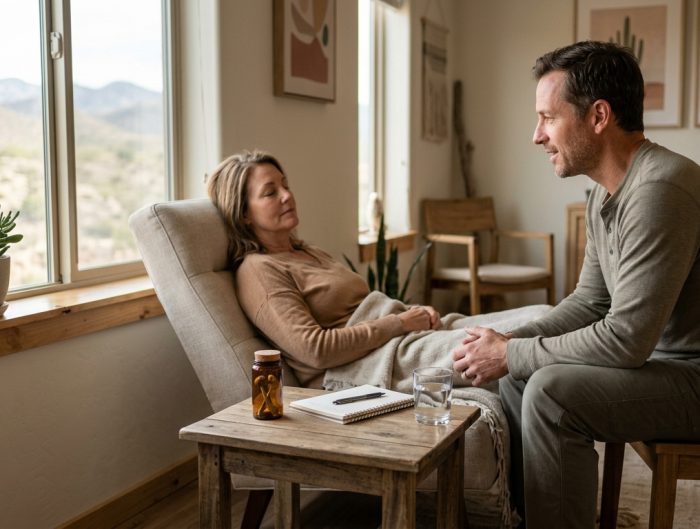
The session itself usually takes place in a comfortable, carefully designed room. Think soft lighting, a couch or bed, eye shades, and curated music playlists (which have been shown to meaningfully influence the experience). One or two trained therapists remain present throughout the session, which typically lasts five to six hours. Their role is not to direct the experience but to provide a grounding, reassuring presence.
Why does this matter so much? Because the same compound can produce vastly different experiences depending on context. A person who takes psilocybin in an unsupported, chaotic environment is far more likely to have a distressing experience than someone in a safe, intentional setting. The clinical data reflects this: the structured therapy model consistently produces better outcomes than psilocybin alone.
If you’re someone who tends to feel anxious about new experiences, this is actually reassuring. The model is specifically designed to create safety. You don’t have to white-knuckle your way through it.
Integration: Turning the Experience into Long-Term Recovery
Here’s something that doesn’t get enough attention: the psilocybin session itself is not where the real work ends. It’s where the real work begins. Integration, the process of making sense of and applying insights from the experience, is what determines whether temporary shifts become lasting changes.
In clinical trials, participants typically have two to three integration sessions with their therapist in the days and weeks following the psilocybin session. These sessions involve talking through what came up, identifying new perspectives or emotional shifts, and developing concrete plans for incorporating those insights into daily life.
But integration isn’t limited to therapy sessions. Journaling is one of the most effective integration practices. Writing down your experiences, even fragmentary impressions or images, helps solidify insights that might otherwise fade. At Healing Dose, we consider journaling and structured reflection essential components of any responsible psychedelic practice, whether you’re working with a full therapeutic dose or exploring microdosing.
Other integration practices include:
- Spending time in nature in the days following a session
- Meditation or mindfulness practice to maintain the sense of openness
- Creative expression: art, music, or movement
- Meaningful conversations with trusted people
- Reducing exposure to screens and overstimulating environments
The people who report the most sustained benefits are almost always the ones who take integration seriously. The experience provides a window of heightened plasticity and openness. What you do with that window determines the outcome.
One thing I’ve noticed in my own experience and in conversations with others: the days immediately after a session can feel tender and raw. That’s normal. You’re not doing it wrong. Give yourself space and be gentle with the process.
Clinical Efficacy Against Treatment-Resistant Depression
The clinical data on psilocybin for depression has moved well beyond preliminary findings. Multiple rigorous trials, including randomized controlled studies with active comparators, have produced results that are hard to ignore. Let’s look at what the numbers actually show.
Comparing Psilocybin to Traditional SSRIs
One of the most cited studies in this area is the 2021 trial published in the New England Journal of Medicine by Robin Carhart-Harris and colleagues at Imperial College London. This study directly compared psilocybin therapy (two sessions over six weeks) with escitalopram (a widely prescribed SSRI) in patients with moderate to severe depression.
Both groups showed improvement, but the psilocybin group showed greater reductions across secondary outcome measures, including anxiety, well-being, social functioning, and the ability to experience pleasure. On the primary outcome measure (the QIDS-SR-16 depression scale), the difference between groups was not statistically significant, though psilocybin numerically outperformed escitalopram.
What’s particularly noteworthy is the dosing difference. The psilocybin group received just two doses over six weeks. The escitalopram group took a daily pill for the entire six-week period. That’s a fundamentally different treatment burden, and it matters enormously for quality of life and adherence.
Subsequent analyses and follow-up studies through 2024 and 2025 have continued to support these findings. A larger Phase IIb trial by COMPASS Pathways, published in the New England Journal of Medicine in 2022, found that a single 25mg dose of their synthetic psilocybin (COMP360) produced significant reductions in depression scores compared to a 1mg control dose. The 25mg group showed a response rate of approximately 37% at three weeks, compared to 18% in the control group.
These numbers are meaningful, but they also deserve honest context. Not everyone responds. Roughly a third of participants in most trials don’t show significant improvement. Psilocybin is not a universal solution, and presenting it as one does a disservice to the people who need accurate information to make good decisions.
Duration of Antidepressant Effects After a Single Dose
One of the most remarkable findings in psilocybin research is how long the antidepressant effects can last after a single session. In the Johns Hopkins trial published in JAMA Psychiatry in 2021, participants with major depressive disorder received two psilocybin sessions. At the one-month follow-up, 71% of participants showed a greater than 50% reduction in depression scores, and 54% met criteria for remission.
Even more striking, follow-up data published in the Journal of Psychopharmacology showed that these improvements were largely maintained at 12 months. That’s a year of sustained benefit from two sessions.
How is this possible? The neuroplasticity and DMN disruption mechanisms discussed earlier likely play a role. But there’s also a psychological component. Many participants describe the psilocybin experience as one of the most meaningful events of their lives, comparable to the birth of a child or the death of a parent. That kind of profound experience can shift your relationship to your own suffering in ways that persist.
It’s worth being honest, though: not everyone maintains these gains indefinitely. Some people experience a gradual return of depressive experiences over months. The question of whether and how often “booster” sessions might be needed is an active area of research. Early data suggests that periodic sessions, perhaps once or twice a year, may help sustain benefits for some individuals.
This long duration of effect stands in sharp contrast to SSRIs, which typically need to be taken daily and whose benefits generally fade within weeks of discontinuation. For people who’ve spent years cycling through different medications, the possibility of sustained relief from a small number of sessions is genuinely meaningful.
Safety Protocols and Potential Risks
Any honest discussion of psilocybin must address safety and risks head-on. While the clinical data is encouraging, psilocybin is not without potential downsides, and responsible use requires understanding them clearly.
Physiologically, psilocybin has a favorable safety profile compared to many other substances. It is not addictive. It does not produce physical dependence. Lethal overdose is essentially unheard of in humans. A 2010 study published in The Lancet ranked psilocybin mushrooms as one of the least harmful substances, well below alcohol, tobacco, and many prescription medications.
That said, the psychological risks are real and deserve respect:
- Challenging experiences: Sometimes called “difficult” sessions, these can involve intense fear, confusion, paranoia, or confrontation with painful memories. In clinical settings with trained support, these experiences are generally manageable and sometimes even therapeutically valuable. Outside a supported setting, they can be genuinely distressing.
- Cardiovascular considerations: Psilocybin can temporarily increase heart rate and blood pressure. People with cardiovascular conditions should discuss this with a physician.
- Psychiatric contraindications: Psilocybin is generally not recommended for individuals with a personal or family history of psychotic disorders, including schizophrenia or bipolar disorder with psychotic features. The risk of triggering a psychotic episode, while low in the general population, is elevated in these groups.
- Medication interactions: Psilocybin can interact with certain medications, particularly lithium (which may increase seizure risk) and SSRIs or MAOIs (which can alter the experience or create safety concerns). If you’re currently taking any psychiatric medication, do not make changes without consulting your prescriber.
- Emotional vulnerability after sessions: The days following a psilocybin experience can involve heightened emotional sensitivity. This is normal but can be disorienting if you’re not prepared for it.
Clinical trials address these risks through careful screening, medical monitoring, and trained therapeutic support. The safety record in controlled research settings has been excellent: serious adverse events are rare.
The concern arises primarily with unsupported use. Without proper screening, preparation, and integration support, the risks increase substantially. This is why we consistently emphasize at Healing Dose that context matters as much as the substance itself. A safety-first approach isn’t about being overly cautious: it’s about respecting the power of these experiences and giving yourself the best possible chance of a positive outcome.
If you’re considering any form of psilocybin use, whether therapeutic-dose sessions or microdosing, start by educating yourself thoroughly. Talk to a healthcare provider. Seek out trained facilitators or therapists with experience in psychedelic-assisted approaches. Don’t rush.
The Future Landscape of Accessible Psychedelic Healthcare
We’re at a genuinely interesting moment in the relationship between psilocybin and depression research. The science is strong and growing stronger. The regulatory environment is shifting, albeit unevenly. And public attitudes have changed dramatically: a 2025 Pew Research survey found that over 60% of Americans now support legal access to psilocybin for therapeutic purposes, up from roughly 40% just five years earlier.
Several developments are shaping what comes next. The FDA is expected to make a decision on psilocybin therapy for treatment-resistant depression in 2026 or 2027, based on Phase III trial data. If approved, it would represent the first federally sanctioned psychedelic therapy in the United States. Canada, the UK, and several European countries are running parallel regulatory processes.
One of the biggest challenges ahead is accessibility. The current therapy model, which involves multiple preparation sessions, a five-to-six-hour supervised psilocybin session, and follow-up integration, is time-intensive and expensive. Estimates for a full course of psilocybin-assisted therapy range from $5,000 to $15,000. Insurance coverage remains uncertain, and without it, this approach will be available primarily to those who can afford it.
Researchers and clinicians are exploring ways to address this. Group therapy models, where multiple participants share a session with a smaller ratio of therapists, are being studied. Shorter-acting psilocybin analogs that could reduce session length are in development. Digital integration tools, including guided journaling apps and virtual follow-up sessions, could reduce costs while maintaining therapeutic quality.
Microdosing, the practice of taking very small, sub-perceptual amounts of psilocybin on a regular schedule, represents another area of growing interest. While the clinical evidence for microdosing is less developed than for full-dose therapy, preliminary studies and a large body of anecdotal reports suggest potential benefits for mood, creativity, and emotional flexibility. The sub-perceptual threshold, meaning a dose small enough that you don’t feel any obvious alteration in consciousness, typically falls in the range of 50 to 200 milligrams of dried psilocybin mushrooms, though individual sensitivity varies widely (much like caffeine sensitivity).
There are also important equity and justice considerations. The War on Drugs disproportionately affected communities of color, and the emerging psychedelic industry risks replicating those inequities if access is limited to wealthy, predominantly white populations. Several organizations are working to ensure that psychedelic therapy is accessible across socioeconomic and racial lines, and this work deserves support and attention.
The path forward isn’t without obstacles. Regulatory hurdles, training bottlenecks (there simply aren’t enough trained psychedelic therapists yet), and the ever-present risk of hype outpacing evidence are all real concerns. But the direction of travel is encouraging. We’re moving, carefully and with appropriate caution, toward a world where psilocybin-assisted therapy is a recognized, accessible option for people who need it.
What excites me most isn’t any single study or regulatory decision. It’s the broader shift in how we think about mental health. The psilocybin research is part of a larger movement toward approaches that treat the whole person, that recognize the importance of meaning, connection, and inner experience, and that don’t reduce depression to a simple chemical imbalance requiring a simple chemical fix.
If you’ve read this far, you’re clearly someone who takes your own well-being seriously and wants to make informed decisions. That matters. Whether you’re considering psilocybin-assisted therapy, exploring microdosing, or simply trying to understand what the research actually says, the most important thing is to move at your own pace, with good information and appropriate support.
If you’re curious about where to begin with microdosing, finding the right starting dose based on your individual goals and sensitivity is a meaningful first step. Our short quiz can help you identify a gentle starting range that respects your body and your pace: take the quiz here.
Whatever path you choose, go slowly, stay curious, and trust yourself to know what feels right.

You might also like