Getting the right amount of psilocybin mushrooms for your particular body and mind is one of the most personal decisions you’ll make on this path. Too little, and you might wonder if anything happened at all. Too much, and you could find yourself in an experience you weren’t ready for. The good news? Figuring out your ideal dosage doesn’t require guesswork. It requires patience, a little knowledge, and a willingness to listen to your own body. Whether you’re curious about microdosing for subtle daily shifts or considering a more immersive experience, understanding how to determine the right mushroom dosage for you is a skill you can build over time. This guide walks you through the science, the personal variables, and the practical steps so you can approach psilocybin with confidence and care. You’re not alone in feeling a bit overwhelmed by the details: that’s exactly why we put this together.
Understanding Psilocybin Potency and Strain Variations
Before you even think about numbers on a scale, you need to understand that not all mushrooms are created equal. Psilocybin content varies wildly depending on the species, the growing conditions, and even which part of the mushroom you’re consuming. The cap, for instance, tends to contain slightly more psilocybin than the stem in many species, though this difference isn’t as dramatic as some people claim.
What matters most is recognizing that a gram of one mushroom variety might produce a vastly different experience than a gram of another. This is why blanket dosage advice like “just take two grams” can be misleading and even risky. A two-gram dose of a mild strain might feel like a one-gram dose of a potent one.
Growing conditions also play a role. Mushrooms cultivated in carefully controlled environments tend to have more consistent potency than wild-harvested specimens. Substrate composition, humidity, temperature, and harvest timing all influence the final psilocybin concentration. If you’re sourcing mushrooms from different batches or growers, treat each batch as potentially different in strength, even if it’s the same species.
This variability is one reason why the “start low, go slow” principle matters so much. You can always take more during a future session, but you can never take less once you’ve already consumed a dose. Treat every new batch as an unknown until you’ve had a chance to gauge its strength at a low amount.
Differences Between Fresh and Dried Mushrooms
One of the most common mistakes beginners make is confusing fresh and dried mushroom weights. Fresh psilocybin mushrooms are roughly 90% water by weight. That means 10 grams of fresh mushrooms will dry down to approximately 1 gram. If someone tells you they took “5 grams” without specifying fresh or dried, you’re missing critical context.
Dried mushrooms are the standard reference point for dosage discussions, and for good reason: they’re more consistent in weight and easier to measure accurately. When you see dosage recommendations online or in research literature, assume they refer to dried material unless stated otherwise.
The drying process itself doesn’t significantly degrade psilocybin if done properly. Low-temperature dehydration preserves the active compounds well. However, mushrooms stored in heat, light, or humidity after drying can lose potency over time. Keep your dried material in an airtight container in a cool, dark place, and you’ll maintain consistency for months.
If you ever work with fresh mushrooms, a simple rule of thumb is to multiply your intended dried dose by 10. Want the equivalent of 0.15 grams dried? You’d need about 1.5 grams fresh. But this conversion is approximate, and fresh mushrooms can vary even more in water content depending on how recently they were harvested.
Common Species and Their Relative Strengths
Psilocybe cubensis is by far the most widely available and commonly discussed species. It’s the “baseline” that most dosage guides reference. Within cubensis alone, though, there are dozens of cultivated varieties: Golden Teacher, B+, Ecuador, and many others. Most cubensis varieties fall within a similar potency range, roughly 0.5% to 0.9% psilocybin by dry weight, though individual batches can fall outside this range.
Then there are species that sit well above cubensis in strength. Psilocybe azurescens, sometimes called “flying saucers,” can contain up to 1.8% psilocybin by dry weight, making it roughly two to three times stronger than an average cubensis. Psilocybe cyanescens (wavy caps) also runs significantly hotter than cubensis. If you’re working with one of these more potent species, you’d need to reduce your dose substantially compared to cubensis-based recommendations.
On the milder end, Psilocybe tampanensis (the species used to produce “philosopher’s stones” or truffles) tends to be less potent gram-for-gram than cubensis. Truffles also have a different water content than mushroom fruiting bodies, adding another layer of calculation.
The takeaway here is simple: always know what species you’re working with before deciding on a dose. If you’re uncertain, err on the side of caution and start with a fraction of what you think you might need.
Defining the Four Main Dosage Tiers
Psilocybin dosing isn’t a single number: it’s a spectrum. Most experienced practitioners and researchers organize this spectrum into distinct tiers, each producing qualitatively different experiences. Understanding these tiers helps you match your dose to your intention, which is one of the most important aspects of responsible use.
The boundaries between tiers aren’t rigid. Your personal sensitivity, the specific mushroom’s potency, and your current state of mind all influence where one tier ends and another begins. Think of these ranges as starting points for exploration, not fixed rules. Psilocybin-assisted sessions in clinical and licensed settings can cost between $1,000 and $3,500 per session, which is one reason many people are interested in understanding personal dosing for their own intentional practice.
Microdosing for Sub-Perceptual Benefits
Microdosing occupies the lowest tier of the spectrum, typically ranging from 0.05 to 0.25 grams of dried cubensis mushrooms. The defining characteristic of a microdose is that it’s sub-perceptual: you shouldn’t feel noticeably altered. No visual changes, no significant shift in consciousness. If you feel distinctly different, you’ve likely taken too much for a microdose.
The goal of microdosing is subtle. People report small shifts in mood, focus, or creative thinking that accumulate over weeks of consistent practice. Think of it less like flipping a switch and more like gently adjusting a dial. Some days you might notice a quiet sense of ease or a slightly different perspective on a problem. Other days, honestly, you might not notice anything at all, and that’s fine.
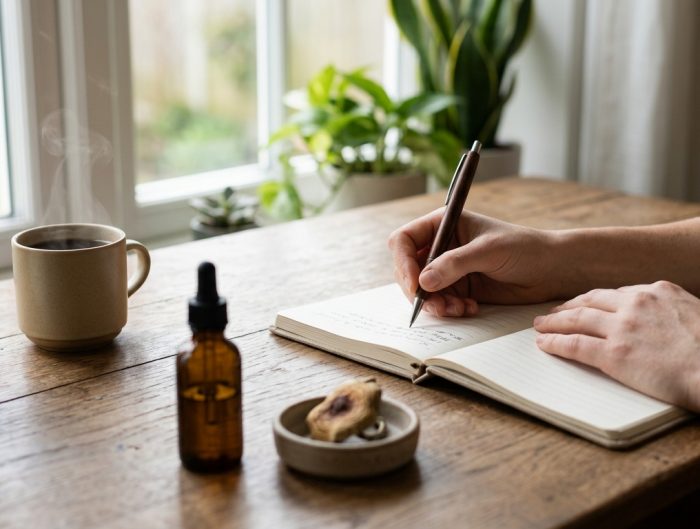
At Healing Dose, we emphasize that microdosing works best when paired with intentional reflection. Keeping a simple journal where you note your dose, the time you took it, and how you felt throughout the day creates a feedback loop that helps you fine-tune your approach over weeks. A comprehensive guide to microdosing protocols and best practices can help you structure your schedule, whether you follow the Fadiman protocol (one day on, two days off) or another cycling method.
Most microdosers take their dose in the morning, as psilocybin can mildly interfere with sleep if taken later in the day. Starting at 0.05 to 0.1 grams and gradually increasing over several sessions is the safest way to find your personal sweet spot.
The Museum Dose: Low to Moderate Effects
The term “museum dose” was popularized by psychedelic chemist Alexander Shulgin, and it describes a dose that’s perceptible but manageable enough that you could, theoretically, walk through a museum without drawing attention to yourself. For dried cubensis, this typically falls between 0.5 and 1.5 grams.
At this level, you might notice enhanced colors, a gentle shift in how music sounds, mild emotional openness, and a subtle physical buzz in your body. Your thinking may feel slightly more fluid or associative. You’re aware that something is different, but you retain full control over your actions and can interact with the world normally if needed.
This tier is popular among people who want to explore psilocybin’s perceptual qualities without committing to a full immersive experience. It’s also a useful range for people who are gradually working their way up from microdoses and want to understand how their body responds to higher amounts before going further.
A museum dose still warrants planning. Choose a comfortable environment, clear your schedule for several hours, and avoid driving or operating machinery. Even at this level, your reaction time and judgment may be mildly affected.
Heroic Doses and Deep Introspection
The upper end of the dosage spectrum includes what Terence McKenna famously called the “heroic dose”: typically 5 grams or more of dried cubensis, taken in silent darkness. Between the museum dose and the heroic dose sits a broad middle range (2 to 3.5 grams) where most people experience significant perceptual changes, emotional intensity, and altered thinking patterns.
At 2 to 3.5 grams, visual patterns become more pronounced, time perception shifts noticeably, and deep emotional material may surface. This is the range most commonly used in clinical research settings and in licensed psilocybin service centers. Oregon’s psilocybin program, for instance, has seen clients engage with these moderate-to-high doses under professional supervision, though data shows that clients using these services tend to be wealthier than the general population, highlighting ongoing access and equity concerns.
Heroic doses (5 grams and above) are not for beginners. They can produce profound and sometimes disorienting experiences that require significant psychological preparation and a trusted support person nearby. The potential for challenging psychological material to surface increases substantially at these levels. Psilocybin dosage tiers range from threshold amounts around 0.25 grams all the way up to heroic doses of 5 grams or more, and each tier demands a different level of preparation and respect.
If you’re drawn to deeper exploration, build your way there gradually over multiple sessions spaced weeks or months apart. There’s no rush, and patience here is a form of self-respect.
Personal Factors That Influence Your Ideal Dose
No two people respond to psilocybin identically. The same dose that gives one person a gentle, contemplative afternoon might leave another feeling overwhelmed. Understanding the personal variables that shape your response is essential for figuring out the right dosage for your unique situation.
This is where the process becomes genuinely individual. You can read all the guides in the world, but ultimately, your body and mind are the final arbiters. The factors below will help you make more informed starting decisions.
Body Weight and Biological Sensitivity
Body weight plays a role in psilocybin response, but it’s not as straightforward as it is with alcohol or many pharmaceutical drugs. A larger person doesn’t automatically need a proportionally larger dose. Research suggests that while body mass has some influence, individual neurochemistry, particularly your serotonin receptor density and sensitivity, matters more.
Think of it this way: two people who weigh the same might have very different responses to the same dose because their brains process serotonin differently. This is similar to how some people are profoundly affected by a single cup of coffee while others can drink three without feeling jittery.
That said, body weight isn’t irrelevant. If you’re significantly lighter or heavier than average, it’s reasonable to adjust your starting dose slightly in either direction. A person weighing 120 pounds might start at the lower end of a given range, while someone at 220 pounds might start slightly higher. But these adjustments should be modest: 10 to 20 percent, not doubling or halving the dose.
Genetic factors also influence your enzyme activity, particularly the CYP enzymes in your liver that metabolize psilocybin into its active form, psilocin. Some people are naturally fast metabolizers, while others process the compound more slowly. You won’t know where you fall without personal experience, which is another argument for starting conservatively.
The Impact of Metabolism and Recent Food Intake
Whether you’ve eaten recently has a noticeable impact on how quickly and intensely psilocybin takes hold. Taking mushrooms on an empty stomach typically produces a faster onset (sometimes within 15 to 20 minutes) and a more intense peak. Taking them with or shortly after a meal slows absorption and can blunt the peak intensity, spreading the experience out over a longer, gentler arc.
Neither approach is inherently better. Some people prefer the cleaner, more defined experience of an empty stomach. Others, especially those prone to nausea (a common side effect of psilocybin), find that having a small, light meal beforehand reduces stomach discomfort without dramatically altering the experience.
If you’re new to psilocybin, consider eating a light meal about 90 minutes before your dose. This gives your stomach something to work with, reducing the chance of nausea, while still allowing reasonable absorption. Avoid heavy, greasy, or protein-rich meals, which can significantly delay onset and make the timing unpredictable.
Your overall metabolic rate matters too. People with faster metabolisms may notice effects sooner and find they clear more quickly, while slower metabolizers might experience a more gradual and prolonged arc. Keeping notes on your timing and food intake helps you identify your personal patterns over multiple sessions.
Psychological State and Intentionality
Your mental and emotional state going into a psilocybin experience is arguably the single most important variable, and it’s the one most often underestimated. Psilocybin tends to amplify whatever is already present in your psychological landscape. If you’re feeling anxious, that anxiety may intensify. If you’re feeling open and curious, that openness may deepen beautifully.
This doesn’t mean you need to be in a perfect mood to have a meaningful experience. But it does mean you should be honest with yourself about where you are emotionally. If you’re going through acute grief, a major life crisis, or a period of high stress, it may be wise to either reduce your planned dose or postpone your session entirely.
Intentionality: having a clear reason for why you’re choosing to take psilocybin: also shapes the experience. This doesn’t need to be elaborate. It can be as simple as “I want to sit quietly and see what comes up” or “I’d like to reflect on my relationship with my work.” Setting an intention gives your mind a gentle anchor point, which can be especially grounding if the experience becomes intense.
We encourage people to spend a few minutes before dosing writing down their intention and their current emotional state. This practice, which we talk about frequently at Healing Dose, creates a reference point you can return to during integration afterward.
The Role of Set and Setting in Dose Management
“Set and setting” is a concept coined by Timothy Leary in the 1960s, and it remains the most important framework for understanding psilocybin experiences. “Set” refers to your mindset: your expectations, emotional state, and psychological readiness. “Setting” refers to your physical environment: where you are, who you’re with, and what sensory inputs surround you.
These two factors interact with dosage in powerful ways. A moderate dose in a safe, comfortable environment with a trusted friend nearby might feel gentle and manageable. That same dose in an unfamiliar, chaotic, or emotionally charged environment could feel overwhelming. Setting doesn’t just influence your experience: it effectively modifies the dose.
Choose a physical space where you feel genuinely safe and comfortable. This might be your living room, a quiet outdoor space you know well, or a friend’s home. Remove potential stressors: silence your phone, clear your schedule, and let anyone who might contact you know that you’ll be unavailable for several hours. Prepare water, comfortable blankets, and a playlist of music you find calming or meaningful.
The people around you matter enormously. If you’re taking a perceptible dose, having a sober, trusted person present (often called a “sitter”) provides a safety net that allows you to relax more fully into the experience. This person doesn’t need special training, though they should understand what psilocybin does and be comfortable sitting quietly with you without trying to direct or interpret your experience.
Colorado’s expanding framework for psychedelic-assisted approaches has reinforced how much professional facilitation and setting influence outcomes. Even outside a clinical context, the principle holds: your environment is not separate from your dose. It’s part of it.
For microdosing, set and setting are less critical since you’re operating below the perceptual threshold. But even microdosers benefit from consistency: taking your dose at the same time of day, in a similar context, helps you notice the subtle patterns that emerge over weeks.
Think of set and setting as a volume knob that works alongside your actual dose. A great setting can make a moderate dose feel comfortable and productive. A poor setting can make even a low dose feel unsettling. You have significant control over this variable, so use it wisely.
Step-by-Step Guide to Calculating a Safe Starting Point
Here’s where we get practical. If you’ve read everything above, you already understand that dosage is personal, variable, and context-dependent. Now you need a concrete process for translating that understanding into action.
Your starting point depends on your intention. If you’re interested in microdosing, begin with 0.05 to 0.1 grams of dried cubensis. If you’re looking for a perceptible but manageable experience, 0.75 to 1 gram is a reasonable first dose for most people. These numbers assume average-potency cubensis mushrooms and a person of roughly average body weight.
Write down your starting dose, the species and variety (if known), and the batch. This becomes your baseline for future adjustments. Without this record, you’re relying on memory, which is unreliable, especially after a psilocybin experience.
Here’s a simple framework for your first few sessions:
- Choose your intention and corresponding dosage tier.
- Weigh your dose precisely using a milligram-capable scale.
- Prepare your set and setting at least an hour before dosing.
- Take your dose on a lightly empty stomach (light meal 60 to 90 minutes prior).
- Note the time, your emotional state, and your physical sensations.
- After the experience, journal about what you noticed: physically, emotionally, and cognitively.
- Wait at least one to two weeks before your next session to allow full tolerance reset.
- Adjust your dose by no more than 0.05 grams (for microdoses) or 0.25 grams (for perceptible doses) based on your notes.
This process is slow by design. Rushing dosage calibration is how people end up in experiences they weren’t prepared for.
The Importance of Using a Milligram Scale
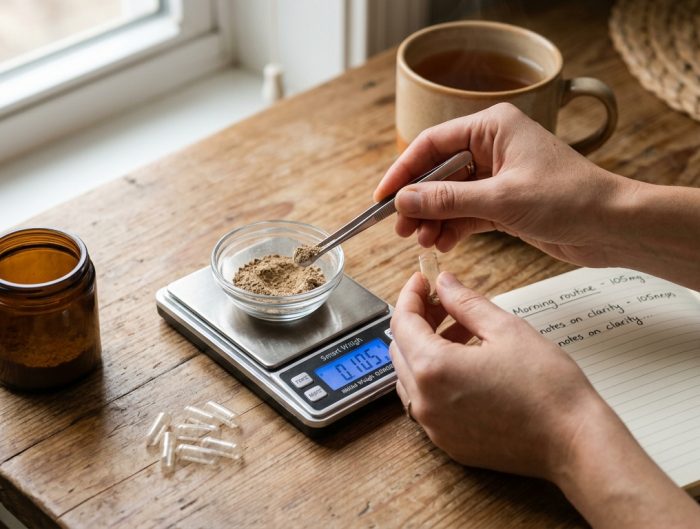
A kitchen food scale won’t cut it here. Standard kitchen scales measure in increments of 1 to 5 grams, which is far too imprecise for psilocybin dosing. You need a digital scale that reads to at least 0.01 grams (10 milligrams). These are widely available online for $15 to $30 and are one of the most important safety tools you can own.
The difference between 0.1 grams and 0.3 grams of dried mushrooms might not look like much in your hand, but it can be the difference between a sub-perceptual microdose and a noticeable shift in consciousness. Eyeballing doses is genuinely risky, especially with potent species or batches.
When weighing, use the tare function to zero out the weight of your container first. Place your mushroom material in a small dish or piece of parchment paper on the scale, and add or remove material until you hit your target weight precisely. If you’re preparing multiple microdoses in advance (which many people do for convenience), weigh each one individually rather than dividing a larger amount by eye.
Calibrate your scale periodically using the calibration weights that come with most models. Scales can drift over time, and even small inaccuracies compound when you’re working with sub-gram quantities.
Titration: The Start Low, Go Slow Approach
Titration is a concept borrowed from pharmacology, and it simply means gradually adjusting your dose upward until you find the minimum amount that produces your desired outcome. It’s the safest and most reliable way to determine your magic mushroom dosage without overshooting.
For microdosing, titration might look like this: you start at 0.05 grams on your first dosing day. You notice nothing at all: no subtle shifts, no changes in mood or focus. On your next dosing day (two or three days later, depending on your protocol), you increase to 0.08 grams. Still nothing noticeable. Next time, 0.1 grams. Here, you notice a slight uplift in mood and a gentle sense of ease. That’s your working dose, at least for now.
For perceptible doses, the process is slower because you need more time between sessions. You might start at 0.75 grams, wait two weeks, then try 1 gram, wait another two weeks, and so on. Each session gives you data about how your body and mind respond at that specific level.
The key discipline is resisting the urge to jump ahead. If 1 gram felt comfortable, it’s tempting to double it next time. Don’t. Increase by 0.25 grams at most. The relationship between dose and intensity isn’t linear: the jump from 1.5 to 2 grams can feel much larger than the jump from 1 to 1.5 grams.
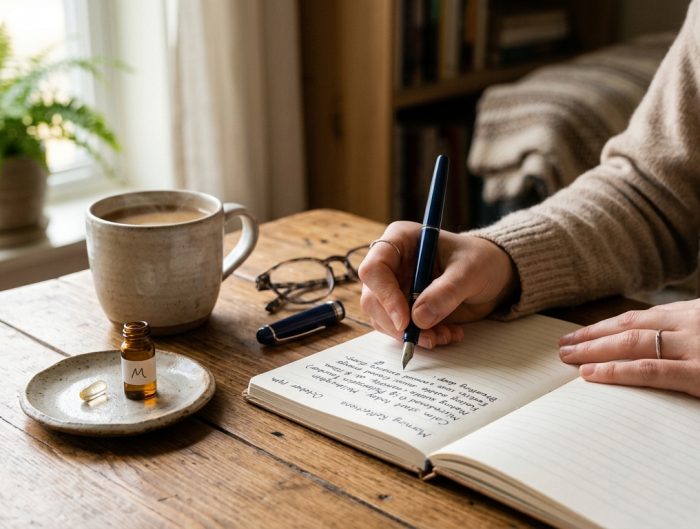
Keep detailed notes after each session. What did you feel physically? Emotionally? How long did effects last? Was there nausea? Did you feel safe throughout? These notes are your most valuable tool for finding your personal dosage over time. At Healing Dose, we consider this kind of reflective journaling just as important as the dosing itself: integration is where the real learning happens.
Safety Protocols and Managing Overwhelming Experiences
Even with careful preparation, psilocybin experiences can sometimes become more intense than expected. Having a plan for this possibility isn’t pessimistic: it’s responsible. The vast majority of challenging moments during psilocybin experiences are temporary and manageable with the right support.
If you or someone you’re sitting with begins to feel overwhelmed, the most important intervention is simple reassurance. Remind yourself (or them) that the experience is temporary, that psilocybin is physiologically very safe, and that the intensity will pass. Most psilocybin experiences peak within 60 to 90 minutes of onset and begin to taper after 3 to 4 hours. Knowing this timeline can be profoundly comforting in the middle of a difficult moment.
Practical grounding techniques include:
- Changing your physical environment slightly: moving to a different room, stepping outside briefly, or adjusting the lighting.
- Focusing on your breath: slow, deep breathing activates your parasympathetic nervous system and can reduce anxiety quickly.
- Holding something with a strong tactile quality: a smooth stone, a soft blanket, or an ice cube.
- Listening to calm, familiar music: this can redirect your attention and shift the emotional tone of the experience.
- Drinking water and having a small snack available, as physical comfort supports psychological comfort.
Avoid combining psilocybin with alcohol, cannabis, or other substances, especially during your calibration phase. Each additional substance introduces new variables that make it impossible to understand your response to psilocybin alone. Certain medications, particularly SSRIs and MAOIs, interact with psilocybin in significant ways. If you’re taking any psychiatric medication, research the specific interaction thoroughly and consult a knowledgeable healthcare provider before proceeding.
Know your local emergency resources, and make sure your sitter does too. While psilocybin has an extremely high safety margin physiologically (there are no confirmed lethal doses in humans), psychological distress can occasionally require professional support. Having a plan you never need is infinitely better than needing a plan you don’t have.
One final note on safety: psilocybin produces tolerance rapidly. If you take the same dose two days in a row, the second day will produce significantly reduced effects. This isn’t dangerous, but it does mean that taking more to compensate for tolerance is a poor strategy. Space your sessions appropriately: at least 48 hours for microdoses (most protocols build in rest days), and at least one to two weeks for perceptible doses.
Finding Your Own Path Forward
The process of determining your ideal psilocybin dosage is less like following a recipe and more like learning to cook by feel. The guidelines, ranges, and frameworks above give you a solid foundation, but your body, your mind, and your intentions are ultimately what shape your experience. Trust the process of starting small, paying attention, and adjusting gradually. The people who have the most meaningful and sustainable relationships with psilocybin are almost always the ones who took their time in the beginning.
If you’re just starting out and want a structured way to identify a gentle starting range based on your goals and sensitivity, you might find it helpful to take the dose quiz we’ve put together. It’s a simple tool designed to help you approach your first steps thoughtfully and at your own pace.
Whatever your path looks like, remember that patience and self-awareness are your most reliable guides. There’s no perfect dose waiting to be discovered in a single session. There’s a process of learning, reflecting, and growing: and that process is where the real value lives.

You might also like