A mushroom experience that turns dark can feel like the ground has dropped out from under you. Your thoughts spiral, your body tenses, and the world seems to warp in ways you didn’t ask for. If you’ve been through this, or if you’re worried about the possibility, you’re not alone. Difficult psychedelic experiences are more common than most people realize, and they don’t have to define your relationship with these substances. Whether you’re mid-experience and looking for immediate help, or preparing for a future session and wanting to reduce risk, this guide is here to walk you through every stage: before, during, and after. You’ll find grounding techniques, safety protocols, prevention strategies, and recovery practices, all written with the kind of care and honesty we prioritize at Healing Dose. There’s no hype here, just practical support you can actually use. A bad experience with mushrooms doesn’t mean something is broken in you. Often, it means something is trying to surface, and with the right tools, you can meet it with more steadiness than you might think possible right now.
Understanding the Nature of a Challenging Experience
Not every difficult moment during a mushroom session qualifies as a genuinely distressing experience. Psilocybin, the active compound in psychedelic mushrooms, works by temporarily altering serotonin receptor activity in the brain, which shifts perception, emotion, and cognition. These shifts can be beautiful, strange, or deeply uncomfortable, sometimes all three in the same hour. Understanding what’s actually happening in your mind and body during a hard moment can take some of the fear out of it.
A challenging mushroom experience typically involves a loss of the ordinary sense of control. Your usual mental filters soften, and material you normally keep tucked away, fears, grief, unresolved conflict, can rush to the surface with startling intensity. This isn’t a malfunction. It’s actually what psilocybin tends to do: it lowers the default mode network’s grip on your thinking, which means your habitual patterns of self-protection temporarily step aside. The problem is that without preparation or support, this can feel terrifying rather than revealing.
The intensity of a difficult experience also depends on factors that are deeply personal. Your current emotional state, your history with anxiety or trauma, your physical health, and even how much sleep you got the night before all play a role. Two people can take the same dose from the same batch and have wildly different sessions. This variability is one of the reasons we emphasize individual sensitivity so strongly at Healing Dose: there is no universal “safe dose” that works for everyone.
Common Symptoms of a Bad Trip
Recognizing what’s happening is the first step toward managing it. During a distressing mushroom experience, you might notice some or all of the following:
- Intense anxiety or panic that feels like it will never end
- Paranoid thinking, such as believing others are watching you, judging you, or trying to harm you
- Visual distortions that feel menacing rather than interesting: walls breathing, faces morphing, colors becoming aggressive
- A sense of losing your identity or forgetting who you are (sometimes called “ego dissolution” when it happens in a less frightening context)
- Physical discomfort including nausea, rapid heartbeat, muscle tension, sweating, or feeling too hot or cold
- Time distortion, where minutes feel like hours and you become convinced the experience will last forever
- Looping thoughts that repeat the same distressing idea over and over without resolution
These experiences are temporary. Psilocybin’s primary effects typically last between four and six hours, with the most intense period usually occurring between the 90-minute and three-hour marks. Even when it feels like you’re stuck in an endless loop, your brain is metabolizing the compound, and the intensity will decrease. Holding onto this fact, even loosely, can be a small anchor during the hardest moments.
The Difference Between Distress and Growth
Here’s something that might surprise you: many people who report a “bad” mushroom experience later describe it as one of the most meaningful experiences of their lives. Research from Johns Hopkins, published in studies spanning 2016 through 2024, found that a significant percentage of participants who had challenging psilocybin sessions rated them among their top five most personally significant experiences, even above many positive ones.
This doesn’t mean you should seek out suffering or dismiss genuine distress. It means that difficulty and value aren’t mutually exclusive. A session where you confront deep grief about a parent, or where you face the full weight of an anxiety pattern you’ve been avoiding for years, can be profoundly uncomfortable in the moment and profoundly clarifying afterward, but only if you have the support and integration tools to process what came up.
The key distinction is between distress that feels dangerous and distress that feels meaningful. If you’re experiencing genuine terror, psychotic symptoms, or urges to harm yourself, that’s a medical situation, not a growth opportunity. We’ll cover when to seek professional help later in this guide. But if the difficulty feels more like emotional labor, like something hard is being shown to you that you’d rather not see, that’s often where the real value lives. Learning to tell the difference, ideally before you sit down with mushrooms, is one of the most important skills you can develop.
Immediate Strategies for Navigating a Difficult Trip
If you’re reading this section while actively having a hard time, take a breath. You are safe. What you’re experiencing is temporary, and it will pass. The strategies below are designed to help you regain a sense of stability without fighting against the experience, because fighting it almost always makes things worse.
The most important thing to understand about managing a difficult psychedelic experience in real time is that resistance amplifies distress. When you clench against uncomfortable feelings or try to force the experience to stop, your nervous system interprets that tension as confirmation that something is truly wrong. This creates a feedback loop: fear creates tension, tension creates more fear, and the spiral deepens. The techniques below are designed to interrupt that loop gently.
Grounding Techniques and Breathwork
Grounding is the practice of reconnecting with your physical body and immediate environment when your mind has gone somewhere overwhelming. It works because it shifts your attention from abstract, spiraling thoughts to concrete, present-moment sensations.
Try this simple sequence:
- Place both feet flat on the floor. Press down gently and notice the sensation of the ground beneath you. You are here. You are solid.
- Hold something with texture: a blanket, a smooth stone, a piece of clothing. Focus on how it feels against your skin. Describe the texture to yourself silently.
- Name five things you can see, four you can touch, three you can hear, two you can smell, and one you can taste. This classic “5-4-3-2-1” technique pulls your awareness back into your body.
Breathwork is equally powerful. A simple box breathing pattern can activate your parasympathetic nervous system and reduce the fight-or-flight response:
- Inhale slowly through your nose for four counts
- Hold for four counts
- Exhale through your mouth for four counts
- Hold for four counts
- Repeat for at least two minutes
You don’t need to do this perfectly. Even a few slow, deliberate breaths can shift your internal state noticeably. If counting feels like too much, just focus on making your exhale longer than your inhale. That single adjustment tells your nervous system that you’re not in danger.
Changing Your Physical Environment
Sometimes the most effective intervention is the simplest: move to a different room. Your environment has an enormous influence on a psychedelic experience, and a space that felt cozy at the start of a session can begin to feel claustrophobic or oppressive as the experience intensifies.
If you’re indoors and feeling trapped, step outside if it’s safe to do so. Fresh air, natural light, and the sight of trees or sky can shift the entire tone of an experience within minutes. If going outside isn’t an option, try changing the lighting, adjusting the temperature, or simply moving to a different spot in the room.
Music is another environmental lever with surprising power. A song that felt beautiful 30 minutes ago might now feel too intense or emotionally charged. Switch to something calmer: ambient music without lyrics, nature sounds, or classical pieces with gentle tempos tend to work well. Playlists designed specifically for psychedelic sessions are widely available in 2026 and can be a real lifeline during rough patches.
Remove anything that’s contributing to anxiety. If your phone is buzzing with notifications, put it in another room. If a particular object or image is feeding into distressing thoughts, cover it or move away from it. You have more control over your environment than you might realize in the moment, and small changes can produce surprisingly large shifts in how you feel.
The Power of Surrender and Acceptance
This is the hardest strategy to practice and often the most effective. The instinct during a frightening experience is to fight it, to try to think your way out of it or will it to stop. But psilocybin doesn’t respond well to brute-force control. The more you fight, the more the experience pushes back.
Surrender doesn’t mean giving up or accepting harm. It means releasing your grip on the need for the experience to be different from what it is. Practically, this can look like lying down, closing your eyes, and saying to yourself: “I don’t have to control this. I can let this move through me.” Some people find it helpful to visualize the difficult feelings as a wave: you don’t stop a wave, you let it carry you and trust that it will set you down.
This approach draws from decades of psychedelic-assisted therapy research, where trained facilitators consistently guide participants toward acceptance rather than resistance. The phrase “trust, let go, be open,” originally attributed to psychedelic researchers in the 1960s, remains one of the most useful mantras during a challenging session.
If surrender feels impossible right now, that’s okay. Start with something smaller. Can you accept just this breath? Just this moment? You don’t have to accept the entire experience all at once. Take it one second at a time.
Harm Reduction and Safety Protocols
Preparation and safety planning are the foundation of responsible psychedelic use. No amount of grounding techniques can substitute for having a solid safety framework in place before you begin a session. This section covers the two most critical safety elements: having a trusted person present and knowing when the situation requires professional intervention.
The concept of harm reduction acknowledges a straightforward reality: people are going to use psychedelic substances whether or not they have institutional permission. Given that reality, the most ethical and practical response is to provide clear, honest information that reduces risk. This is the philosophy behind everything we publish at Healing Dose, and it’s especially relevant when discussing bad experiences with mushrooms, because most of the worst outcomes are preventable with basic precautions.
The Role of a Trusted Trip Sitter
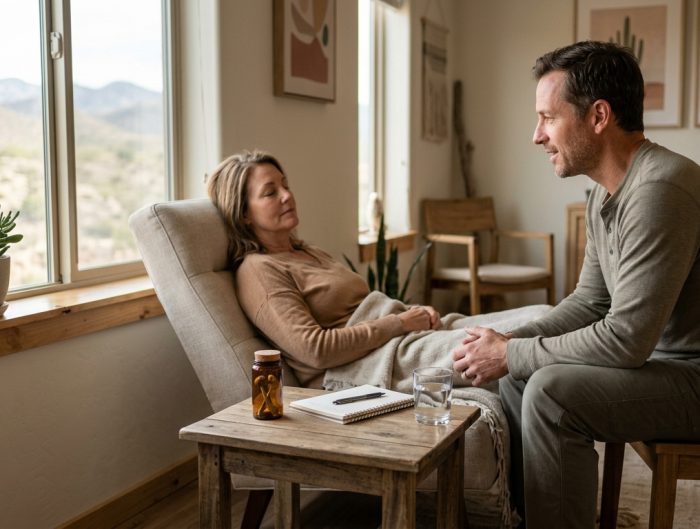
A sitter is someone who remains sober during your session and whose sole job is to keep you safe and supported. This person doesn’t need to be a therapist or have professional training, though both are helpful. What they do need is your trust, a calm temperament, and a basic understanding of what psilocybin does.
Here’s what a good sitter provides:
- A calm, non-judgmental presence that reminds you someone is watching out for you
- Gentle verbal reassurance when you’re struggling: simple phrases like “you’re safe,” “this is temporary,” and “I’m right here” can be incredibly grounding
- Physical comfort like a glass of water, a blanket, or a hand to hold
- The ability to recognize when something has moved beyond normal difficulty into a genuine emergency
Before your session, have an honest conversation with your sitter about your intentions, your fears, and what kind of support you’d like if things get hard. Some people want physical touch during difficult moments; others find it overwhelming. Some want to talk through what they’re experiencing; others prefer silence. Establishing these preferences in advance means your sitter can respond appropriately without guessing.
If you don’t have someone you trust enough to sit with you, that’s a strong signal to postpone your session until you do. Going through a challenging mushroom experience alone, especially at higher doses, significantly increases the risk of panic, injury, or lasting psychological distress.
When to Seek Professional Medical Help
Most difficult psychedelic experiences, while deeply uncomfortable, resolve on their own within hours and don’t require medical intervention. But there are situations where professional help is necessary, and knowing the line between “hard but manageable” and “genuinely dangerous” could save a life.
Seek emergency medical help if:
- The person is having a seizure
- They’ve lost consciousness or are unresponsive
- They’re expressing active intent to harm themselves or others
- They’ve consumed an unknown substance or mixed mushrooms with other drugs, especially lithium or MAOIs
- They’re experiencing chest pain, difficulty breathing, or severe physical symptoms beyond typical nausea
- Psychotic symptoms persist well beyond the expected duration of the experience (more than eight to ten hours)
If you need to call emergency services, be honest about what was consumed. In most jurisdictions in 2026, Good Samaritan laws protect people who call for help during a drug-related emergency. Medical professionals need accurate information to provide appropriate care, and withholding it out of fear of legal consequences can lead to worse outcomes.
For situations that are distressing but not immediately dangerous, crisis support lines staffed by people trained in psychedelic experiences can be invaluable. The Fireside Project (62-FIRESIDE / 623-473-7433) operates a peer support line specifically for people having difficult psychedelic experiences. Having this number saved in your phone before a session is a simple precaution that can make a real difference.
Pre-Trip Prevention: Set and Setting
The single most effective way to handle a bad mushroom experience is to prevent one. While no preparation can guarantee a smooth session, the concept of “set and setting,” your internal mindset and your external environment, dramatically influences the direction an experience takes. This framework, first articulated by Timothy Leary and refined by decades of clinical research, remains the gold standard for psychedelic preparation.
Prevention isn’t about eliminating all risk. It’s about reducing unnecessary risk so that whatever arises during your session is more likely to be manageable. Think of it like preparing for a hike in variable weather: you can’t control the storms, but you can wear the right gear, check the forecast, and choose a trail that matches your fitness level.
Optimizing Your Mindset and Intentions
Your psychological state going into a session is one of the strongest predictors of how that session will unfold. This doesn’t mean you need to be in a perfect mood, but it does mean you should be honest with yourself about where you are emotionally.
If you’re currently in the middle of acute grief, a mental health crisis, or a period of intense interpersonal conflict, consider waiting. Psilocybin tends to amplify whatever is already present in your emotional landscape. Taking mushrooms to escape from difficult feelings almost always backfires, because the substance brings those feelings directly to the surface rather than suppressing them.
Setting an intention before your session gives your experience a gentle direction without rigidly controlling it. An intention isn’t a goal or an expectation. It’s more like a question you’re holding loosely: “What am I avoiding?” or “What does self-compassion feel like in my body?” or simply “I’m open to whatever needs my attention.” Writing your intention down and reading it aloud before you begin can help anchor it in your awareness.
Spend the day before your session in relative calm. Avoid stressful conversations, heavy news consumption, and stimulating media. Get a full night of sleep. Eat a light, nourishing meal a few hours before your session. These small preparations signal to your nervous system that you’re entering a safe, intentional space.
Curating a Safe and Comfortable Space
Your physical environment should feel like a container that can hold whatever comes up. This means choosing a private, comfortable space where you won’t be interrupted by roommates, deliveries, or obligations. Turn off notifications on your devices. Let anyone who might try to contact you know that you’ll be unavailable for several hours.
The details matter more than you might expect. Soft lighting, comfortable seating or a place to lie down, easy access to water and a bathroom, and a comfortable temperature all contribute to a sense of safety. Have a few comfort objects nearby: a favorite blanket, a journal, art supplies, or a stuffed animal. These might seem trivial, but during a psychedelic experience, tactile comfort can be profoundly reassuring.
Prepare a playlist in advance. Music is one of the most powerful influences on a psychedelic session, and scrambling to find the right song while you’re already deep in an experience is stressful and disorienting. Create two playlists: one for the main session with music that feels emotionally resonant, and one “safety” playlist with calm, grounding ambient tracks you can switch to if things get intense.
Nature settings can be wonderful for experienced users, but for anyone worried about difficult experiences, an indoor space you control completely is usually the better choice. You want to minimize variables, not add them.
Dosage Control and Substance Purity
Dose is one of the most controllable risk factors, and getting it wrong is one of the most common causes of a bad experience with mushrooms. The relationship between dose and difficulty isn’t perfectly linear, but higher doses significantly increase the likelihood of ego dissolution, intense emotional content, and perceptual distortions that can become overwhelming.
For reference, here are general psilocybin mushroom dosage ranges (for dried Psilocybe cubensis, the most common species):
- Microdose: 0.05 to 0.25 grams (sub-perceptual, meaning you shouldn’t feel obvious psychedelic shifts)
- Low dose: 0.5 to 1.0 grams (mild perceptual changes, gentle mood shift)
- Moderate dose: 1.5 to 2.5 grams (noticeable visual and emotional shifts, the range where many people find meaningful experiences)
- High dose: 3.0 to 5.0 grams (intense, potentially overwhelming, recommended only for experienced users with strong support)
If you’re new to mushrooms or have a history of anxiety, start at the lower end. You can always take more another time; you can never take less once you’ve ingested it. This is one of the most important pieces of advice in all of psychedelic harm reduction, and it bears repeating: you can always go deeper next time.
Substance purity is equally important. In 2026, reagent testing kits are widely available and affordable. Use them. Misidentified mushroom species, contaminated products, or substances sold as psilocybin that contain something else entirely are real risks, especially in unregulated markets. If you can’t verify what you have, don’t take it.
A kitchen scale that measures to 0.01 grams is a small investment that makes a significant difference in safety. Eyeballing mushroom doses is unreliable because potency varies between individual mushrooms, even within the same batch.
Post-Trip Integration and Recovery
The experience doesn’t end when the psilocybin wears off. What you do in the hours, days, and weeks following a difficult session has an enormous impact on whether that experience becomes a source of lasting distress or a catalyst for genuine personal growth. Integration is the process of making sense of what happened and incorporating those insights into your daily life, and it requires active participation.
Many people make the mistake of trying to “move on” from a difficult experience as quickly as possible. They go back to work the next day, avoid thinking about what happened, and hope the uncomfortable feelings will fade on their own. Sometimes they do. But more often, unprocessed psychedelic material lingers as free-floating anxiety, disturbing dreams, or a vague sense of unease that can persist for weeks.
At Healing Dose, we consider integration to be just as important as the experience itself. A powerful session without integration is like having a profound dream and never writing it down: the details fade, the emotional charge dissipates, and the potential for meaningful change slips away.
Processing the Experience Through Journaling
Journaling is one of the most accessible and effective integration tools available to you. Within 24 hours of your session, while the experience is still vivid, sit down with a notebook and write freely about what happened. Don’t worry about structure, grammar, or making it sound coherent. Just get it out of your head and onto paper.
Some helpful prompts to guide your writing:
- What were the most intense moments? What emotions came up?
- Did any specific images, memories, or themes keep recurring?
- What surprised you about the experience?
- Was there a moment where you felt most afraid? What were you afraid of?
- Did anything shift for you, even subtly, by the end of the session?
- What, if anything, feels different about how you see yourself or your life right now?
Return to your journal over the following days and weeks. You’ll often notice patterns or insights that weren’t visible in the immediate aftermath. A detail that seemed random during the experience might suddenly connect to something meaningful in your waking life. This is the integration process at work: your conscious mind gradually makes sense of material that was presented in the symbolic, nonlinear language of the psychedelic state.
If journaling feels too solitary, consider talking through your experience with a trusted friend, a therapist experienced with psychedelic integration, or a peer support group. Psychedelic integration circles, both in-person and online, have become increasingly common in 2026 and can provide a valuable sense of community and normalization.
Prioritizing Rest and Psychological Aftercare
The day after a significant mushroom experience, especially a difficult one, is not the time to push yourself. Your nervous system has been through something intense, and it needs time to recalibrate. Think of it like the day after running a marathon: your body did something extraordinary, and now it needs rest, nourishment, and gentle care.
Clear your schedule for at least the full day following your session. Sleep as much as your body wants. Eat nourishing food: warm soups, fresh fruit, simple meals that feel comforting rather than heavy. Spend time outside if the weather allows. Gentle movement like walking or stretching can help release physical tension that accumulated during the experience.
Be patient with yourself emotionally. It’s common to feel raw, sensitive, or emotionally “open” for several days after a psilocybin experience. You might cry more easily, feel unusually moved by music or beauty, or notice that your usual emotional defenses are thinner than normal. This isn’t a problem. It’s your psyche processing what happened, and it will settle.
Avoid making major life decisions in the first week after a significant experience. The insights that arise during a psychedelic session can feel absolutely certain and urgent, but they benefit from the test of time. An insight that still feels true and relevant two weeks later is worth acting on. One that fades or shifts as you return to baseline was probably more about the altered state than about lasting truth.
If difficult emotions persist beyond two weeks, or if you’re experiencing flashbacks, persistent anxiety, depersonalization, or difficulty functioning in daily life, reach out to a mental health professional. These experiences are uncommon but real, and they respond well to professional support, especially from therapists trained in psychedelic integration. The MAPS (Multidisciplinary Association for Psychedelic Studies) therapist directory and the Psychedelic Support network both maintain searchable databases of qualified professionals.
Finding Your Way Forward
A difficult mushroom experience can shake you, but it doesn’t have to define your relationship with psychedelics or with yourself. The tools in this guide, grounding techniques, environmental adjustments, surrender practices, harm reduction protocols, thoughtful preparation, and intentional integration, form a comprehensive framework for both managing difficulty in the moment and preventing it in the future.
The most important takeaway is this: preparation and integration matter as much as the experience itself. A well-prepared session with a trusted sitter, a comfortable environment, a carefully measured dose, and a plan for aftercare is a fundamentally different proposition than taking an unknown amount of mushrooms in an unfamiliar setting with no support. Most of the worst outcomes are preventable, and most of the difficult experiences that do arise can become sources of genuine insight with proper processing.
If you’re interested in exploring psilocybin at lower, sub-perceptual doses as a gentler way to begin, finding the right starting point matters. Our microdose quiz can help you identify a range that fits your goals, experience level, and individual sensitivity, so you can approach the process thoughtfully and at your own pace.
Whatever path you choose, go gently. You have more resilience than you think, and you don’t have to figure this out alone.

You might also like