A psilocybin experience that turns frightening can feel like the longest hours of your life. Your heart races, thoughts spiral, and the walls of reality seem to buckle in ways you never anticipated. If you’ve had a bad experience with mushrooms, or you’re worried about the possibility before your first time, you’re not alone. Difficult psychedelic experiences are more common than most people realize, and they don’t have to define your relationship with these substances. The good news is that preparation, awareness, and a handful of practical techniques can dramatically reduce the likelihood of distress, and help you move through it if it does arise. This guide is built from a combination of published research, harm reduction best practices, and the kind of lived-experience perspective we value at Healing Dose: honest, grounded, and free of hype. Whether you’re a cautious beginner or someone reflecting on a rough past experience, you’ll find something here that meets you where you are.
Understanding the Nature of a Challenging Experience
Not every difficult moment during a psilocybin session is a crisis. In fact, many experienced practitioners draw a clear distinction between genuine psychological emergencies and the kind of discomfort that, while deeply unpleasant in the moment, can carry real value when processed afterward. Understanding this distinction is one of the most useful things you can do before sitting with mushrooms.
Psilocybin works primarily by binding to serotonin 5-HT2A receptors in the brain, temporarily disrupting your default mode network: the part of your brain responsible for your sense of self, your habitual thought patterns, and your internal narrative. When that network loosens its grip, you may feel a profound sense of openness and connection. But you may also feel exposed, confused, or overwhelmed. Both responses come from the same mechanism. The substance doesn’t distinguish between comfortable revelations and terrifying ones.
A 2023 survey published in the Journal of Psychopharmacology found that roughly 39% of participants who used psilocybin reported at least one experience they described as psychologically difficult. Yet a significant portion of those same participants also rated those difficult experiences among the most meaningful of their lives. This paradox sits at the heart of psychedelic work: discomfort and growth are often intertwined.
Common Physical and Psychological Symptoms
When a mushroom experience turns distressing, the body and mind tend to respond in predictable ways. Physically, you might notice nausea (especially during the onset), muscle tension, jaw clenching, rapid heartbeat, sweating, or chills. Some people describe a heavy, leaden feeling in their limbs, while others feel restless and unable to sit still. These physical sensations often peak during the first 60 to 90 minutes and then gradually ease.
Psychologically, the range is wider and more variable. Common experiences during a difficult session include:
- Intense anxiety or panic, sometimes described as a feeling of impending doom
- Thought loops, where the same distressing idea replays over and over
- Paranoia or suspicion of the people around you
- A sense of losing control over your body or mind
- Ego dissolution that feels terrifying rather than liberating
- Vivid, disturbing visual imagery
- Emotional flooding: sudden grief, rage, or sadness that feels disproportionate to any obvious cause
These experiences are not signs that something has gone permanently wrong. They are, in most cases, temporary responses to a powerful psychoactive substance interacting with your unique neurochemistry and emotional history. Knowing this won’t make the moment painless, but it can prevent the kind of secondary panic that comes from thinking you’ve broken your brain.
The Difference Between a ‘Bad’ Trip and a ‘Difficult’ One
The language we use matters more than you might think. Calling every uncomfortable psilocybin experience a “bad” one flattens a wide spectrum of experiences into a single, unhelpful category. Some experiences are genuinely traumatic and warrant professional support. Others are uncomfortable in the way that a hard conversation with a close friend is uncomfortable: painful, but ultimately clarifying.
A difficult experience is one where you encounter challenging emotions, unsettling thoughts, or physical discomfort, but you’re able to move through it, either on your own or with the support of someone you trust. Afterward, you may feel shaken but also strangely lighter, as though something that needed to surface finally did. Many integration therapists describe these experiences as psychologically productive, even when they don’t feel that way in the moment.
A genuinely harmful experience, on the other hand, tends to involve lasting psychological distress: persistent anxiety, depersonalization, flashbacks, or a worsening of pre-existing mental health conditions in the days and weeks that follow. These outcomes are less common but real, and they’re more likely when someone takes a high dose without preparation, in an unsafe environment, or while dealing with unaddressed psychiatric vulnerability.
The takeaway here isn’t that all suffering during a psilocybin session is secretly good for you. It’s that the framing you bring to the experience, both before and after, plays a significant role in whether discomfort becomes destructive or becomes something you can learn from.
The Importance of Set and Setting for Prevention
If there’s one concept that has stood the test of time in psychedelic harm reduction, it’s “set and setting.” Coined by Timothy Leary in the 1960s and refined by generations of researchers and practitioners since, the idea is straightforward: your mindset going in and the physical environment around you are the two strongest predictors of how your experience will unfold.
This isn’t just folk wisdom. A 2024 study from Imperial College London’s Centre for Psychedelic Research confirmed that pre-session anxiety levels and environmental comfort were more strongly correlated with negative psilocybin experiences than dosage alone. In other words, two people can take the same amount of mushrooms and have wildly different sessions based on how they feel and where they are.
Preventing a bad experience with mushrooms starts well before you put anything in your mouth.
Mindset: Mental Preparation and Intention Setting
Your mental state in the hours and days leading up to a psilocybin session sets the stage for everything that follows. If you’re feeling anxious, grieving, or emotionally raw, that doesn’t necessarily mean you shouldn’t sit with mushrooms, but it does mean you should proceed with extra care and realistic expectations.
Intention setting is one of the most practical tools available to you. An intention isn’t a goal or a demand: it’s more like a compass heading. Instead of “I want to have a beautiful, blissful experience,” try something like “I’m open to whatever arises, and I intend to stay curious rather than fearful.” The difference is subtle but important. Goals create expectations, and unmet expectations during a psychedelic session are a fast track to panic.
Spend some time in the days before your session reflecting on what’s going on in your life. Are there unresolved conflicts? Suppressed emotions? Big life transitions? These are the kinds of material that psilocybin tends to surface. If you’re aware of them going in, you’re less likely to be blindsided.
Journaling is a simple and effective way to do this kind of pre-session reflection. Even ten minutes of freewriting about how you’re feeling, what you’re hoping for, and what you’re afraid of can give you valuable self-awareness. At Healing Dose, we consider this kind of reflective practice essential, not optional, for anyone working with psychedelics intentionally.
Environment: Creating a Safe and Comfortable Space
Your physical surroundings during a psilocybin session have an outsized influence on your emotional state. A noisy, chaotic, or unfamiliar environment introduces variables you can’t control, and during a psychedelic experience, uncontrollable variables tend to become sources of anxiety.
The ideal space is one where you feel genuinely safe. For most people, this means a private, comfortable room in a familiar location. Think soft lighting, comfortable seating or a place to lie down, blankets, and easy access to water and a bathroom. Temperature matters more than you’d expect: being too cold or too hot can become an obsessive focus during a session.
Music is worth careful thought. Many clinical psilocybin studies use curated playlists that move through phases: gentle and ambient during the onset, emotionally evocative during the peak, and warm and grounding during the comedown. Avoid music with aggressive energy or lyrics that might steer your thoughts in unwanted directions. Instrumental music, nature sounds, or classical compositions tend to work well.
Remove potential stressors from the environment ahead of time. Put your phone on airplane mode. Make sure you won’t be interrupted by deliveries, roommates, or obligations. Lock the door if that helps you feel secure. These small preparations might seem fussy, but during a psilocybin experience, every sensory input is amplified. A ringing phone can feel like a fire alarm.
The Role of a Trusted Trip Sitter
Having someone sober and trustworthy present during your session is one of the single most effective harm reduction strategies available. A good sitter doesn’t need special training, though training helps. What they need is patience, empathy, and the ability to remain calm when you’re not.
The sitter’s role is primarily passive. They’re there to hold space, not to guide or direct. If you’re having a wonderful time, they sit quietly. If you’re struggling, they offer gentle reassurance: “You’re safe. You took mushrooms. This will pass.” They don’t try to talk you out of your experience or analyze what’s happening. They don’t panic.
Choose someone you trust deeply. This isn’t a casual favor: it’s an intimate role. You may cry, say strange things, or need physical comfort like a hand on your shoulder. The wrong sitter, someone who’s judgmental, anxious, or likely to make jokes at your expense, can actually make a difficult experience worse.
If you don’t have someone who fits this description in your life, consider whether this is the right time for a higher-dose session. Solo experiences are possible and can be meaningful, but they carry more risk, especially for people who are newer to psilocybin.
Practical Harm Reduction Strategies Before Dosing
Prevention doesn’t stop at set and setting. There are concrete, practical steps you can take before dosing that significantly reduce the likelihood of a distressing experience. These aren’t complicated, but they require honesty with yourself.
Dosage Control and Potency Awareness
Dosage is the variable you have the most direct control over, and it’s the one most often misjudged. The difference between a gentle, reflective experience and an overwhelming one can be as little as half a gram, depending on the species, the specific batch, and your individual sensitivity.
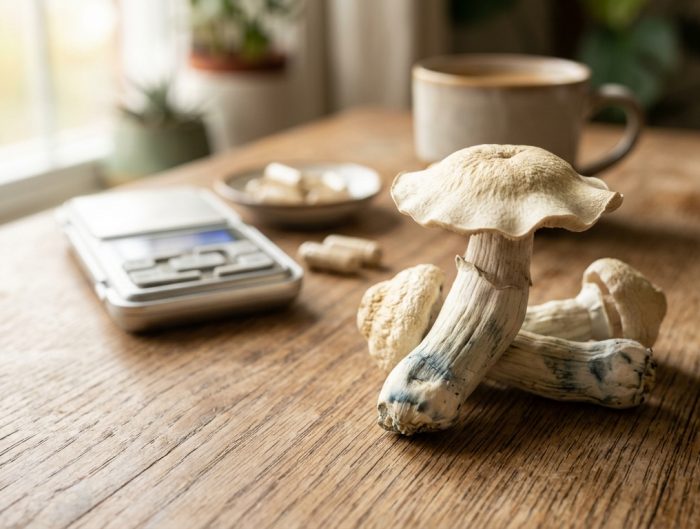
Psilocybe cubensis, the most commonly available species, typically contains between 0.5% and 0.9% psilocybin by dry weight. But potency varies significantly between individual mushrooms, even within the same batch. Psilocybe azurescens, by contrast, can contain up to 1.8% psilocybin: nearly three times as potent gram-for-gram.
Here are some general dosage ranges for dried Psilocybe cubensis, though individual responses vary widely:
- Microdose: 0.05 to 0.25 grams (sub-perceptual, meaning you shouldn’t feel any psychoactive shift)
- Low dose: 0.5 to 1.0 grams (mild mood lift, slight visual enhancement)
- Moderate dose: 1.5 to 2.5 grams (noticeable perceptual changes, emotional intensity)
- High dose: 3.0 to 5.0 grams (strong psychoactive experience, potential ego dissolution)
If you’re concerned about a difficult experience, start lower than you think you need to. You can always take more another time. You can never take less once it’s in your system. This is especially true if you’re working with a new batch, a new species, or if it’s been a while since your last session.
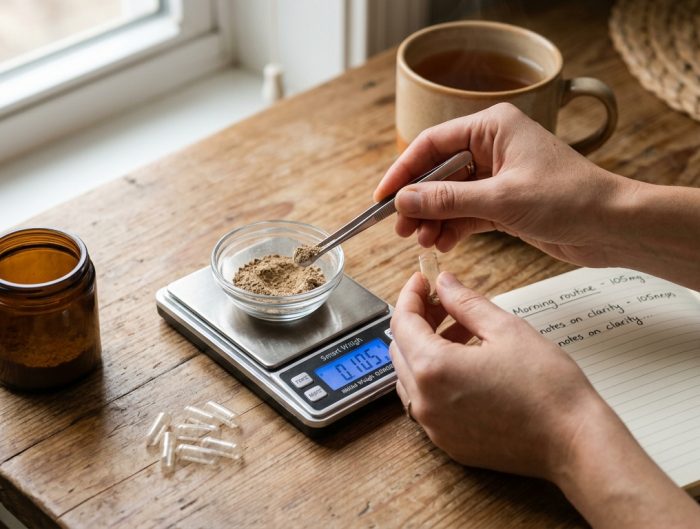
A kitchen scale that measures to 0.01 grams is a worthwhile investment. Eyeballing dosage is one of the most common ways people accidentally end up in over their heads.
Screening for Personal and Family Medical History
This is the part of harm reduction that people most often skip, and it’s arguably the most important. Psilocybin is generally well-tolerated physiologically, but it interacts with certain psychiatric conditions and medications in ways that can increase risk.
If you or a close family member has a history of psychotic disorders such as schizophrenia or bipolar I disorder with psychotic features, psilocybin carries a meaningful risk of triggering or worsening psychotic episodes. This isn’t a theoretical concern: it’s well-documented in clinical literature. The risk is highest in people with a personal history, but a strong family history also warrants serious caution.
Medications matter too. SSRIs and SNRIs (common antidepressants like sertraline, fluoxetine, and venlafaxine) can blunt or unpredictably alter the psilocybin experience. MAOIs, though less commonly prescribed, can dangerously intensify it. Lithium combined with psilocybin has been associated with seizures in anecdotal reports. If you’re on any psychiatric medication, do your research thoroughly and consult a healthcare provider who is knowledgeable about psychedelic interactions.
Be honest with yourself about your current mental health. If you’re in the middle of a depressive episode, processing recent trauma, or feeling emotionally fragile, a high-dose session may not be the right choice right now. There’s no shame in waiting. The mushrooms aren’t going anywhere.
Immediate Techniques to De-escalate a Difficult Experience
Even with perfect preparation, difficult moments can arise. Psilocybin has a way of finding the things you didn’t know you were carrying. When distress shows up mid-session, having a few reliable techniques in your back pocket can make the difference between a rough patch and a full-blown crisis.
Grounding Exercises and Breathwork
Grounding is the practice of reconnecting with your physical body and immediate environment when your mind is spiraling. It works by activating your parasympathetic nervous system, the branch responsible for calming you down, and giving your attention something concrete to anchor to.
The simplest grounding technique is the 5-4-3-2-1 method. Name five things you can see, four things you can touch, three things you can hear, two things you can smell, and one thing you can taste. This exercise pulls your awareness out of abstract thought loops and back into sensory reality. During a psilocybin session, even the act of feeling the texture of a blanket or noticing the color of a wall can be profoundly stabilizing.
Breathwork is equally powerful. Box breathing is a reliable go-to: inhale for four counts, hold for four counts, exhale for four counts, hold for four counts. Repeat this cycle for two to three minutes. The rhythmic structure gives your mind something predictable to follow, which is exactly what it craves when everything else feels chaotic.
If you’re sitting with someone, ask them to breathe with you. Matching your breath to another person’s creates a sense of co-regulation that can feel deeply reassuring. Even placing a hand on your own chest and feeling it rise and fall can help.
Changing Sensory Stimuli and Surroundings
Sometimes the most effective intervention is the simplest: change something in your environment. If you’re lying in a dark room and the darkness feels oppressive, turn on a soft lamp. If the music feels too intense, switch to something gentler or turn it off entirely. If you’re indoors and feel trapped, step outside for fresh air, assuming you have a safe, private outdoor space.
Physical movement can also shift your internal state. Standing up, stretching, or walking slowly around the room engages your body in a way that can interrupt psychological spiraling. Some people find that holding something cold, like an ice cube or a chilled glass of water, creates a sharp sensory anchor that cuts through confusion.
A change of room can feel like entering a completely different world during a psilocybin session. The bathroom, oddly enough, is a common refuge. The cool tile, the mirror, the running water: these familiar sensory details can feel grounding when everything else is unfamiliar.
The key principle here is that you are not stuck. Your experience is not a fixed state. It’s a fluid process, and small external changes can create meaningful internal shifts. Remind yourself of this, or have your sitter remind you.
The ‘Surrender’ Method: Leaning Into the Experience
This technique is counterintuitive, and it’s not appropriate for every situation. But for many people, the most effective way to move through a difficult psilocybin experience is to stop fighting it.
Much of what makes a bad mushroom experience feel unbearable is resistance. When something frightening or painful surfaces, the instinct is to push it away, to clench, to try to regain control. But psilocybin temporarily dissolves the very mechanisms you’d normally use to maintain control. Fighting the current is exhausting and usually futile.
The surrender method involves consciously choosing to let go. Instead of resisting the fear, you acknowledge it. “I’m scared right now. That’s okay. I’m going to let this move through me.” Instead of fighting the sadness, you let yourself cry. Instead of trying to stop the strange thoughts, you observe them with curiosity rather than judgment.
This approach draws heavily from mindfulness traditions and is supported by clinical research. A 2022 study published in Psychopharmacology found that participants who reported “letting go” during challenging psilocybin sessions had significantly better psychological outcomes than those who reported resisting. The willingness to surrender was a stronger predictor of positive long-term outcomes than the intensity of the experience itself.
This doesn’t mean you should force yourself to endure genuine terror without support. If you’re in real distress, reach out to your sitter. But if you’re facing something uncomfortable rather than truly dangerous, the invitation to stop running and turn toward it can be profoundly freeing.
Post-Experience Integration and Emotional Recovery
What happens after your psilocybin session matters just as much as what happens during it. A difficult experience that goes unprocessed can linger as anxiety, confusion, or emotional numbness. The same experience, when given proper attention and reflection, can become a source of genuine insight and personal growth.
Integration is the bridge between the experience and your everyday life. Without it, even the most profound session can fade into a strange memory that doesn’t connect to anything meaningful.
Processing the Experience Through Journaling or Therapy
In the first 24 to 48 hours after a psilocybin session, your brain is in a uniquely receptive state. Neuroplasticity is temporarily elevated, and the insights or emotional material that surfaced during the session are still close to the surface. This is the window where integration work is most effective.
Journaling is the most accessible tool for this. You don’t need to write beautifully or even coherently. The goal is to capture what you experienced, what you felt, and what, if anything, seemed important. Write about the difficult parts especially. What were you afraid of? What emotions came up? Did any specific images, memories, or themes recur?
Some useful journaling prompts for post-session reflection:
- What was the most challenging moment, and what did it feel like in my body?
- Did any memories or relationships come up unexpectedly?
- What, if anything, do I want to do differently in my daily life based on what I experienced?
- What am I still confused or unsettled about?
If your experience was particularly intense or distressing, working with a therapist who has experience with psychedelic integration can be enormously helpful. Psychedelic-informed therapy has grown significantly in recent years, and directories like MAPS (Multidisciplinary Association for Psychedelic Studies) and the Psychedelic Support Network can help you find qualified practitioners. A good integration therapist won’t judge your experience or try to explain it away. They’ll help you sit with it, make sense of it, and connect it to your broader life.
At Healing Dose, we consistently emphasize that the experience itself is only half the work. The other half is what you do with it afterward. Integration isn’t a luxury: it’s the mechanism through which temporary states become lasting changes in how you think, feel, and relate to the world.
Physical Aftercare: Rest, Nutrition, and Hydration
The psychological dimension of recovery gets most of the attention, but your body needs care too. A psilocybin session, especially a challenging one, is physically taxing in ways that are easy to underestimate.
In the hours immediately following your session, prioritize rest. Your nervous system has been working overtime, and sleep is one of the most effective recovery tools available. Don’t be alarmed if you feel unusually tired for a day or two afterward: this is normal and expected.
Hydration matters more than you might think. Many people forget to drink water during a psilocybin session, and mild dehydration can contribute to headaches, fatigue, and brain fog the following day. Start sipping water or herbal tea as soon as you feel able. Electrolyte drinks can help if you’ve been sweating or if you experienced nausea and vomiting during the session.
Eat something nourishing when your appetite returns. Your body has been running on adrenaline and serotonin for several hours, and it needs fuel to recover. Simple, whole foods are best: fruit, soup, toast, eggs. Avoid alcohol for at least 24 hours, as it can interfere with the integration process and worsen any residual emotional sensitivity.
Give yourself permission to take it easy for a day or two. Cancel non-essential obligations if you can. Spend time in nature. Move gently: a walk, some stretching, nothing intense. Treat yourself with the same kindness you’d show a friend who just went through something emotionally significant, because you did.
Finding Your Way Forward
A difficult mushroom experience doesn’t have to be the end of your exploration. For many people, it becomes a turning point: the moment they started taking preparation seriously, the moment they learned to trust the process, or the moment they realized they needed support they hadn’t been asking for. The experience itself, however painful, often carries information worth listening to.
If you’re reading this after a rough experience, be gentle with yourself. What you went through was real, and your feelings about it are valid. Give yourself time. Reach out to people you trust. Consider working with a therapist. And remember that millions of people have walked this same path and found their footing again.
If you’re reading this before your first experience, you’re already doing something right. The fact that you’re researching, preparing, and taking this seriously puts you in a much stronger position than someone who dives in without thinking. Trust that preparation. Trust yourself.
For those curious about starting with smaller, sub-perceptual doses as a gentler entry point, Healing Dose offers a short quiz to help you find your starting range based on your goals, experience level, and individual sensitivity. It’s a thoughtful way to begin at your own pace, without pressure.
Whatever path you choose, go slowly, stay honest with yourself, and remember: you don’t have to do this alone.

You might also like