Few questions in the world of psychoactive mushrooms spark as much curiosity as the comparison between Amanita muscaria and psilocybin-containing fungi. On the surface, both are mushrooms with mind-altering properties, but the similarities end almost as quickly as they begin. These two species differ in their chemistry, their subjective experiences, their safety profiles, and their legal standing around the world. If you’ve been curious about one or both of these mushrooms, maybe for microdosing exploration or simply to understand what makes them distinct, you’re in the right place. This guide will walk you through everything you need to know, step by step, without hype and without shortcuts. Whether you’re a cautious beginner or someone deepening your understanding, the distinctions between Amanita muscaria and psilocybin mushrooms matter more than most people realize, and getting them right could shape your entire approach to intentional personal growth.
The Biological Roots: Fly Agaric vs. Magic Mushrooms
Before we talk about what these mushrooms do inside your body, it helps to understand what they are as living organisms. Amanita muscaria and psilocybin mushrooms belong to entirely different biological families, grow in different ways, and look nothing alike once you know what to look for. This isn’t just trivia: understanding their biology is the first step in making informed, safe decisions about either one.
Distinct Physical Characteristics and Habitat
Amanita muscaria, commonly called the fly agaric, is probably the most recognizable mushroom on the planet. Its bright red or orange cap dotted with white warts has appeared in fairy tales, video games, and holiday decorations for centuries. The cap can range from 8 to 20 centimeters across, and the mushroom stands on a thick white stalk with a skirt-like ring and a bulbous base. You’ll find it growing beneath birch, pine, spruce, and fir trees across the Northern Hemisphere, from Scandinavia to Siberia, throughout North America, and in parts of the Southern Hemisphere where European trees have been introduced.
Psilocybin mushrooms, on the other hand, are a far less conspicuous group. The genus Psilocybe contains over 200 known species, and most of them are small, brown or tan, and easy to overlook. Psilocybe cubensis, the most widely recognized species, has a golden-brown cap that typically measures between 2 and 8 centimeters. Many psilocybin-containing species grow in tropical and subtropical climates, often in dung or decaying organic matter, though some species like Psilocybe semilanceata (the liberty cap) thrive in cooler, temperate grasslands.
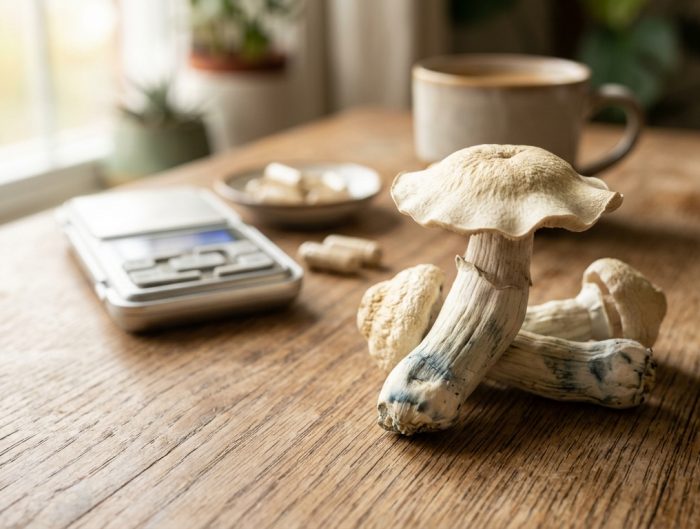
One key identification feature of many psilocybin mushrooms is bruising: when the flesh is damaged, it turns blue or blue-green due to the oxidation of psilocin. Amanita muscaria does not bruise blue. This single visual cue has saved many foragers from dangerous misidentification, though it should never be your only identification method.
Taxonomy: Amanita vs. Psilocybe Genera
Amanita muscaria belongs to the family Amanitaceae, a group that includes some of the most toxic mushrooms on Earth, such as Amanita phalloides (the death cap) and Amanita ocreata (the destroying angel). This family connection alone should give any curious explorer pause. While Amanita muscaria is not typically lethal in moderate doses, its close relatives absolutely are, and misidentification within this genus carries serious risk.
Psilocybin mushrooms primarily fall within the family Hymenogastraceae, though psilocybin-producing species have been found across multiple genera, including Panaeolus, Gymnopilus, and Pluteus. The Psilocybe genus itself is the most well-studied, with Psilocybe cubensis and Psilocybe semilanceata being the most commonly encountered species in both research and personal use contexts.
The evolutionary distance between these two groups is significant. They are not closely related, and they developed their psychoactive compounds through entirely different evolutionary pathways. Amanita muscaria’s active compounds likely evolved as part of its symbiotic relationship with tree roots (mycorrhizal association), while psilocybin may have evolved as a defense mechanism or as a way to influence insect behavior. Understanding this taxonomic separation helps explain why their chemistry and their subjective experiences are so profoundly different.
Pharmacology and Active Compounds
This is where the comparison between Amanita muscaria and psilocybin mushrooms gets genuinely fascinating, and where the differences become impossible to ignore. These two mushrooms act on completely different neurotransmitter systems in the brain. If you remember nothing else from this article, remember this: they are not pharmacological cousins. They are pharmacological strangers.
Muscimol and Ibotenic Acid: The GABAergic Path
The primary psychoactive compound in Amanita muscaria is muscimol, a potent agonist of GABA-A receptors in the brain. GABA (gamma-aminobutyric acid) is the brain’s main inhibitory neurotransmitter: it slows things down. When muscimol binds to GABA-A receptors, it produces sedation, altered perception, and a dream-like state that is fundamentally different from what serotonergic psychedelics produce.
Raw Amanita muscaria also contains ibotenic acid, which is a prodrug that converts to muscimol through decarboxylation (a process we’ll discuss in the safety section). Ibotenic acid itself is a glutamate receptor agonist and is considered neurotoxic in significant quantities. This is why preparation method matters enormously with Amanita: consuming raw or improperly prepared specimens means you’re ingesting a substantial amount of ibotenic acid alongside muscimol, and that’s a recipe for nausea, confusion, and potentially harmful excitotoxicity.
The ratio of ibotenic acid to muscimol in a given specimen depends on factors like drying method, temperature, and duration. A well-prepared Amanita muscaria product should have undergone sufficient decarboxylation to convert most ibotenic acid into muscimol. This is one area where Healing Dose’s emphasis on safety-first education becomes especially relevant: understanding preparation isn’t optional with this mushroom. It’s essential.
Typical muscimol content in dried Amanita muscaria caps ranges from roughly 3 to 10 mg per gram of dried material, though this varies widely between specimens, regions, and preparation methods. This variability is one of the biggest practical challenges with Amanita muscaria.
Psilocybin and Psilocin: The Serotonergic Path
Psilocybin mushrooms work through an entirely different mechanism. Psilocybin itself is a prodrug: once ingested, your body converts it into psilocin through dephosphorylation in the gut and liver. Psilocin is the compound that actually crosses the blood-brain barrier and produces psychoactive experiences.
Psilocin is a partial agonist at serotonin 5-HT2A receptors, and this receptor interaction is responsible for the characteristic perceptual changes, emotional shifts, and cognitive alterations associated with psilocybin mushrooms. The serotonin system is involved in mood regulation, sensory processing, and self-referential thinking, which is why psilocybin experiences often involve vivid visual phenomena, emotional intensity, and shifts in how you relate to yourself and others.
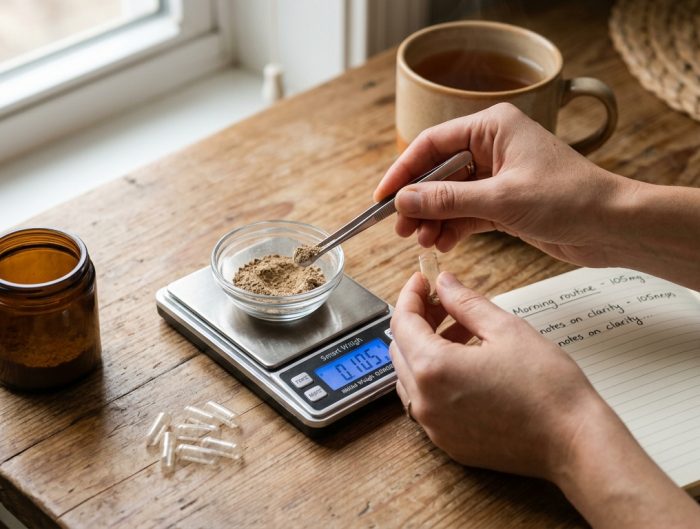
Psilocybin content in Psilocybe cubensis typically ranges from 0.5% to 1.0% by dry weight, with psilocin adding another 0.1% to 0.3%. A standard microdose of dried Psilocybe cubensis is generally considered to be between 0.05 and 0.25 grams, while a full-dose experience might involve 1.5 to 5 grams depending on individual sensitivity. These numbers are more consistent across specimens than Amanita muscaria’s muscimol content, though strain-to-strain variation still exists.
The pharmacokinetic profile differs too. Psilocybin experiences typically begin within 20 to 60 minutes of ingestion, peak at 1 to 2 hours, and resolve within 4 to 6 hours. Muscimol onset can be slower and more unpredictable, sometimes taking 1 to 3 hours, with experiences lasting anywhere from 4 to 10 hours.
Comparing the Psychoactive Experience
If you’re comparing Amanita muscaria vs. psilocybin from a purely experiential standpoint, the differences are striking. These are not two versions of the same experience. They feel fundamentally different in quality, character, and emotional tone.
Deliriant and Sedative Effects of Amanita
Amanita muscaria is often classified as a deliriant or a hypnotic rather than a classical psychedelic. At moderate to higher doses, users frequently report a heavy, sedative body sensation, sometimes described as feeling like gravity has increased. Perception shifts tend to involve size distortion (macropsia and micropsia, where objects appear larger or smaller than they are), a phenomenon that some researchers believe inspired Lewis Carroll’s “Alice in Wonderland.”
The mental state during an Amanita experience is often described as dream-like or dissociative. People report feeling as though they are in a waking dream, with thoughts that loop or become difficult to track. Unlike psilocybin, which tends to produce a heightened sense of emotional clarity, Amanita muscaria can produce confusion, disorientation, and amnesia at higher doses. Some people describe the experience as watching a movie of their own thoughts from a distance.
At lower doses, and particularly in microdose ranges (typically 0.5 to 1.5 grams of properly prepared dried cap), the experience is much subtler. People report a gentle relaxation, improved sleep quality, and a quiet reduction in anxious thought patterns. This is the range that has attracted growing interest in the microdosing community, and it’s where the GABAergic mechanism seems to produce its most interesting and manageable changes.
One honest note: many people who have tried both mushrooms at full doses report that the Amanita experience is less pleasant, less insightful, and harder to integrate than psilocybin. That doesn’t mean it lacks value, but it does mean you should approach it with realistic expectations rather than assuming it will feel like a milder version of psilocybin. It won’t.
Visual and Emotional Journeys with Psilocybin
Psilocybin mushrooms produce a qualitatively different experience. At full doses, visual changes are common: geometric patterns, enhanced colors, flowing or breathing textures on surfaces, and sometimes fully formed visual imagery with closed eyes. But the visual component is often secondary to the emotional and cognitive shifts.
Many people describe psilocybin experiences as emotionally profound. There’s often a sense of heightened empathy, interconnectedness, and emotional vulnerability. Difficult emotions can surface, sometimes intensely, but this is frequently described as cathartic rather than distressing when the experience is supported by a safe setting and intentional preparation. Research from institutions like Johns Hopkins and Imperial College London has consistently shown that psilocybin can produce lasting positive changes in mood, openness, and sense of meaning, often from just one or two sessions.
At microdose levels, the experience is sub-perceptual by definition: you shouldn’t feel “altered” in any obvious way. Instead, people report a subtle lift in mood, slightly enhanced creativity, and a gentle sense of presence or engagement with daily activities. Think of it less like a switch being flipped and more like a quiet hum of energy that you might not even notice until you reflect on your day later. This is where integration practices like journaling become so valuable: without active reflection, these subtle shifts can go unnoticed entirely.
The emotional depth of the psilocybin experience, even at micro levels, is one reason it has attracted so much research attention. As of 2026, psilocybin-assisted therapy is in advanced clinical trials for depression, PTSD, and end-of-life anxiety in multiple countries, with several jurisdictions having already approved therapeutic frameworks.
Safety Profiles and Potential Toxicity
Safety is where this comparison gets genuinely critical. Neither of these mushrooms should be approached carelessly, but the specific risks differ, and understanding those risks is non-negotiable.
The Importance of Decarboxylation in Amanita Preparation
If you take one thing away from this section, let it be this: raw Amanita muscaria is not safe to consume without proper preparation. The ibotenic acid present in raw or insufficiently processed specimens is a known excitotoxin. It overstimulates glutamate receptors, which can cause nausea, vomiting, excessive salivation, muscle twitching, confusion, and in severe cases, seizures.
Decarboxylation is the process of converting ibotenic acid into muscimol, and it requires specific conditions. The most common method involves:
- Drying the mushroom caps at temperatures between 70-80°C (158-176°F) for several hours
- Simmering dried material in acidic water (pH 2.5-3.0, achieved with citric acid or lemon juice) at temperatures below boiling for 2-3 hours
- Straining and carefully dosing the resulting liquid
This process can convert a significant percentage of ibotenic acid into muscimol, but the conversion is rarely 100% complete. Variability between batches is a real concern, and there is no simple home test to verify your muscimol-to-ibotenic-acid ratio. This is one of the reasons why Amanita muscaria carries more practical risk than psilocybin mushrooms for the average person: the preparation step introduces a variable that’s difficult to control without laboratory analysis.
Some commercial Amanita muscaria products available in 2026 claim to have undergone standardized decarboxylation, but quality control varies enormously between vendors. If you’re considering Amanita, sourcing from transparent, lab-tested suppliers is one of the most important safety decisions you can make.
Physiological Risks and Side Effects
Amanita muscaria is rarely lethal in adults, but “rarely lethal” is a low bar for safety. Reported cases of serious toxicity typically involve large quantities of raw or poorly prepared material. Common side effects at moderate doses include nausea, vomiting, dizziness, loss of coordination, and confusion. At higher doses, loss of consciousness, delirium, and ataxia (loss of muscle control) have been documented. Recovery usually occurs within 12-24 hours, but the experience can be frightening and physically uncomfortable.
Psilocybin mushrooms have a remarkably favorable physiological safety profile. The lethal dose in humans has never been established through actual cases: it is estimated to be hundreds of times a typical full dose. Psilocybin does not cause organ damage, is not addictive, and does not produce physical dependence. The primary risks are psychological: anxiety, panic, paranoia, and disorientation can occur during full-dose experiences, particularly in unsupportive settings or in individuals with a personal or family history of psychotic disorders.
Both substances interact with other medications. Psilocybin should not be combined with SSRIs, MAOIs, or lithium. Amanita muscaria should not be combined with alcohol, benzodiazepines, or other GABAergic substances, as the sedative effects can compound dangerously.
For anyone exploring microdosing with either substance, starting with the lowest possible dose and increasing gradually is the safest approach. At Healing Dose, we consistently emphasize that individual sensitivity varies widely: what feels like nothing to one person may feel like too much to another. Think of it like caffeine sensitivity. Some people drink espresso at midnight and sleep fine. Others feel jittery from half a cup of green tea. Your nervous system is unique, and respecting that uniqueness is part of the practice.
Legal Status and Cultural History
The legal and cultural stories of these two mushrooms are as different as their pharmacology. Both have deep roots in human history, but they’ve followed very different paths through modern regulation.
Shamanic Traditions and Folklore
Amanita muscaria holds a special place in the cultural history of northern Eurasia. Siberian shamanic traditions, particularly among the Koryak, Kamchadal, and other indigenous peoples of northeastern Siberia, used fly agaric in ceremonial contexts for centuries. The practice is well-documented by ethnographers dating back to the 18th century. Some scholars have even proposed that Amanita muscaria was the mysterious “soma” described in the ancient Hindu text Rigveda, though this theory (first popularized by R. Gordon Wasson in 1968) remains debated.
The mushroom’s iconic appearance has woven itself into European folklore. Its association with Christmas traditions, gnomes, and fairy tales is well-established in Nordic and Germanic cultures. Some researchers have suggested connections between fly agaric use and the mythology of flying reindeer, based on the observation that reindeer in Siberia actively seek out and consume the mushroom.
Psilocybin mushrooms have their own rich cultural lineage, centered primarily in Mesoamerica. The Aztecs called them “teonanácatl,” meaning “flesh of the gods,” and used them in religious ceremonies. Archaeological evidence suggests that psilocybin mushroom use in Central America dates back at least 3,000 years, with mushroom-shaped stone artifacts found in Guatemala and southern Mexico. The Mazatec healer María Sabina brought psilocybin mushrooms to Western attention in the 1950s when she shared a velada ceremony with R. Gordon Wasson (the same researcher who later theorized about Amanita and soma).
Both mushrooms carry deep spiritual significance in their respective cultural contexts. Approaching either one with respect for these traditions isn’t just polite: it provides useful context for understanding why intentionality and preparation have always been central to their use.
Current Regulatory Landscape Worldwide
The legal status of psilocybin has shifted dramatically in recent years. As of 2026, Oregon and Colorado have implemented regulated psilocybin service programs. Australia approved psilocybin-assisted therapy for treatment-resistant depression in 2023, and Canada has expanded its Special Access Programme. Several European countries are in various stages of clinical or regulatory review. However, psilocybin remains a Schedule I substance under United States federal law and is prohibited under the UN Convention on Psychotropic Substances of 1971 in most signatory nations.
Amanita muscaria occupies a curious legal gray area. Because its active compounds (muscimol and ibotenic acid) are not scheduled under the UN conventions or under U.S. federal law, the mushroom itself is legal to buy, sell, and possess in most countries. Notable exceptions include Louisiana (which specifically banned Amanita muscaria in 2005), Romania, and Australia (where muscimol is a controlled substance). In most of Europe, Canada, and the majority of U.S. states, Amanita muscaria products are sold openly as supplements or ethnobotanical specimens.
This legal distinction is one of the primary reasons Amanita muscaria has attracted growing commercial interest. You can find dried caps, tinctures, gummies, and capsules sold online and in some retail stores. But legal availability does not equal safety or quality assurance. The lack of regulation means that product quality, potency, and preparation standards vary wildly. If you’re exploring Amanita muscaria, treat the legal accessibility as a reason to be more careful with sourcing, not less.
Psilocybin’s tighter regulation, paradoxically, has driven more rigorous research and quality control in clinical settings. The growing body of peer-reviewed research on psilocybin (over 400 published studies as of 2026) provides a level of evidence that simply doesn’t exist yet for Amanita muscaria microdosing.
Choosing the Right Path: Summary of Key Differences
The comparison between Amanita muscaria and psilocybin mushrooms isn’t a matter of one being “better” than the other. They are fundamentally different tools with different mechanisms, different experiences, and different risk profiles. Here’s a clear summary of the most important distinctions:
- Active compounds: Muscimol (GABAergic) vs. psilocybin/psilocin (serotonergic)
- Experience quality: Sedative, dream-like, and potentially deliriant vs. visually rich, emotionally deep, and cognitively expansive
- Safety profile: Requires careful preparation to reduce ibotenic acid; higher variability in potency vs. well-studied physiological safety with primary risks being psychological
- Legal status: Largely unregulated and commercially available vs. scheduled in most jurisdictions but increasingly approved for therapeutic and research use
- Research base: Limited formal research, mostly anecdotal and ethnographic vs. extensive and growing clinical evidence
- Microdosing interest: Emerging, with focus on sleep and relaxation vs. well-established, with focus on mood, creativity, and cognitive flexibility
If you’re drawn to exploring either of these mushrooms, the most important thing you can do is educate yourself thoroughly before you begin. Understand what you’re working with at a chemical level. Start with the smallest possible dose. Keep a journal. Reflect on what you notice, even if what you notice is “nothing happened today.” Those quiet observations often become the most valuable data over weeks and months.
Your path is your own, and there’s no rush. Whether you’re curious about the gentle relaxation some people report from properly prepared Amanita muscaria microdoses or the subtle mood shifts associated with psilocybin microdosing, approaching either one with patience, respect, and honest self-awareness will serve you far better than chasing dramatic experiences.
If you’re not sure where to begin with dosing, especially for psilocybin microdosing, Healing Dose offers a short quiz that can help you find a gentle starting range based on your goals, experience level, and personal sensitivity. It’s a thoughtful first step that respects your pace. Take the quiz here.
Whatever you choose, go slowly. Pay attention. And trust that the quiet changes are often the ones that matter most.

You might also like